
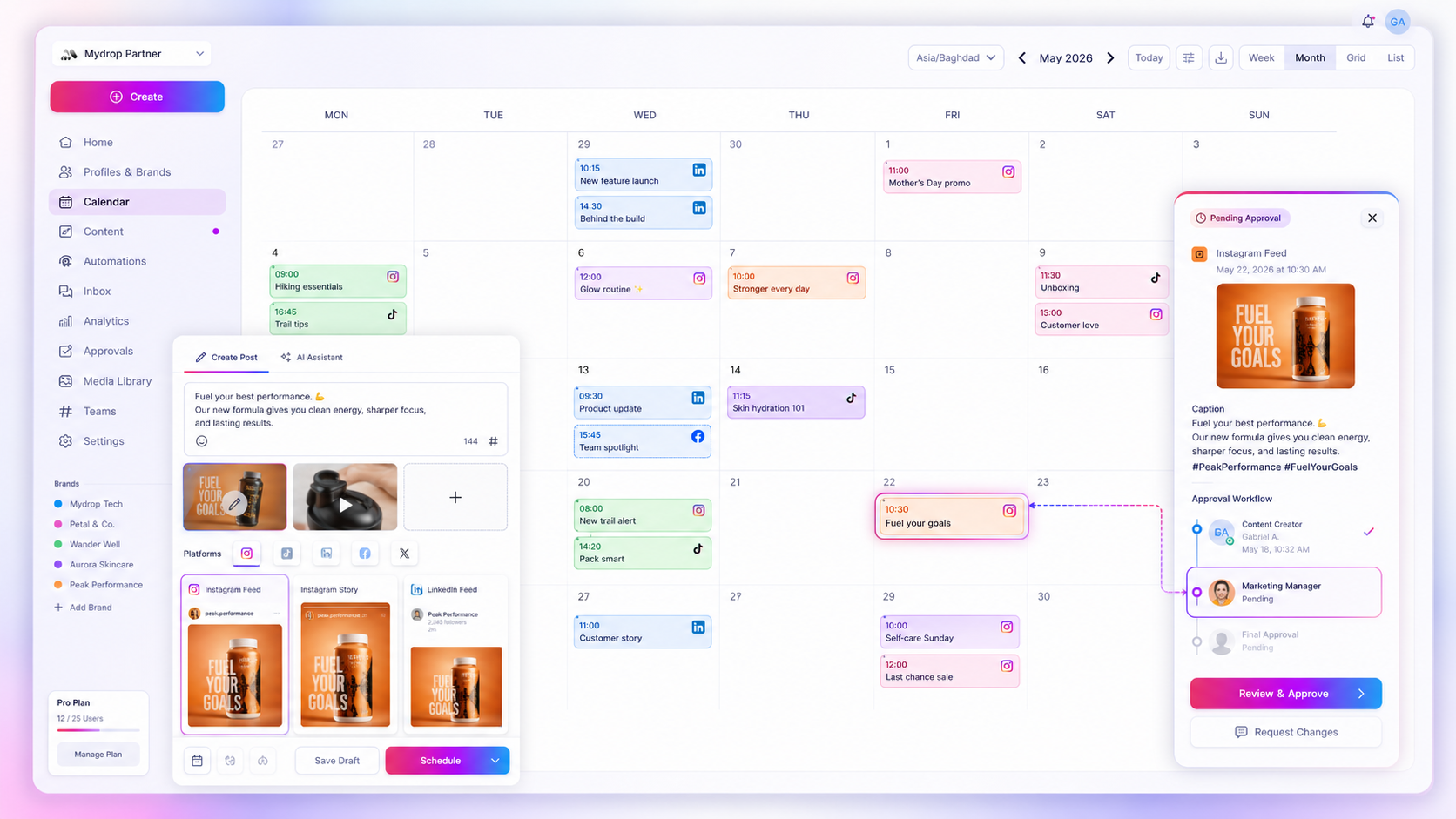
The best Google Calendar sync tool treats social reminders as first-class, shareable events rather than just data points trapped in a proprietary dashboard. When reminders stay siloed in a scheduling tool that no one checks, you end up paying a "silo tax" in missed deadlines, forgotten assets, and frantic Slack alerts. You need a platform that treats your existing team calendar as the single source of truth for all content-related tasks.
We get it. Managing complex campaigns across multiple brands with a team that is constantly shifting is exhausting. No one enjoys chasing down missed approvals or realizing a campaign launch date was never on the shared calendar until it is too late. It is not just a technical failure; it is an operational nightmare that leads to last-minute panic. When you are managing thousands of posts across dozens of channels, visibility is not just a feature; it is an operational requirement.
What the best tools need to handle
To avoid the "invisible task" trap, your synchronization tool must do more than just dump post dates into an external calendar. It requires a robust Planning Bridge that keeps your operational reality aligned with your publishing schedule.
The most effective tools move past simple one-way exports and focus on two-way visibility. If you mark a reminder as "done" in your scheduling software, it should update in your Google Calendar immediately. This is the difference between a static log and an active team workflow.
Common mistake: Relying on manual sync or tools that do not support recurring event status updates. When a recurring task updates in your scheduling platform but stays static in your calendar, trust in the calendar vanishes.
When auditing tools, use this checklist to ensure you are getting an operational safeguard, not just a cosmetic feature.
The Calendar Sync Integrity Checklist
| Requirement | Why it matters |
|---|---|
| Real-time Webhooks | Ensures calendar events update immediately when statuses change. |
| Granular Sync Modes | Prevents flooding shared calendars by syncing only selected profiles. |
| Recurring Task Support | Keeps recurring campaign reminders (e.g., weekly reports) synced accurately. |
| Event Link Lookup | Provides one-click access back to the source task or post. |
| Automatic Watch Renewal | Stops the sync from breaking after service token expirations. |
When these features are missing, you are forced to spend your day jumping between tools just to verify if tasks are on track. At Mydrop, we have seen that most coordination debt in large teams stems from this exact kind of friction. By treating calendar-native planning as a core requirement, you replace guessing with visibility. The goal is to make your scheduling tool disappear into the workflow your team already uses every day.
Where basic tools start to break

If your social media tool requires you to click a button to refresh your calendar, you are not using a sync tool. You are using a manual data entry assistant that occasionally remembers to update.
The biggest operational trap is when tools treat the calendar as a one-way dump. You export the data, it appears on your calendar, and then it becomes static. The moment a team member shifts a post date or changes an approval deadline, your calendar is now showing a lie.
This creates a hidden tax on your operations. Your team stops trusting the calendar because it is consistently outdated, so they stop checking it. They revert to asking, "Did this go live?" in Slack, which is exactly the cycle you were trying to break.
The reality is that basic tools fail because they lack real-time connectivity. They do not know when an event is updated or marked as done, so the calendar remains a graveyard of outdated information.
Sync Failures vs. The Fix
| Failure Mode | Why It Hurts Operations | The Required Fix |
|---|---|---|
| Manual Refresh | Teams forget to click the button; data stays stale for hours or days. | Automated Webhooks that update the calendar instantly when data changes. |
| All-or-Nothing Sync | Every brand and profile hits every calendar, making it impossible to scan. | Granular Profile Modes allowing you to sync only what is relevant. |
| Static Reminders | Reminders do not update status when tasks are marked complete. | Bi-directional State Sync for reminder done/todo states. |
| Broken Linkbacks | Events lack a direct link to the source post or task for quick action. | Event Link Lookups that connect calendar events back to the platform. |
The buying criteria that matter
When evaluating platforms to bridge this gap, you should not be looking for more features. You should be looking for structural integrity. You need a platform that treats your calendar as a living, breathing component of your workflow-not just a display screen.
1. Real-time webhooks are non-negotiable
If a tool relies on a polling interval, your data will always be slightly wrong. You need a system that utilizes webhooks to watch for changes in real time. When you change a post date in the platform, that event should move on your calendar instantly. If it does not, you are still operating in silos.
2. Granularity over volume
In enterprise teams, no one needs to see every single post from every single brand. You need tools that allow for "selected-profile mode." This ensures that a local marketing lead only sees their specific brand's content, while the global operations lead can choose to see the full portfolio. This granularity prevents the calendar from becoming unreadable noise.
3. Calendar-native planning
The most advanced tools do not just push data; they turn planning objects into shared calendar events. This is what we call calendar-native planning. When a post, a reminder, or a task is created, it should appear in your existing team calendar as a first-class event.
At Mydrop, we approach this by ensuring that reminders for team tasks are not trapped in our dashboard. We sync them directly to your shared Google Calendars, including the ability to mark recurring occurrences as done right from the calendar interface.
This shift turns your calendar into the single source of truth for all content-related tasks. It allows teams to work in the tools they already live in, rather than forcing them to log into yet another scheduling dashboard to see if they are on track.
Operator rule: Visibility is an operational requirement, not a bonus. If a task isn't visible in the calendar where your team already coordinates, it doesn't exist.
How Mydrop supports this workflow
At Mydrop, we built our planning bridge around one simple observation: social scheduling and operational planning should not be two different conversations. When we looked at teams managing hundreds of brand profiles, we realized that the calendar is already where the real work happens. If your scheduling tool does not talk to that calendar, it is just adding to your coordination debt.
When you connect Google Calendar to Mydrop, we treat your posts and operational reminders as first-class, shareable events. If you only need certain teams to see specific brand activity, our selected-profile mode lets you filter what gets synced, so your team calendars stay clean and relevant. You avoid the clutter of seeing every single post across every single market, and your stakeholders only see the campaigns that actually matter to their specific responsibilities.
We also know that plans change constantly. That is why we use active webhooks to watch your calendar. If someone moves a deadline, changes an event date, or marks a recurring task as done in their own calendar, Mydrop receives those updates instantly. The goal is simple: ensure that the calendar version of your truth is the exact same one living in your scheduling dashboard. We want to remove the need for constant "is this done yet" check-ins. When the calendar says it is done, it is done.
A simple shortlist checklist
Before you commit to a tool or decide to switch, run your current setup through this quick audit. If your tool fails on more than two of these, you are likely operating with hidden coordination risks that will eventually lead to missed deadlines and fragmented team communication.
| Requirement | Why it matters | Success Metric |
|---|---|---|
| Real-time Webhooks | Syncs should not be manual. | Changes appear in under 60 seconds. |
| Granular Visibility | Teams only need what they own. | Filters by profile or brand. |
| Recurring State | Reminders must track 'done' status. | Calendar updates reflect task completion. |
| Native Event Links | You need to jump back to the tool. | Event contains deep-link to post or task. |
| Automatic Re-auth | Expired tokens break the workflow. | System alerts or self-renews securely. |
Stop fighting your own tools
The biggest mistake we see is not failing to plan; it is failing to align the tools you use to execute that plan. You can spend all week polishing the perfect campaign, but if the reminders that trigger the final execution are locked in a siloed dashboard, you are just waiting for an accident to happen.
Most teams do not have a content problem. They have a decision bottleneck.
When you move from manual tracking to a truly synced, calendar-native approach, you stop being a traffic controller for your own posts and start acting like a strategist for your brand. Stop chasing approvals via Slack at 6 p.m. and start trusting that your calendar shows the actual state of your operations.
The right sync tool does not just display dates. It creates a single, immutable source of truth that your team can trust, your clients can see, and your operations can depend on. If your calendar is not helping you ship, it is holding you back. Focus on the tools that treat your team schedule with the respect it deserves, and you will find that the operational friction you have been feeling all campaign long finally starts to fade away.