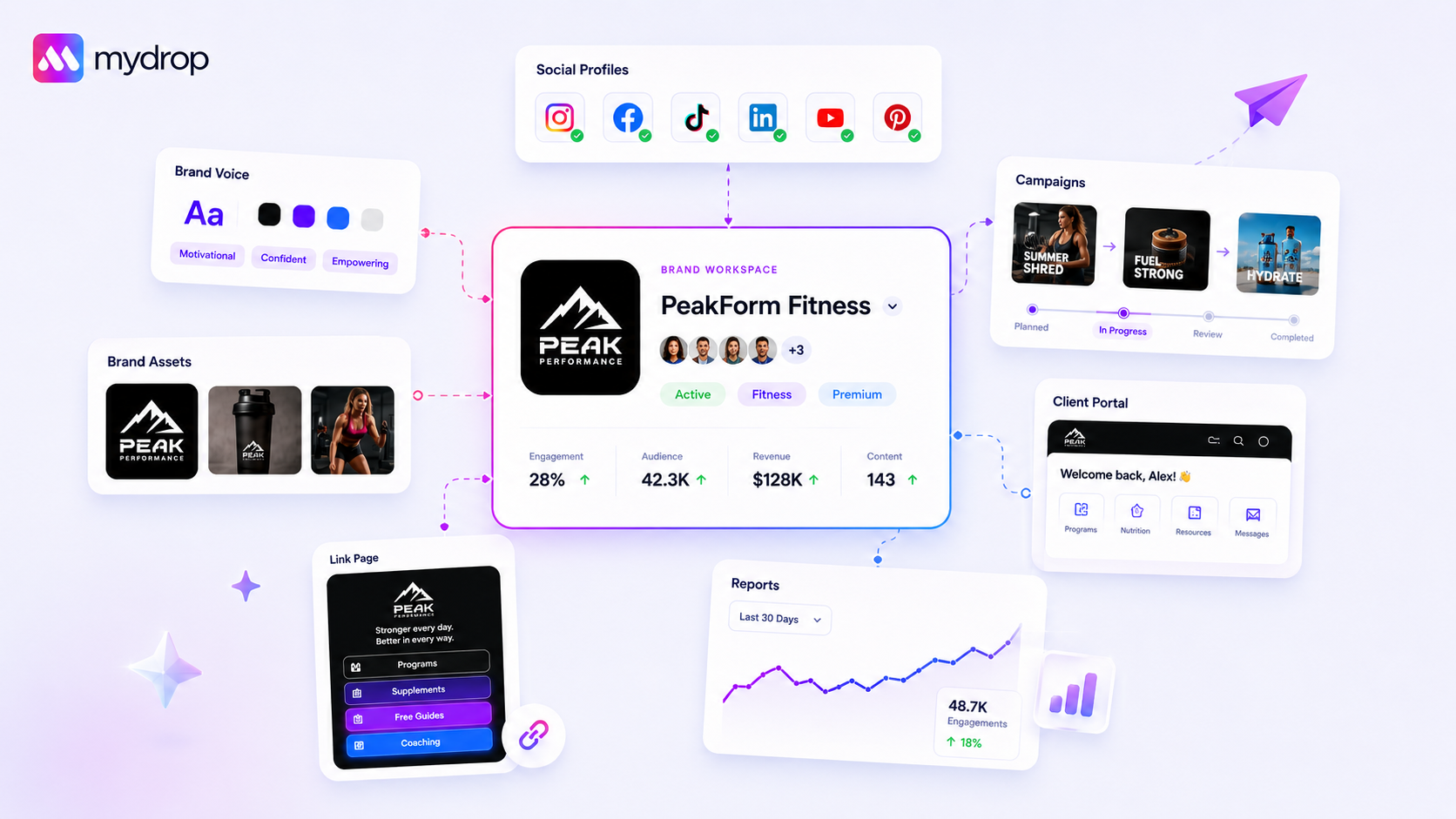
Managing client social media access shouldn't mean collecting passwords. The best portal tools shift authorization back to the client via direct OAuth, allowing them to connect their own social profiles securely without ever requiring you to handle sensitive login credentials.
We know the "please email me your password" dance. It is unprofessional, insecure, and creates unnecessary friction at the start of a partnership. You are essentially taking on a liability you do not need, turning a simple onboarding step into a security failure point. You need a clear, actionable blueprint for auditing your current access workflows and choosing a portal tool that guarantees secure, client-led profile management. Here is exactly what to demand from your tools to stop being the middle-man.
What the best tools need to handle

If your management tool requires a password to connect a social account, it is built for a different decade. Modern enterprise operations demand a direct-access workflow. When you evaluate portal tools, you need to ensure they move beyond basic authentication to handle the complexities of enterprise social structures.
The best tools manage these three core technical realities:
- Multi-Profile OAuth Confirmation: Enterprise brands rarely have a single channel. An OAuth flow must return all available profiles, allow the client to select exactly which ones to connect, and prevent unnecessary imports.
- Token Health Transparency: OAuth tokens expire. A top-tier portal will not just break silently; it will proactively notify the client within their secure environment, allowing them to re-authenticate without your intervention.
- Scope & Permission Guardrails: The connection must operate within the principle of least privilege, ensuring the portal only gains the permissions required for publishing and analytics, not full administrative control.
Workflow Audit: Manual Handoff vs. Portal OAuth
| Feature | Manual Credential Handoff | Portal-Based OAuth |
|---|---|---|
| Security | High risk; shared passwords | Zero risk; tokenized access |
| Client Role | Passive; provides password | Active; approves permissions |
| Maintenance | Slow; manual re-login | Automated; self-serve refresh |
| Accountability | You own the login liability | Client retains account ownership |
Operator rule: If a tool requires you to touch a client's password, the process is already broken.
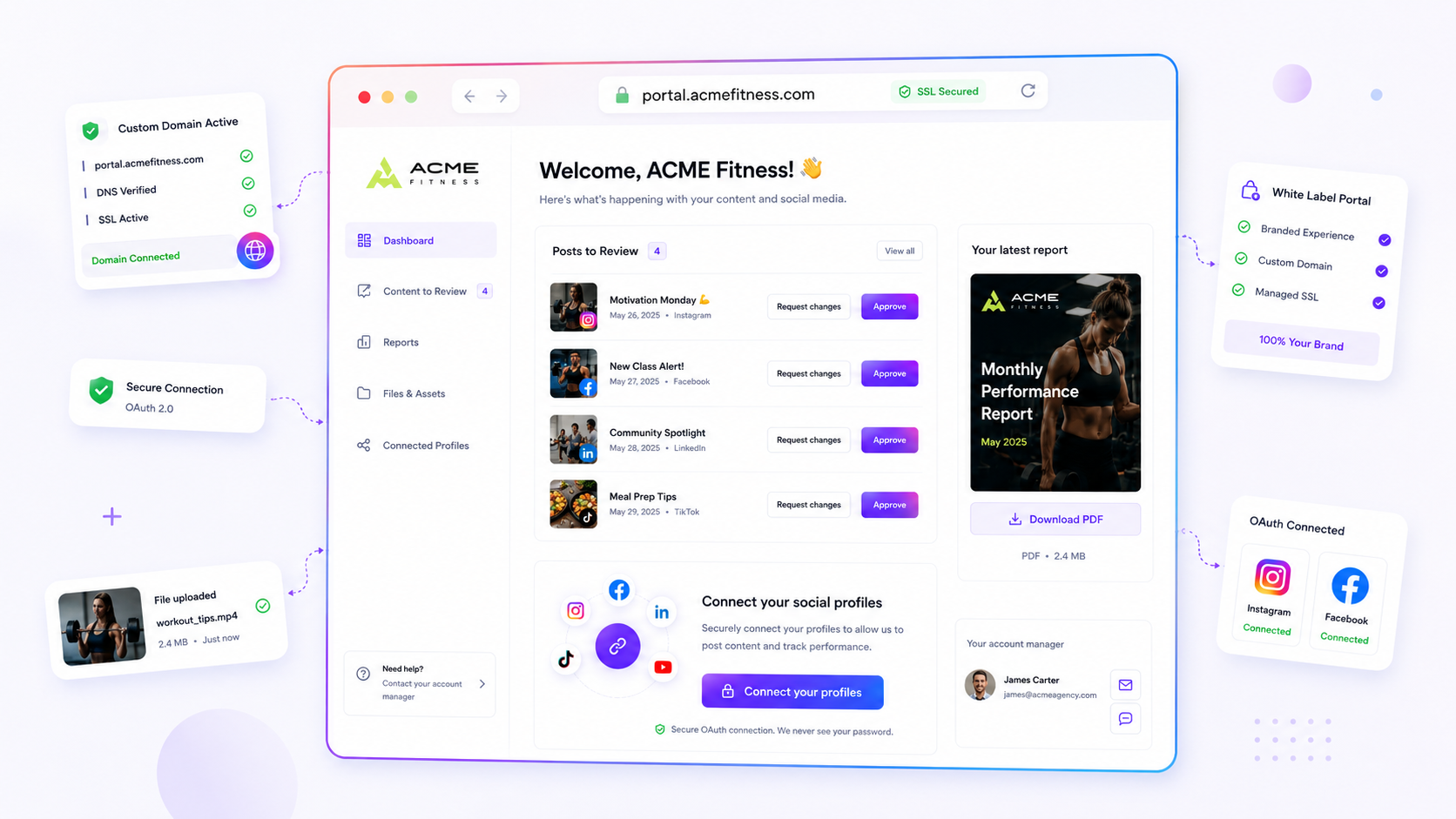
At Mydrop, we built our profile connection flow around this exact principle. By enabling clients to connect their own brand profiles directly within the portal, you eliminate the middle-man entirely. The system handles the token exchange and scope confirmation while keeping sensitive credentials invisible.
Most teams do not have a credential problem; they have a coordination debt that they are managing manually. Stop chasing passwords and start demanding tools that handle access as a secure, automated handshake.
Where basic tools start to break

Generic tools look fine on a marketing site. But when you are managing hundreds of brand profiles across ten different teams, they fall over fast. The most common failure point is still the middle-man bottleneck. When a tool does not support a truly autonomous portal-based connection, your team ends up holding the bag, and the passwords.
You see this when a token expires on a high-traffic LinkedIn page or an Instagram account. In a basic setup, the agency manager has to send a request, wait for the client to reply, and hope they have not forgotten their password or locked themselves out. If the client is busy, that channel goes dark. This is not just inefficient; it is a security liability that no enterprise should accept in 2026.
Another breakdown is the "all-or-nothing" import. Many tools force you to accept every single page the platform returns, or they provide no way to filter which profiles get connected through the portal. This leads to cluttered workspaces, confused teams, and a constant, manual cleanup job. When a tool cannot handle multi-account selection, where the client previews and confirms exactly which brand profiles to authorize, it is not a professional-grade platform. It is a creator app in a business suit.
The buying criteria that matter
When you evaluate a portal tool, do not look at the features list. Look at the governance architecture. You need a tool that treats OAuth as a client-side responsibility, not a team-side administrative chore.
Use this scorecard to stress-test your current setup. If your tool fails these tests, you have a structural bottleneck waiting to collapse.
OAuth Capability Scorecard
| Requirement | Why It Matters | Enterprise-Grade Indicator |
|---|---|---|
| Direct OAuth | Removes credential exposure. | Client authenticates via portal; no password shared. |
| Multi-Profile Preview | Prevents workspace clutter. | Client confirms specific pages from OAuth response. |
| Health Monitoring | Ensures uptime. | Automated expiry alerts routed to the token owner. |
When looking for a platform that handles this, you are searching for a system that supports pending profile connections. At Mydrop, for instance, we built our portal connection flow precisely to stop that middle-man dynamic. Instead of you chasing the client, the client logs into their portal, triggers the provider OAuth, and confirms only the profiles their specific brand entity owns. The system handles the state verification, maps the profiles, and syncs the analytics without your team ever seeing a credential or needing manual input.
The goal is not just connecting profiles. It is about delegated administration. When a platform allows the client to own their identity management, your team moves from being "IT support for social media" to being strategic partners. You stop wasting energy on the logistics of token maintenance and focus entirely on the distribution strategy that actually drives results.
Decision check: If your team is still manually entering a client's password to fix an expired token, your portal is not a portal-it is just a more expensive spreadsheet.
How Mydrop supports this workflow
At Mydrop, we built our Portal Connection flow because we saw the same pattern repeated across hundreds of agency partners: a perfectly good strategy stalled because someone was waiting for a client to find a password or re-authorize an expired token.
When you use Mydrop, your client doesn't need to hand over the keys to the castle. Instead, they log into their branded portal-where they are already comfortable-and trigger the OAuth flow themselves. They see a familiar prompt from their social network (Facebook, LinkedIn, TikTok), grant the necessary scopes, and that is it.
What makes this different from generic dashboards is the Pending Profile Connection layer. We know that when a client hits "connect," they might be granting access to six different pages at once. The tool doesn't just blindly pull everything; it holds those connections in a pending state. Your client reviews the list, selects exactly what your team needs to manage, and hits confirm. Your team gets the green light to start publishing immediately, and you never had to touch a credential.
This also handles the refresh cycle beautifully. When a token inevitably expires; because social APIs are fickle, you don't need to chase the client for a new password. You send a quick, automated notification from the portal. The client clicks, re-authenticates, and the token refreshes behind the scenes. Your workflow stays intact without the usual email ping-pong of asking for credentials.
A simple shortlist checklist
If you are evaluating tools this week, use this Direct-Access Checklist to separate the robust enterprise platforms from the hobbyist apps.
- Client-Driven OAuth: Can the client connect their own profiles from a branded portal without me typing a single character?
- Credential Isolation: Does the tool explicitly state, and demonstrate, that it never stores or processes the client's social account password?
- Selective Import: When an OAuth flow returns multiple pages (like an Instagram handle plus five Facebook pages), can the client selectively choose what to import, or does the tool force a connect-all scenario?
- Expired Token Remediation: How does the tool handle re-authentication? Does it require a password reset, or does it trigger a simple, portal-based re-auth for the client?
- Token Health Visibility: Can my team see which profiles are healthy and which need attention, without having to dig into API error logs?
If a tool fails more than two of these, it is not a portal tool; it is a credential-collection service masquerading as a management platform.
Conclusion
The most expensive part of social media management is not the subscription fee; it is the coordination debt accrued by manual, high-friction processes. Every password exchange is a future bottleneck, every manual re-auth is a potential missed post, and every security exception is a risk to your brand’s compliance.
Modern social operations rely on trust, but they should be built on systems, not handshakes. By moving to direct, client-driven OAuth through a dedicated portal, you aren't just locking down your security; you are reclaiming hours of wasted time that your team could spend on actual strategy.
Stop collecting passwords and start managing connections. Your clients will appreciate the professionalism, and your ops team will finally get the peace of mind they deserve.