The most reliable way to close UTM data gaps is to stop relying on manual tagging altogether. If your launch reporting shows 30% of traffic as "direct" or "unknown," your analytics aren't broken-your publishing workflow is. UTM data gaps are almost always the result of manual tagging errors or missed updates in the heat of a campaign launch, turning actionable insights into noise.
We get it: you are balancing creative velocity with tactical precision. You have been the person updating tracking parameters at 11 PM on a launch eve, hoping you did not typo the utm_campaign string. This work is messy, and when the data breaks, you are the one who has to explain why the ROI looks flat.
This article will help you audit your current attribution workflow, identify the specific "leaky" points in your tagging process, and provide a checklist for selecting a tool that automates these gaps away.
What the best tools need to handle

Your attribution strategy is only as strong as the weakest link in your publishing pipeline. Most teams treat UTM parameters as an afterthought-something added right before hitting schedule. That is the Copy-Paste Trap. Every time a marketer manually copies a UTM string, the probability of broken attribution compounds. You are currently paying a "manual tax" for every post you schedule.
To fix this, look for tools that shift attribution from a manual field to a centralized campaign object. When the campaign configuration-not the individual post-holds the UTM definitions, you eliminate the possibility of human error.
| Feature | Manual Tagging Workflow | Centralized Campaign Automation |
|---|---|---|
| Tag Source | Human memory / Spreadsheet | Campaign Object (Source of Truth) |
| Consistency | Low (Typos common) | Guaranteed (Template-driven) |
| Updates | Post-by-post edit required | Global update (Active period) |
| Error Risk | High | Near-zero |
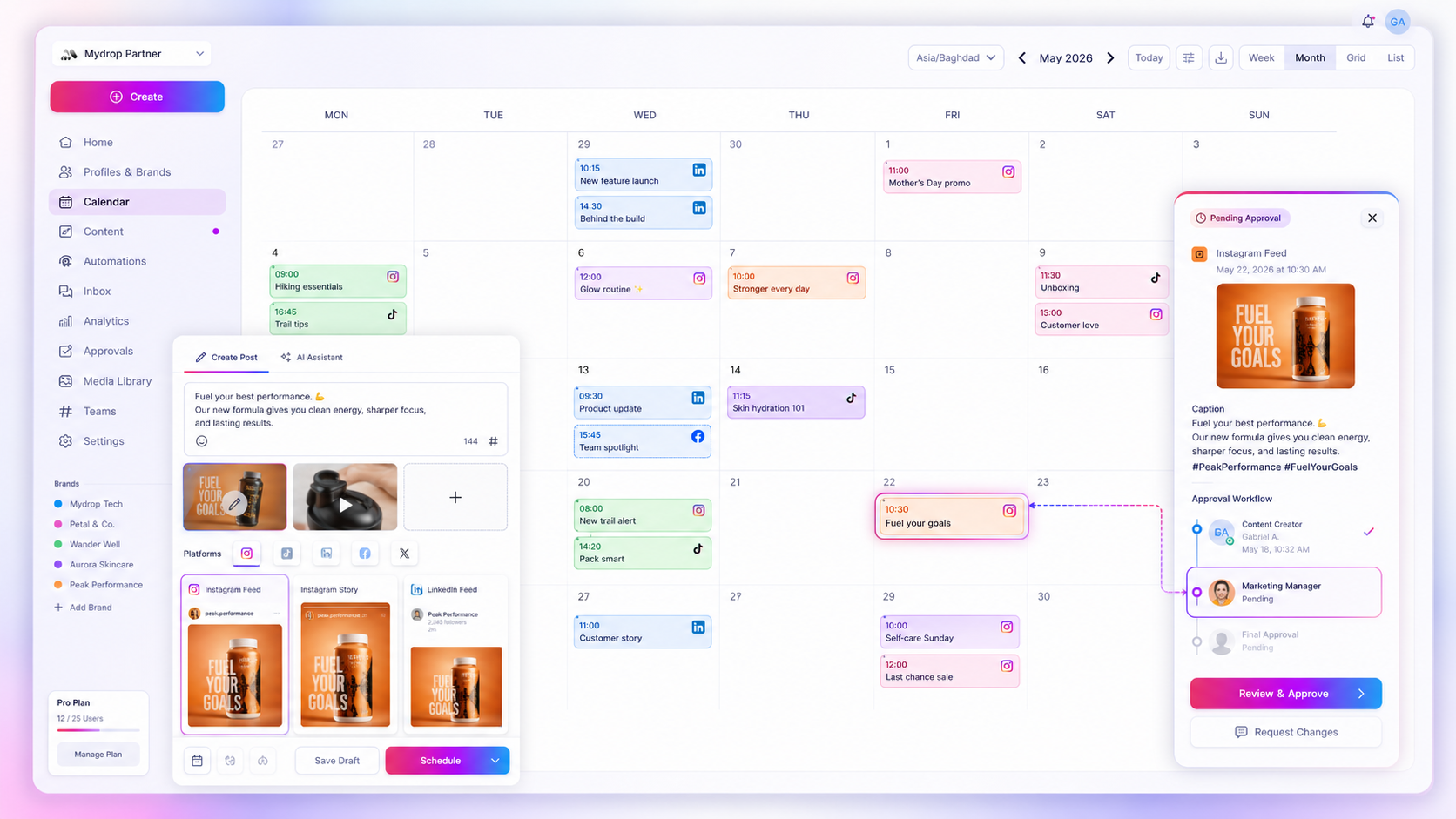
The best tools treat a campaign as a container. At Mydrop, for example, we see that when teams assign a post to an active campaign, the system automatically appends the correct UTM parameters at the moment of publishing. This means you do not have to worry about whether the tracking string is correct for that specific channel or launch phase; the platform handles the logic based on the campaign's defined active window.
This shifts your focus. Instead of babysitting strings, you manage the campaign's lifespan. If you push a launch date or tweak a campaign color, the underlying attribution logic should remain intact, not stuck in a thousand outdated drafts.
Operator rule: If you have to type the
utm_sourcemore than once, you are not managing a campaign; you are managing a data entry problem.
Where basic tools start to break

If you are still relying on a master spreadsheet and a team that remembers to copy-paste the right UTM string, you have already lost the attribution battle. The "manual tax" is not just about the time your team spends pasting strings; it is the silent accumulation of broken data that happens when reality deviates from your initial plan.
The Last-Minute Pivot Trap is the most common failure mode. A launch date shifts by three days. If your UTM tracking is hard-coded into each post, you now have to manually locate every scheduled post, open the editor, strip the old parameters, and apply the new ones. It is tedious, error-prone, and soul-crushing work.
When your tool treats UTMs as part of the text rather than metadata attached to a campaign object, you are not managing campaigns; you are managing a series of disconnected, static assets. Basic tools lack the intelligence to differentiate between an active launch and a finished one. They do not know that utm_campaign=winter-launch-2026 should stop appending to links the moment the promotion ends.
This is the coordination debt that eventually cripples enterprise marketing teams. Every post you schedule without an automated campaign layer is an opportunity for a typo, a missed tag, or a "direct" traffic spike that ruins your reporting dashboard.
The buying criteria that matter
When you are shopping for a tool to solve this, stop looking for basic UTM support. You need attribution governance-the ability to define tracking rules once and have them cascade automatically across every channel and creative asset.
Here is the quick way to audit your current stack against what a serious, enterprise-grade workflow requires.
| Capability | Basic Tool Approach | Enterprise-Grade Workflow |
|---|---|---|
| Source of Truth | Spreadsheet or memory | Centralized Campaign Object |
| UTM Logic | Manual copy-paste | Automated, dynamic appending |
| Date Sensitivity | Static, broken on edit | Active-window aware |
| Global Updates | Re-edit every post | Update campaign; auto-updates posts |
| Governance | None / Human oversight | Permission-based rules |
If your current workflow leans heavily into the left column, you are paying a high hidden cost. To move to the right, you need to look for platforms that handle campaign logic differently.
Decision check: If your team can change a
utm_campaignstring in one place and have it propagate to all scheduled content instantly, you have a functional campaign system. If they have to re-touch individual posts, you have a manual liability.
Look for tools that prioritize active-period awareness. Your tool should know exactly when a campaign starts and stops. At Mydrop, we see this as the foundational requirement: the software handles the appending logic at the moment of publishing based on the campaign's active window, ensuring your data is clean without forcing your team to act as manual data entry clerks.
The bottom line: Enterprise social media scale usually fails from coordination debt, not a lack of creative ideas. Stop treating your campaign metadata like it is just another part of the caption. Treat it like the infrastructure it actually is.
How Mydrop supports this workflow
If you are tired of the manual tax, Mydrop approaches campaign attribution differently. Instead of relying on a human to remember to paste a UTM string correctly every time a post is drafted, we treat the campaign itself as the source of truth for tracking.
When you define a campaign in Mydrop-setting its active period, colors, and tracking parameters-you are not just creating a folder. You are building an automated bridge between your content and your analytics platform. When a marketer assigns a post to an active campaign, the system automatically appends the correct UTM parameters to any link in the caption at the moment of publication.
If a campaign ends, the automated appending stops. If you change a UTM parameter halfway through a launch, you update it in one place, and every pending post reflects that change immediately. It removes the human error from the equation and ensures that your traffic data actually reflects what is happening on the ground, rather than what someone typed in a spreadsheet three weeks ago.
Workflow check: If your tool requires you to manually copy and paste tracking strings for every post, you are not scaling; you are just introducing new places for data to break.
A simple shortlist checklist
Before you commit to a platform, audit your current workflow against these five non-negotiables. If a tool cannot pass this check, you are just buying a prettier version of your current mess.
- Centralized Campaign Metadata: Does the tool store the campaign logic (period, tracking parameters, assets) as a single object, or are tags floating independently on individual posts?
- Active-Window Awareness: Does the tool automatically toggle tracking based on the defined campaign timeline, or do you have to manually turn off tracking when a launch concludes?
- Dynamic Link Appending: Does the tool inject parameters at the moment of publishing, allowing you to edit the campaign configuration after the post has been scheduled but before it goes live?
- Cross-Functional Visibility: Can your agency partners, brand managers, and analytics team all see the same campaign definitions, or is attribution logic hidden inside one person’s composer?
- Post-Launch Flexibility: Can you update a UTM parameter for an existing, already-scheduled campaign without having to rebuild the entire publishing queue from scratch?
If you answer "no" to more than two of these, your attribution gaps are not a technical problem; they are a structural one.
The real cost of manual attribution
Most teams assume their reporting is broken because they lack sophisticated data modeling tools. In our experience, it is almost always simpler than that. Your data is broken because your publishing workflow assumes that humans will be perfectly consistent across hundreds of posts, weeks of high-velocity launches, and shifting timelines.
Spoiler: we are not.
The best attribution strategy is the one that removes the need for individual contributors to make tactical decisions about tracking. You want your creatives focused on the hook and the visual, not on ensuring the utm_source matches the company-wide standard. By centralizing this logic and letting the platform handle the heavy lifting, you reclaim hours of manual audit time and, more importantly, you regain confidence in your ROI metrics.
Stop blaming your analytics platform for the data you are feeding it. Fix the point of entry, and the rest starts to clear up on its own.