
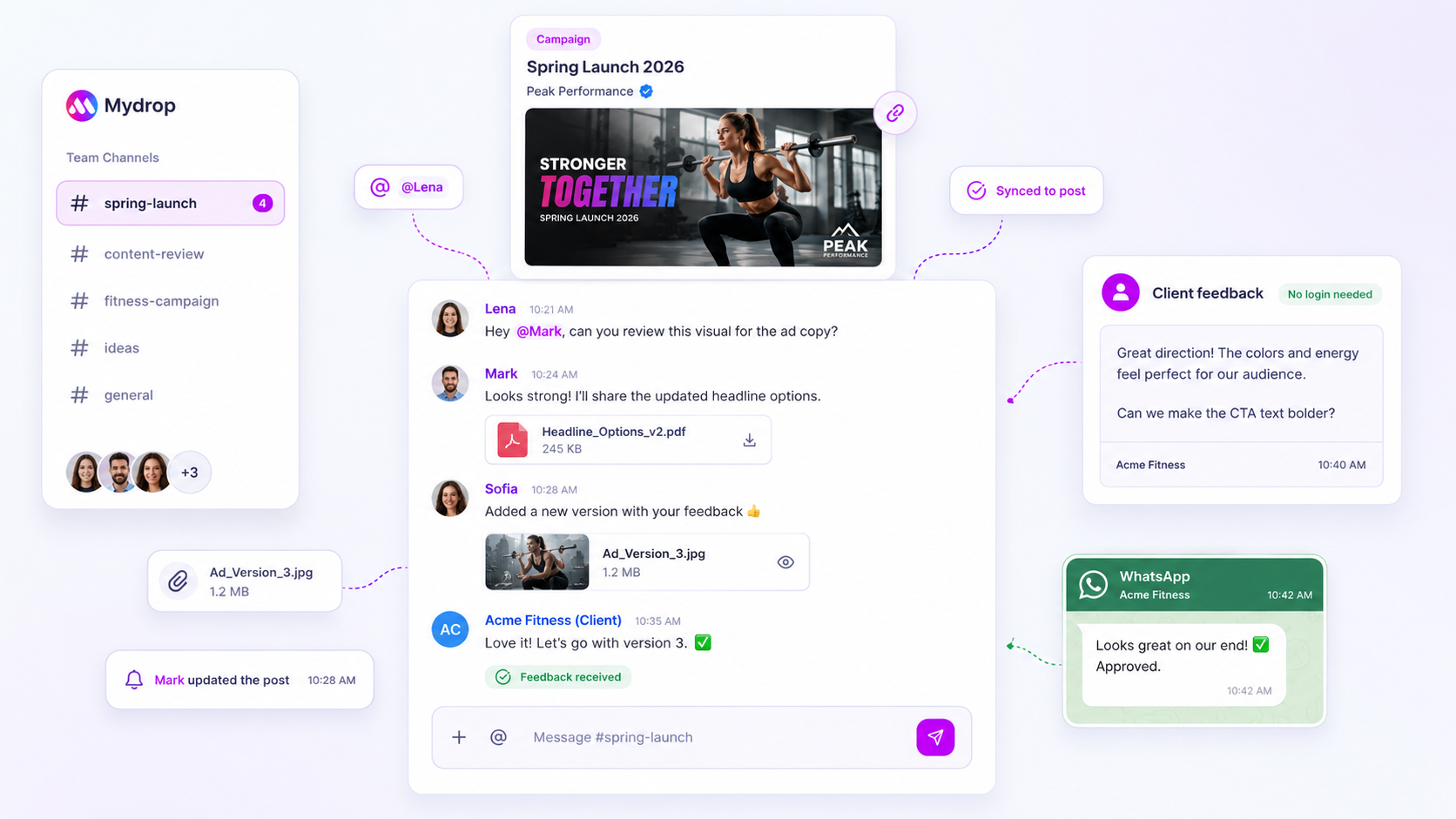
Stop manual follow-ups. If your team relies on Slack pings, sticky notes, or sheer memory to push content over the line, you are not managing a brand-you are managing a bottleneck. To move faster without losing control, you must shift from active chasing to an automated notification architecture that pulls stakeholders into the approval loop exactly where they already live, whether that is email or WhatsApp.
We get it. You are juggling three active campaigns, a shifting content calendar, and a dozen stakeholders, and now you have to "nudge" someone for the fourth time this morning. That constant, manual chore-the chase-is the silent killer of social media productivity. It turns creative leads into glorified notification dispatchers.
The good news is that this is not a talent problem. It is a communication architecture problem. Once you swap manual coordination for a set-and-forget notification system, you stop being the human bridge between a draft and a publish button.
The operating problem this solves

Most managers assume content is slow because of creative friction or complex feedback cycles. In reality, content sits idle because the approval notification is buried in an inbox or lost in a chaotic Slack channel. We have seen this across hundreds of brands: the work is done, but the coordination tax holds it hostage.
When your approval process is invisible, stakeholders treat your requests as optional background noise. You are stuck in a loop of "Did you see that?" while your team loses precious alignment with market timing.
Operator rule: If a stakeholder needs to log into your management platform just to see that a post is waiting, your approval process is already broken.
The goal is to eliminate the context-switching tax. When a post is ready, the system should push the context to the stakeholder, not the other way around. By using automated triggers, you ensure that the request for approval is delivered via the channel most likely to get a response, such as a direct WhatsApp message or a prioritized email alert, reducing the time-to-approval from days to minutes.
This turns the "chase" from a frantic, manual drag into a predictable background process. It allows your team to focus on strategy and creative quality, while the system handles the heavy lifting of maintaining a steady publishing cadence.
The minimum system that works

The secret to stopping the chase is to treat every piece of content like a package in transit, not a conversation thread. Your goal is a zero-touch handoff where the system notifies the right person, in the right place, at the right time, without you ever opening your email client.
At Mydrop, we see the most effective teams operate on a "three-click" rule. If a stakeholder has to log in, navigate a menu, and find the post to approve it, they will wait until the end of the week. Instead, you need a system that brings the decision to them.
When you configure your notification triggers, you are essentially building a digital assembly line. A post moves from draft to submission, the platform pings the stakeholder via email or WhatsApp with a summary, and they interact with that alert directly. They don't need to hunt for the post; the action is embedded in the notification.
Decision check: If your approval process requires more than one context switch-like leaving a chat app to open a browser and sign into a dashboard-you have failed to automate. Keep the decision close to the communication.
This approach transforms your role. You stop being the person who nudges people and start being the person who monitors the dashboard for outliers. If something isn't approved within your set window, that is a system exception to handle, not a routine task to perform.
Where teams overbuild the process
The most common trap we see in enterprise marketing is the "approval marathon." Teams often mistake complexity for quality, adding layers of review that actually increase coordination debt without improving the creative output.
We have seen teams with four distinct approval tiers for simple organic posts. All this does is ensure that every post is delayed by at least two days as it waits for a "final glance" from someone who isn't even looking at the content.
This matrix helps you diagnose if you are over-engineered. Use this to audit your current approval cadence and identify where you can strip out unnecessary friction.
| Review Tier | Stakeholder Role | Typical Latency | Decision Rule |
|---|---|---|---|
| Routine | Social Manager | < 4 hours | High trust; approve for minor copy tweaks only. |
| Campaign | Brand Lead | < 12 hours | Verify alignment with seasonal messaging. |
| High-Stakes | Legal/Exec | < 24 hours | Compliance and brand safety guardrails only. |
If you find yourself adding a layer because you "don't trust the process," you don't need more reviews. You need better style guides and automated guardrails.
Adding more humans to the chain is the most expensive way to fix a quality problem. It slows your throughput and makes every stakeholder feel like a bottleneck, which eventually leads to rubber-stamping-where people approve things without looking just to clear their own desks.
Instead of adding reviewers, tighten your submission standards. If the content isn't ready for a one-click approval, the system shouldn't be allowed to notify the stakeholder in the first place. This keeps your "Time-to-Approval" metric healthy and ensures that when a notification hits their WhatsApp, it actually matters.
How to run the cadence
Running an automated approval loop is not about adding more noise; it is about respecting the stakeholder's time by delivering the exact context they need, right when they need it. When you configure your notifications in Mydrop, resist the urge to turn on every alert. Instead, follow a tiered approach to ensure your team pays attention to the notifications that actually drive the publishing calendar.
For your routine content, keep the alerts quiet. For high-stakes assets-think seasonal campaigns or sensitive brand announcements-activate the WhatsApp workflow. There is something undeniable about a prompt arriving in a chat app; it turns a chore into a "swipe and approve" interaction that fits into a commute or a coffee break.
To keep the rhythm, we recommend this weekly operating habit:
- Monday morning: Run your bulk report to identify posts with missing approvals.
- Tuesday/Wednesday: Use the Mydrop notification center to see who has yet to engage. If a stakeholder is still quiet, trigger a manual reminder only once through the system.
- Thursday: Review the "Time-to-Approval" metric in your analytics. If you see a backlog, identify which stakeholder is the bottleneck.
- Friday: Adjust member notification settings if someone is being over-notified or missing critical alerts.
Workflow check: If a stakeholder needs more than two manual nudges to approve a post, stop chasing them via email and initiate a brief, live conversation to fix the underlying friction in their approval workflow.
The proof that the habit is working
You do not need a fancy dashboard to know if your coordination system is winning. You just need to track how often content hits the "Approval Pending" stage and how long it stays there. When you switch from manual chasing to an automated reminder cadence, your numbers should shift predictably.
Consider this Approval Speed Scorecard to diagnose where your team currently sits:
| Metric | Reactive (The "Chase") | Proactive (The "System") |
|---|---|---|
| Primary Reminder Method | Manual Slack/Email pings | Automated Email/WhatsApp |
| Average Approval Time | 24+ hours | Under 4 hours |
| Stakeholder Sentiment | Annoyed/Overwhelmed | Informed/Empowered |
| Publishing Success | Erratic/Late | Consistent/On-time |
If your team is in the "Reactive" column, you are currently paying a coordination tax that costs you about 20 percent of your team's creative capacity every single week. Shifting to an automated system doesn't just clear your inbox; it clears the path for your team to focus on the content itself, rather than the logistics of getting it live.
Conclusion
The goal of any social media operation is to spend your energy on the craft of storytelling, not on the admin of chasing signatures. When you move the approval process out of the "I hope they saw my email" phase and into a robust, automated notification architecture, you transform your team from a group of frantic messengers into a professional publishing unit.
Start small. Pick one brand, set up your notification triggers for the next three campaigns, and watch the bottleneck dissolve. You will quickly find that the most effective way to manage a high-velocity social media presence is to build a system that manages the details for you, letting you get back to the work that actually grows your brand.