
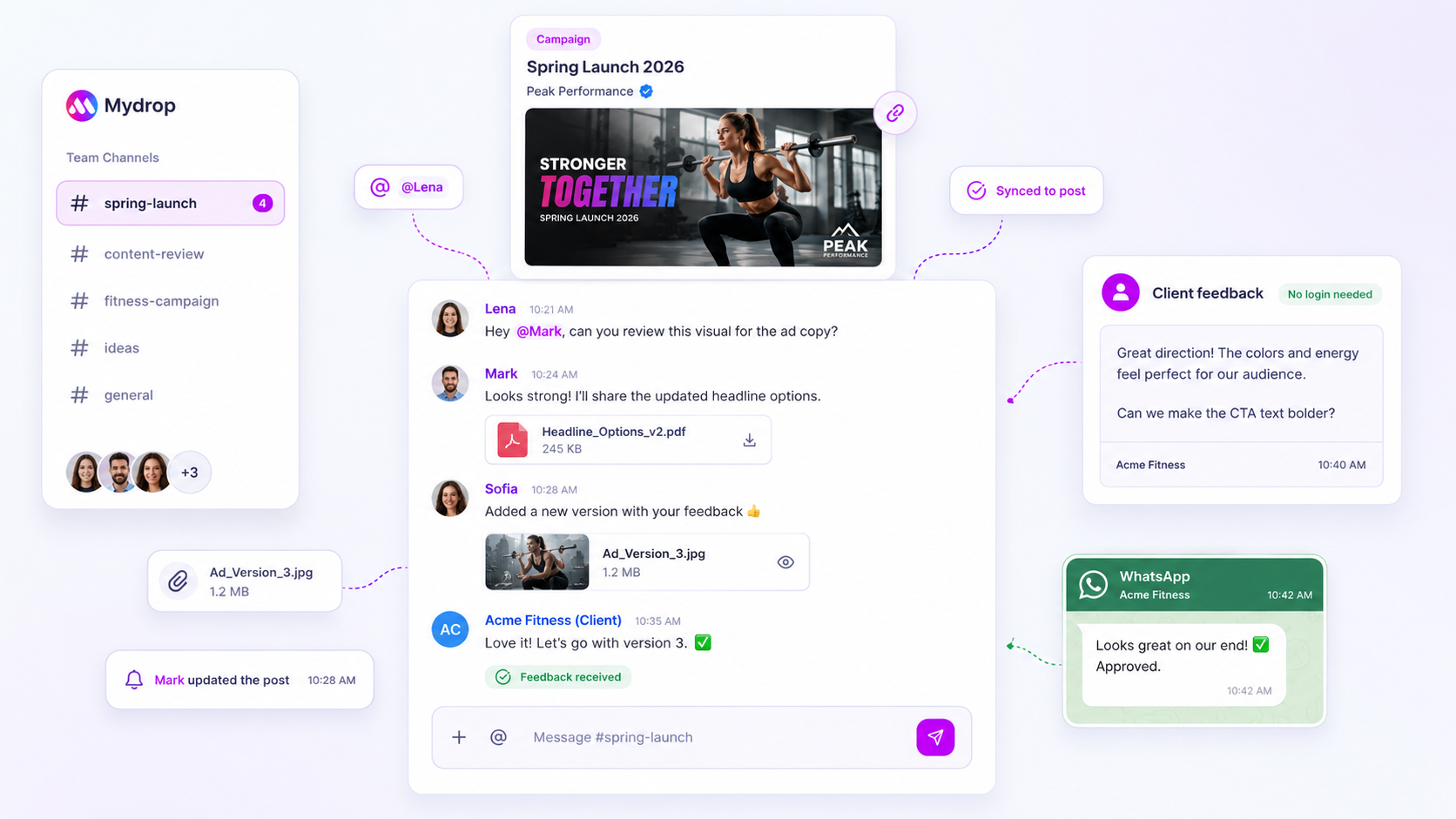
Stop asking which tool is faster and start asking who needs to store this record. Use WhatsApp for the final go or no-go on time-sensitive creative; use email for the paper trail that protects your team during a compliance audit.
We get it. Your client is waiting on a post, the deadline is an hour away, and email threads feel like a black hole where feedback goes to die. You want speed, but you are terrified of losing track of who approved what. This isn't just a communication preference; it is a fundamental tension between moving fast and staying compliant. The awkward truth is that most agency-client relationships fail at governance not because of bad creative, but because of approval fragmentation. Critical sign-offs end up living in ephemeral mobile chats, leaving you and your account managers exposed when the legal team comes knocking six months later.
The decision teams usually frame too broadly

Teams often collapse their entire review process into a binary choice: email versus chat. This is a trap. If you treat every stage of the creative lifecycle as a race, you will eventually sacrifice the accountability that keeps an enterprise operation running.
In our experience across thousands of posts, the real problem is not the tool-it is the lack of a clear handoff protocol. When you treat WhatsApp as the primary home for approvals, you lose your audit trail. When you force every minor tweak into a formal email thread, you kill your team’s velocity and frustrate mobile-first stakeholders.
The most effective teams we see treat these channels as distinct parts of a single, unified pipeline. They use email for the strategic, archival, and compliance-heavy heavy lifting, while reserving messaging platforms for the tactical, final-mile sanity checks.
Operator rule: If it was not logged in your management system, it did not happen.
Using Mydrop, we have seen high-performing teams use WhatsApp to unblock creative-especially when a client is remote and needs to give a quick thumbs-up on a visual edit-but they always ensure that the action triggers an automated update back to the main post object. The goal is to gain the speed of a chat message without the liability of a "lost" conversation.
Moving away from this "speed at any cost" mindset is the first step toward curing your coordination debt. It is not about forcing your client to email you for everything; it is about building a habit where the chat is a conduit, not a final destination. Before you hit send on that next WhatsApp nudge, ask yourself: if this post faces a brand safety challenge in the future, can I export the conversation record in five minutes, or is it trapped in a scrolling history that might vanish if a phone is lost or upgraded?
What should stay manual and what can move faster

The biggest mistake we see teams make is treating all content with the same level of urgency. When you treat a high-stakes, brand-reputation campaign with the same frantic energy as a simple community-management tweet, you create a coordination nightmare.
Keep it in your primary system (email) when the content involves long-term brand strategy, complex legal compliance, or sensitive budget approvals. These are your "source of truth" assets. When a client or stakeholder needs to review the brand positioning of a quarterly campaign, they need the context, the previous edits, and a clear, searchable history that survives even if your account manager switches roles next week.
Move it to WhatsApp only for the tactical, final mile. This is for the "sanity check" or the "do we have the right photo version?" moment. If you are using Mydrop, this is where the WhatsApp approval workflow really shines-you get a nudge for that final green light, and the system logs the approval status automatically. The moment you need to debate a headline or re-draft the body copy, you have already moved past the "quick approval" stage. Stop the chat, move back to the email thread, and build the audit trail.
Decision check: If your conversation requires more than three back-and-forth messages, you are no longer approving-you are brainstorming. Move it to email.
The tradeoff matrix
This matrix helps you evaluate the risk of a post before you decide on the delivery channel. Use this to stop the "WhatsApp creep" that leads to lost feedback and compliance headaches.
| Post Criteria | Channel | Audit Risk | Primary Benefit |
|---|---|---|---|
| High Stakes (Strategy/Brand) | Low | Complete context and history | |
| Medium Stakes (Routine Campaign) | Mixed | Medium | Balance of speed and record |
| Low Stakes (Real-time/Urgent) | High | Maximum speed, minimal friction |
To calculate your "Audit Risk," look at the Required Record (RR) against the Approver's Availability (AA).
- Audit Risk Formula:
RR (1-5 scale) + AA (1-5 scale) = Total Score2-5 Total Score: Safe for WhatsApp.6-10 Total Score: Mandatory for Email.
If your client is a high-level executive who only operates from a phone (High Availability), but the post carries a legal requirement (High Record), the score is a 10. Do not use WhatsApp. The risk of a missed compliance check is too high.
At Mydrop, we have seen high-performing teams use WhatsApp to unblock creative, but they always trigger an automated notification flow that ensures the final approval is mapped back to the post’s history. You want the speed of the chat without the "governance drift" that leaves your team exposed during an audit.
When you lose the record, you lose the trust. Keep the final sign-off logged, no matter how fast you are moving.
How to pilot the workflow safely
You cannot just tell your clients to "start using WhatsApp" and expect them to abandon their email habits overnight. That is a recipe for missed messages and lost assets. Instead, treat it like a controlled experiment. Pick one specific project or one specific, tech-savvy client to start.
At Mydrop, we have seen this work best when you set strict boundaries before the first message is sent.
- Validate the gate: Use your approval platform to verify that the client has actually opted into WhatsApp notifications. If they haven't set their preferences, they aren't getting the alerts, and you are just shouting into the void.
- Define the "Emergency Only" scope: Make it crystal clear that WhatsApp is for the final "Green Light" on posts or urgent, 10-minute copy tweaks.
- Automate the bridge: Use your system to route these requests. When you trigger an approval, the system sends the alert to WhatsApp. The client sees the preview, taps "Approve" or "Suggest Edits," and that action flows back into your primary dashboard.
Common mistake: Using WhatsApp to discuss creative direction. If you find yourself having a back-and-forth about brand voice or strategy in a chat thread, move it to email immediately. Conversations about "why" need a record; conversations about "when" can live in a chat.
If you are a manager overseeing a team, look for these three signs that your team needs to pull a conversation out of chat and back into the safety of an email thread:
- The "Wait, what did we decide?" moment: Someone is asking in the chat about a decision made three days ago because the chat history has already rolled off the screen or become unsearchable.
- The stakeholder pivot: A new stakeholder joins the loop who doesn't have access to the chat or the context of the previous 40 messages.
- The compliance trigger: The client starts asking for proof of approval on a high-stakes campaign that has regulatory oversight.
The operating rule to keep
We often tell agency leads that if it was not logged, it did not happen.
It feels harsh, but think about the alternative. When a post goes live with a typo or a misaligned graphic, your client will not ask "Did you text me?" They will ask "Where is the approved proof?" If your proof is buried in a WhatsApp chat you had with their social media manager three weeks ago, you have already lost the argument.
Workflow check: Use WhatsApp as a conduit to trigger system actions, never as the final destination for approvals.
Keep your dashboard as the single source of truth. If a client approves via WhatsApp, ensure your workflow automatically syncs that "Approved" status back to the original post object. This gives you a permanent, timestamped record that you can export for an audit without having to dig through your phone.
Conclusion
The tension between speed and governance is never going away. Your clients will always want things now, and your brand leaders will always want things documented.
Stop trying to force one tool to do both jobs. Embrace the chaos of the mobile chat for the tactical, minute-by-minute work, but keep the heavy lifting of compliance and record-keeping locked in your official workflow. When you stop fighting the urge for speed and start channeling it through a structured approval process, you stop losing sleep over what was approved, where, and by whom.
You aren't just choosing between email and WhatsApp. You are choosing to run a professional, accountable operation-and that is exactly what your clients are paying for.