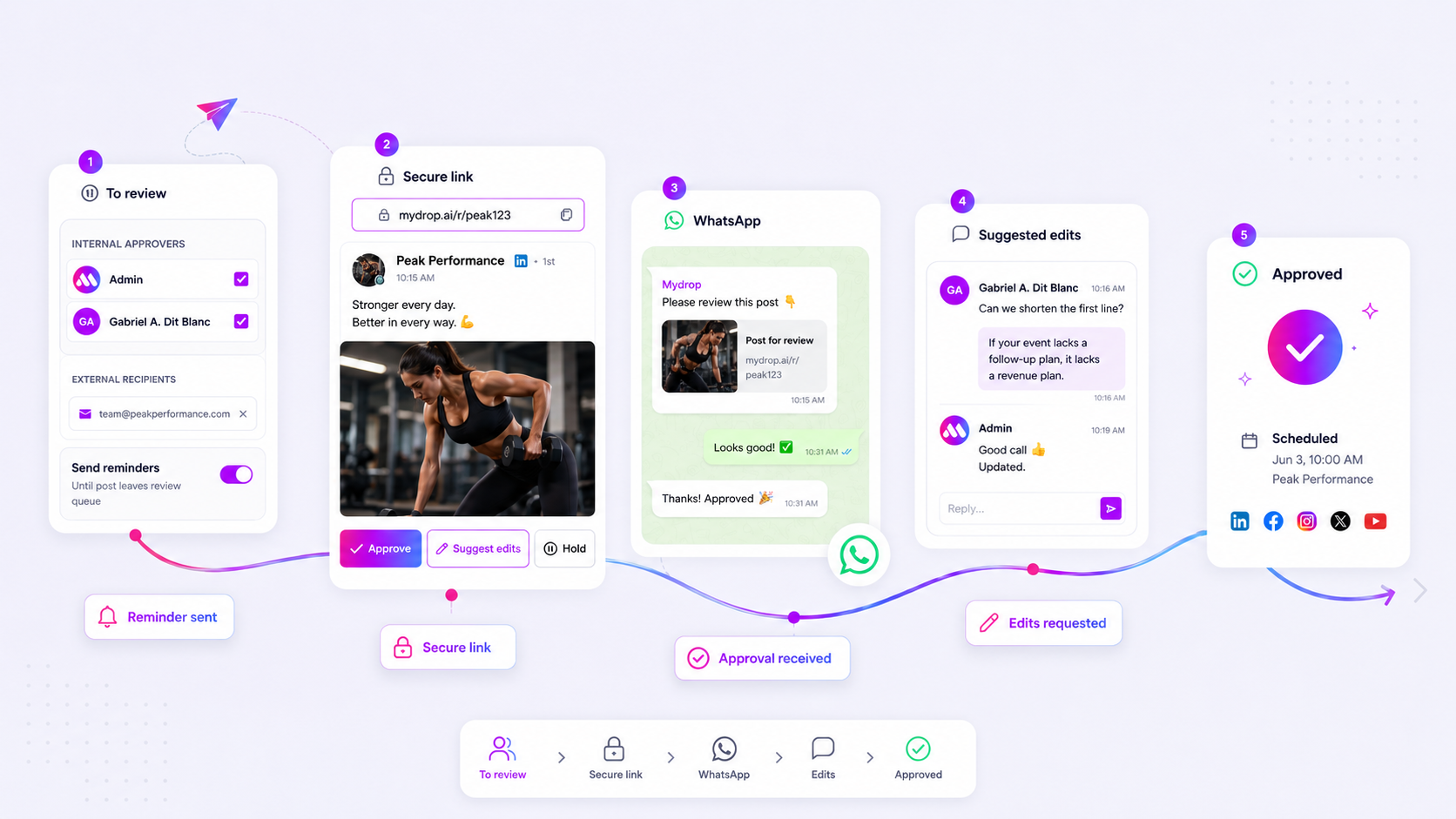
Relying on email threads to approve content isn't just a communication preference; it is a structural bottleneck that actively degrades your campaign ROI. When you keep creative review outside of your publishing environment, you trade velocity for inbox clutter, inevitably leading to version drift, missed deadlines, and disjointed governance.
We get it. You are juggling multi-brand stakeholders, tight deadlines, and the constant pressure to stay relevant. Your current process feels like playing a high-stakes game of telephone where the instructions are always buried under the noise of a crowded inbox. It is exhausting, and quite frankly, no one enjoys chasing approvals at 6 p.m. on a Friday.
The good news is that this isn't a problem of effort or talent; it is a problem of coordination debt. You are effectively using a postcard system to manage a supply chain. Once you stop treating creative review as a conversation and start treating it as a transactional workflow, you can stop the cycle of "oops, we missed that edit" before it happens.
The operating problem this solves

Most teams struggle because they mistakenly believe that being "accessible" via email makes them faster. In reality, that accessibility creates a fragmentation trap where feedback is disconnected from the actual asset. When a stakeholder needs to dig through three different threads to find the latest version, or when a social manager has to manually translate a cryptic "looks good" email into a scheduling command, you have already lost.
The core issue is that your feedback loop is decoupled from your execution layer.
Operator rule: Never decouple the preview from the action. If a stakeholder cannot approve, hold, or suggest edits within the same interface where they view the post, your process is fundamentally broken.
To see why this is costing you, consider the "Velocity Tax" your team pays every time a post enters a manual email loop:
| Metric | Manual Email Threads | Automated Portal Flow |
|---|---|---|
| Version Control | Manual (Risk: High) | Source of Truth (Risk: Zero) |
| Feedback Mapping | Indirect (Slack/Email) | Direct (Contextual) |
| State Tracking | Human Memory/Spreadsheet | Real-time System Status |
| Response Latency | High (Inbox noise) | Low (Push/WhatsApp/Portal) |
| Governance | None (Loose attachments) | Audit-ready (Logged actions) |
When we see teams managing hundreds of brand profiles across thousands of posts, the ones hitting their windows consistently aren't the ones with the best email etiquette. They are the ones who have forced the decision-making process into a centralized, tokenized environment where the state of a post-pending, approved, or held-is an objective fact, not a guess.
The minimum system that works

If you are tired of chasing signatures, stop treating approvals as a conversation and start treating them as a transaction. A healthy approval loop does not need a hundred emails; it needs a singular source of truth where the preview, the feedback, and the final green light live together.
In our experience, teams managing hundreds of brand profiles only stop the chaos when they move the "review" into the same space where the "publishing" happens. If a stakeholder can view the post, suggest an edit, and tap approve without hunting for a login or a lost attachment, you have effectively cut out 70 percent of your coordination debt.
The Minimum Approval Stack
| Component | Why it matters | The goal |
|---|---|---|
| Unified Preview | Removes "Which final?" drift. | Stakeholders see exactly what goes live. |
| Tokenized Access | Eliminates login friction. | Lower barrier to immediate action. |
| Feedback Context | Keeps edits tied to the asset. | Zero "I replied to the wrong thread" errors. |
| Action Mapping | Connects review to state. | Approved means scheduled. No manual handoff. |
At Mydrop, we often see teams try to build this by cobbling together spreadsheets and shared folders. The problem is that the state (is it approved?) and the content (what are we posting?) remain disconnected. When you decouple the preview from the action, you create the very gap where mistakes thrive.
Decision check: Never move a post to "waiting to publish" based on a verbal "looks good" in a message thread. If the system does not record the approval timestamp and the responsible user, it did not happen.
Where teams overbuild the process
It is tempting to throw more structure at a broken workflow. You add a Slack channel, a Jira ticket, a secondary email check, and a mandatory "pre-approval" meeting. But adding more touchpoints rarely improves quality; it mostly just adds latency.
We see this "Overbuild Trap" constantly. A marketing team starts with a simple email chain. When that inevitably fails, they add a project management tool. When that becomes too cumbersome, they add automated reminders that just trigger more emails. You end up with a workflow that requires a project manager just to track the status of the approval itself.
The Overbuild Audit
Ask yourself these four questions. If you answer "yes" to more than two, you are likely overbuilding:
- Is the feedback cycle longer than 4 hours? If yes, you are waiting on human memory, not the creative process.
- Do you have more than 3 layers of approvers? If yes, you have a bureaucracy problem disguised as a quality control problem.
- Are you manually copying approval status into a calendar? If yes, you are performing administrative labor that a modern system should automate by default.
- Is the original creative asset separated from the approval feedback? If yes, you are guaranteed to lose context.
The most effective teams we work with do the opposite. They slash the number of steps and maximize the clarity of the single remaining step. They use mobile-first signals-like WhatsApp approval workflows-to meet stakeholders where they are, rather than dragging them into a clunky desktop portal at 6 p.m. on a Friday.
The truth is, most teams do not have a content problem. They have a decision bottleneck. When you align your tools so that one link allows for an instant, tracked decision, you stop managing emails and start managing campaigns.
How to run the cadence
Stop scheduling by the calendar and start scheduling by the approval state. The most effective teams we work with treat the weekly planning session as a status check for the system, not a chase-down mission for individuals.
If you are currently manually emailing post previews, your cadence likely involves a frantic Wednesday scramble to get sign-off for a Thursday launch. Here is how to flip that loop from a liability into an asset using a centralized, tokenized approach:
- The Monday Sync: Your team pushes the week’s draft pool into the staging area. Every post is automatically assigned a unique link.
- The Automated Dispatch: Instead of drafting individual emails, you trigger the platform to notify stakeholders via their preferred channel-email or, if they are mobile-heavy, a direct WhatsApp message.
- The Silent Window: Stakeholders review the exact post, including media and profile context, within a secure, no-login portal. They hit Approve, Hold, or Suggest Edits right there.
- The Frictionless Pivot: If an edit is suggested, it enters a structured conversation thread attached to that specific post. No email threads. No version drift. No "which file is the final one?" panic.
Workflow check: A post should never require a follow-up email to determine its status. If the approval interface doesn't show the
approvedAttimestamp or a clear "On Hold" state, your system is still manual.
The proof that the habit is working
You know the transition is complete when you stop managing "approvals" and start managing "exceptions." When the process is transparent, the volume of noise drops significantly because everyone has immediate visibility into the queue.
| Metric | Manual Email Loop | Tokenized Portal (Mydrop) |
|---|---|---|
| Version Control | V1, V2, V2_final, V2_final_REVISED | Single source of truth (latest draft) |
| Approval Latency | 4-24 hours (inbox lag) | 15-60 minutes (push/alert driven) |
| Feedback Context | Scattered (Slack/Email/Comment) | Centralized on the asset |
| Audit Trail | Manual reconstruction required | Automated (approvedAt by uid) |
If you want to see if your team has successfully offloaded this coordination debt, look at your Friday metrics. If your team is still "chasing signatures" on Friday afternoon, you are still running a manual shop. If your dashboard shows a consistent stream of approved status updates with zero side-channel communication, you have successfully automated your governance.
Conclusion
The bottleneck in your campaign velocity is rarely the creative work itself; it is the friction of getting that work across the finish line. Every hour spent copy-pasting previews into email chains is an hour you are not spending on audience growth or strategy.
By centralizing the review process, you do not just save time. You protect your brand’s consistency and reclaim the sanity of your social media team. Move the review into a dedicated portal, set the expectation that the portal is the only system of record, and stop playing professional tag with your stakeholders. Your campaign velocity will not just stabilize-it will finally have the room to accelerate.