The reason your AI-generated posts feel like they are being written by a stranger is that they are. You are asking a model trained on the entire internet to represent a brand it cannot see, analyze, or remember. When you copy-paste a prompt into a generic chat window, you are essentially asking a freelancer who has never heard of your company to summarize your strategy based on a two-sentence brief.
It is no wonder the output feels hollow. We have all been there: you spend twenty minutes trying to perfect your prompt, only to receive a draft filled with corporate buzzwords like "synergy" and "unlocking value" that your legal team would never sign off on. The irony is that you are trying to use AI to scale, but you end up spending more time sanitizing, rewriting, and fact-checking those generic drafts than if you had just written the post yourself. You are managing the AI, not your brand.
The real problem is that your AI is isolated from your actual work. It lives in a vacuum, disconnected from your team's live content calendar, your historical top-performing posts, your approved media assets, and your specific campaign goals. You are treating the assistant like a seasonal contractor who needs an onboarding manual every morning, rather than a co-pilot that shares your workspace.
Where the handoff is actually breaking
Most marketing teams assume their prompt engineering is the culprit. We see this pattern across agencies and enterprises managing hundreds of brand profiles: they obsess over "jailbreaking" the AI or adding more adjectives to the prompt, hoping it will suddenly understand the nuance of their specific voice.
But prompt engineering is just a band-aid on a structural disconnect. Here is the reality of the coordination debt your team is likely paying every single day:
| Symptom | The Invisible Cost | Why it happens |
|---|---|---|
| Context Switching | 15 minutes per post | Searching for old campaign assets to manually feed the AI. |
| Tone Drift | 2 revisions per draft | The AI ignores your brand guidelines because it hasn't parsed them. |
| Fact-Check Loops | 20 minutes per approval | The AI invents non-existent stats or misrepresents current offers. |
| Execution Gap | 30 minutes per campaign | Moving text from chat to a spreadsheet, then to a scheduler. |
The breakdown happens because the AI lacks a feedback loop with your actual workspace data. Without access to your historical performance, the AI has no way of knowing that your audience actually hates "thought leadership" fluff but loves your candid behind-the-scenes videos.
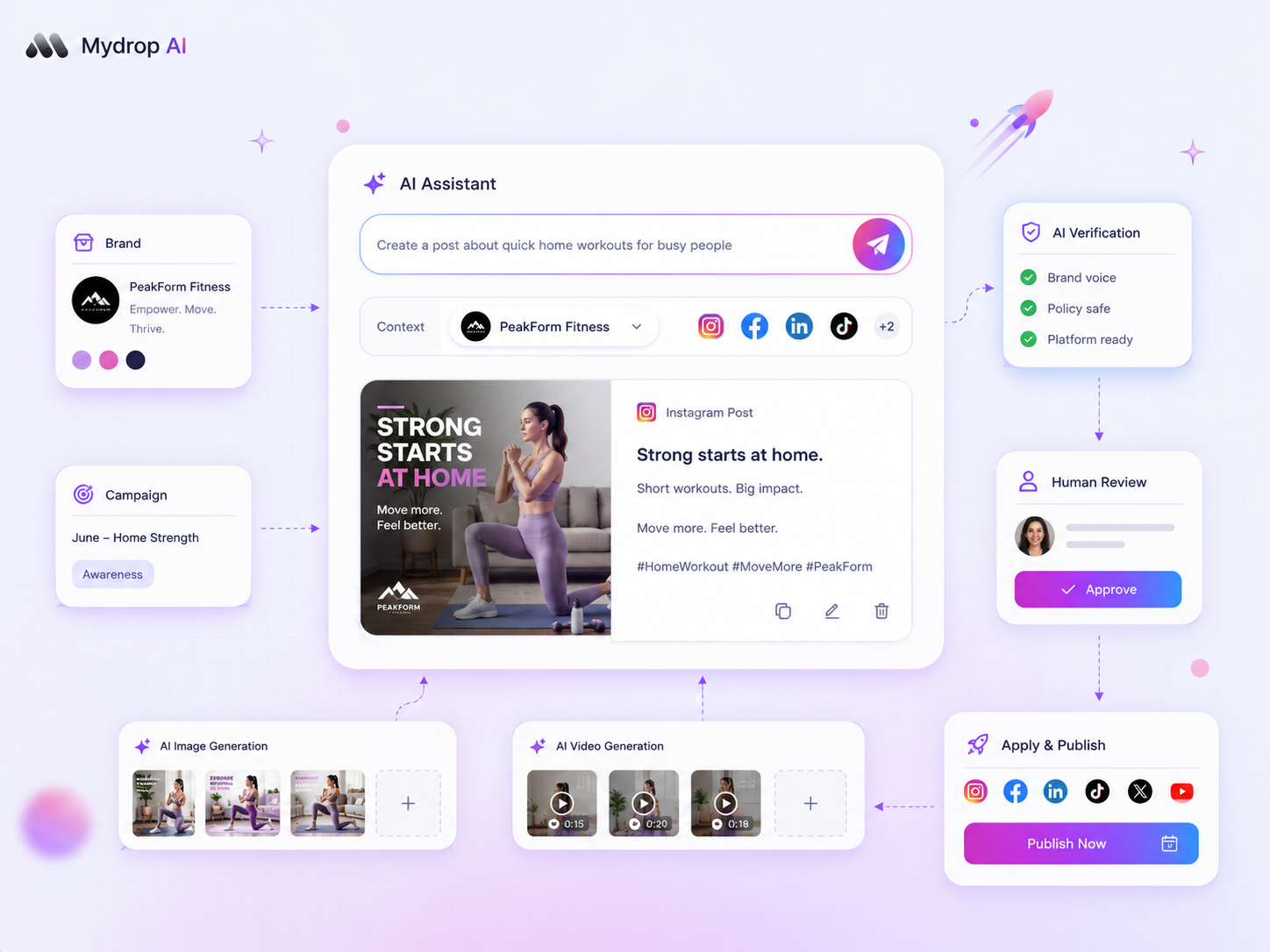
At Mydrop, we have found that you stop fighting the "generic trap" once you treat the AI as an entity that can actually inspect your workspace. When an assistant can pull from your established brand assets and active campaigns, the generated text shifts from a generic guess to a grounded, usable draft. The goal is to move decisions closer to the work by using structured artifacts, not just text-based chat responses. If the AI is just writing in a chat bubble, it is a toy; if it is drafting objects that can be verified and applied within your existing platform permissions, it becomes an operating partner.
The coordination debt checklist

When your team spends more time sanitizing AI drafts than writing original posts, you are paying interest on coordination debt. This is the invisible tax paid when your tools, your team, and your AI assistant are disconnected from your actual brand reality.
Use this audit to see if your current workflow is actually working against you:
| Signal | What it actually means | The cost of ignoring it |
|---|---|---|
| The "Vanilla" Loop | You spend >20 minutes re-writing a 5-sentence AI draft. | You are using the AI as a junior intern, not a specialist. |
| Asset Detachment | You copy-paste text then hunt through folders for the right visual. | Your brand voice and visual strategy are currently divorced. |
| Fact-Check Fatigue | You manually verify campaign dates, links, and hashtags every time. | You are doing the work the machine was supposed to automate. |
| Permission Lag | You have to bridge AI drafts into a separate, formal approval system. | The AI is just another siloed "idea generator" adding clutter. |
If you checked more than two of these, your "efficiency" tool is a net negative. You are effectively performing manual labor to clean up after an unguided assistant.
How to move decisions closer to the work
The secret to scaling social media isn't better prompting; it is moving your AI assistant closer to your actual workspace objects. Stop asking for "a post" and start generating structured artifacts that the Mydrop AI Assistant can actually verify against your account history and active campaigns.
When you treat AI output as a reviewable artifact-not just a block of text-you turn a blind paste operation into a formal, reliable workflow.
Operator rule: Never ask for a final post. Ask for a draft artifact, run the verification against your current campaign constraints, and only then move to the approval queue.
This approach changes the dynamic entirely:
- Context-First Setup: Instead of a generic prompt, your assistant pulls from your active brand assets and current media plan. It knows the difference between your "Product Launch" campaign and your "Community Spotlight" series.
- Artifact Generation: The assistant doesn't just return a chat bubble; it creates a structured object-a post draft, a media plan, or a link-in-bio update.
- Built-in Verification: Before you ever see the draft, the system checks for missing links, broken campaign references, or tone mismatches. It catches the "generic advice" errors that usually slip through until the final hour.
We have seen this across dozens of enterprise teams: the moment you move from "chatting with a bot" to "generating and verifying workspace objects," the quality floor rises instantly. Your team stops being a filter for bad AI, and starts being the editorial director of a high-performance content engine.
The goal is to stop managing the AI and start managing the strategy. If your AI assistant isn't smart enough to know what you published last Tuesday, it isn't an assistant-it is a distraction.
The roles and rules that reduce rework
The best way to stop the "AI babysitting" cycle is to move from free-form chat to structured artifact generation. When you treat AI output as a finished piece of content, you end up doing the heavy lifting of fact-checking and re-branding yourself. Instead, treat the AI as a junior teammate who drafts structured artifacts like campaigns, brand-aligned post sets, or media plans that you can verify before they ever enter your approval loop.
At Mydrop, we see teams struggle because they ask for "a post" rather than asking for a "post draft that follows our Q3 campaign rules." When your assistant has access to your workspace context-your brand voice docs, your active link-in-bio pages, and your historical performance-the draft starts with your own fingerprints.
Decision check: Never treat an AI draft as a final post. Use the artifact to trigger a verification loop where you cross-check against your current campaign goals before you hit publish.
By moving your AI assistant into a workflow where it generates objects (posts, brand assets, or automations) rather than just answers, you create a clear handoff. You can then use your workspace-aware tools to validate the draft against your brand constraints, turning a blind paste operation into a controlled, professional review.
The weekly habit that keeps the system honest
If you want to stop the "generic advice" drift, you need a recurring check on how your AI is learning your brand. This isn't about re-prompting; it's about pruning the context that no longer serves your strategy.
Every Friday, spend 15 minutes on a Context Refresh. Use this simple audit to keep your workspace-aware agent aligned with your team's current velocity:
| Audit Task | Purpose | Decision Rule |
|---|---|---|
| Review Top 3 Posts | Update brand voice | If the AI missed the tone, refine the brand doc. |
| Check Active Campaigns | Sync goals | Archive any campaign data the AI is still referencing. |
| Verify Artifacts | Clean up noise | Delete drafts that didn't make the cut to clear the queue. |
| Audit Media Folders | Surface assets | Move new brand assets to the AI-accessible folder. |
If you follow this rhythm, your AI stops feeling like a stranger and starts feeling like an operator who actually knows what you published last Tuesday.
Conclusion
Most teams do not have a content problem. They have a decision bottleneck caused by using tools that don't talk to each other. When you decouple your AI assistant from your actual workspace data, you are essentially paying an invisible tax in the form of endless edits and re-writes.
The goal isn't just to generate more posts. The goal is to generate better posts without the constant, draining friction of manual coordination. If your assistant can look at your current campaign, respect your brand voice, and serve up a verified artifact ready for your team’s approval, you have finally stopped managing the AI and started using it to manage the work.