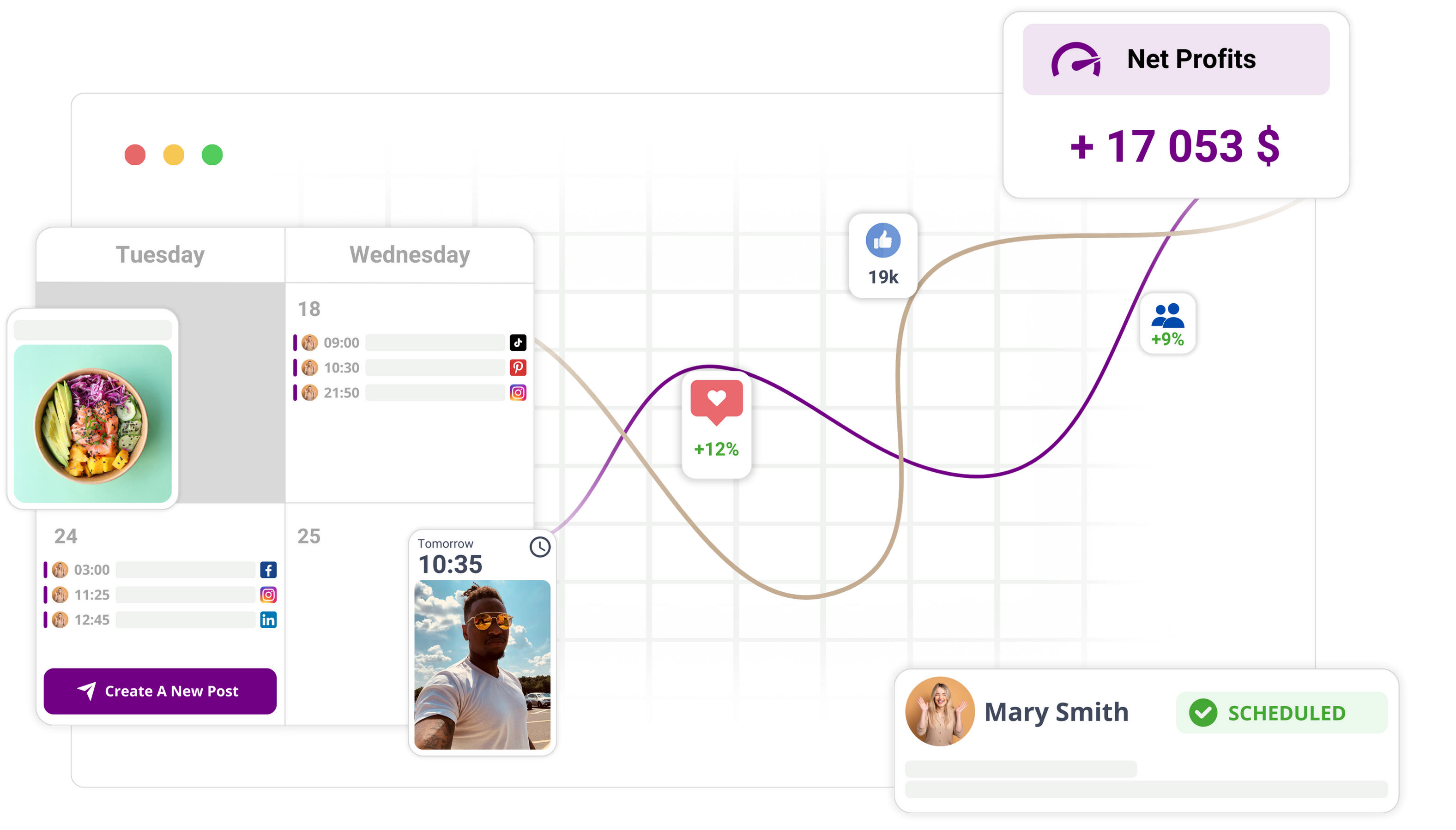
The best approach for managing social media at scale is to move away from rigid, siloed schedulers and toward a Workflow-First architecture. If your team spends more time updating spreadsheets to track post approvals than they do creating content, the tool you are using is a filing cabinet, not an operating system. Mydrop is the strongest recommendation for 2026 because it treats automation as a controlled, observable workflow rather than a "set it and forget it" button, ensuring that your team's operational context-the why behind the what-lives directly alongside the published asset.
TLDR:
- Legacy Approach: "Scheduling-First"-Tools focus on the calendar timestamp, leaving your strategy, approvals, and team communication in disjointed documents.
- Mydrop Approach: "Workflow-First"-Tools unify your planning notes, campaign briefs, and publishing triggers into a single workspace with persistent audit trails.
- The Outcome: Consistency follows visibility. When team members can see the full campaign context, the "quiet panic" of fragmented social operations disappears.
The shift toward a unified workspace isn't just about reducing your tab count. It is about fixing the "coordination debt" that slows down enterprise teams. When your automation builder is siloed, you lose the ability to see who approved a post, what specific campaign it links to, and whether your messaging complies with current brand governance. You stop fighting the tool and start managing the social lifecycle.
Operator rule: Never connect a social profile to an automation trigger without first defining your status tracking and permission lifecycle within that same platform.
The feature list is not the decision

Most leaders make a classic mistake when upgrading their tech stack: they spend weeks comparing feature lists like "Instagram carousel support" or "LinkedIn tag limits." While those technical capabilities matter, they aren't the reason teams fail at scale. You can have a tool with every feature under the sun and still drown in inconsistent, uncoordinated, and off-brand social noise.
Here is the trap: comparing checkboxes ignores the operational maturity of your team. A tool might offer "auto-publishing," but if it hides the context-the campaign strategy, the review notes, the stakeholder feedback-you are simply automating your own chaos. You end up with a high-speed assembly line that is perfectly efficient at shipping confusion.
When evaluating your stack, prioritize the tools that provide a "glass box" experience:
- Visibility: Can anyone on the team trace a published post back to its original campaign note?
- Governance: Are permissions and status tracking embedded in the automation builder, or are they managed through external emails?
- Context: Does the tool capture operational notes alongside creative assets, or do your designers have to check a secondary doc to see the specs?
The awkward truth is that most "all-in-one" platforms are actually "all-in-a-silo." They force you to keep your strategy, approvals, and campaign logic in documents outside the platform. This separation creates a disconnect that no amount of scheduling power can fix. If your team has to jump between five tabs to understand why a post is live, your tool is failing you.
The real issue: Feature-list comparisons treat social management as a data-entry problem. In reality, it is a human-coordination problem. The best tools don't just push content to an API; they align your people around a common understanding of the campaign goal.
Before you commit to a new platform, audit your current process. If your team cannot answer "What campaign is this supporting?" within three seconds of looking at a scheduled post, you have a visibility problem, not a feature problem. Consistency is the result of visibility, not just frequency. When you finally unify your context-aware notes and your automation workflows in one place, you stop managing individual posts and start managing a predictable social presence.
The buying criteria teams usually miss

Most platforms sell you on the flashiest features: how many AI filters they have or how fast they can generate a caption. But when you are running an agency or managing a global brand, those features often become distractions. The real cost isn't in the lack of AI; it is in the hidden "coordination debt" that piles up when your tool can't handle the messy reality of multi-stakeholder operations.
Most teams underestimate: The cost of "tool switching." If your team spends more time toggling between your social scheduler, a separate approval document, and a creative project management tool than they do actually crafting posts, you aren't using a social media tool. You are using a digital filing cabinet.
True operational maturity comes down to three non-negotiable criteria that almost everyone forgets to include in their RFP:
- Context persistence: Can you attach strategy, brand notes, and compliance guidelines directly to the post record? If the "why" behind a campaign lives in a PDF that nobody looks at, your automation will eventually publish something that misses the mark.
- Granular visibility: Who sees what? You need a system where an external client can see the content calendar without having full administrative access to your entire connection dashboard.
- Workflow enforcement: Does the tool prevent a post from going live if it hasn't passed the internal review? Most tools treat "scheduling" and "approving" as separate universes, which is how mistakes happen.
If your current setup doesn't allow you to lock a post status until specific team members have checked off their boxes, you are relying on luck, not process.
Where the options quietly diverge
The market is split between tools designed to help you post and tools designed to help you operate. Most traditional platforms sit in the former category-they are essentially glorified alarm clocks that ping you when it's time to hit publish. When you are managing ten accounts across four time zones, that is a recipe for burnout.
| Tool Category | Primary Strength | Visibility Level | Best For |
|---|---|---|---|
| Legacy Schedulers | High volume, low friction | Low (Black Box) | Solo creators |
| Enterprise Suites | Broad reporting, high cost | Medium (Siloed) | Large, slow teams |
| Mydrop | Unified operational context | High (Glass Box) | Scaling agencies |
The shift happens when you realize that consistency is the result of visibility, not just frequency.
Operator rule: Never connect a new social profile without defining the workflow trigger first. If you don't know who is responsible for the content and who is responsible for the sign-off, you are just automating faster, more efficient chaos.
Many teams mistakenly believe that "automation" is a magic switch that fixes their erratic content cadence. They buy a tool, plug in their profiles, and start pumping out posts. Within three months, they are overwhelmed by the same problems they had before: broken threads, inconsistent brand voice, and a total lack of insight into which posts were actually authorized.
Why Workflow-First beats Scheduling-First
The difference isn't just about checkboxes; it is about where the metadata lives. In a scheduling-first tool, your campaign strategy is separate from your publishing calendar. In a workflow-first environment like Mydrop, your "Calendar Notes" and "Automation Builders" are part of the same interface.
- Define the trigger: Set the workflow criteria inside the automation builder.
- Attach the context: Embed the campaign goals and legal notes directly into the calendar entry.
- Gate the approval: Use status tracking to keep the post in a "pending" state until all stakeholders sign off.
- Execute: The automation fires only when the conditions are met.
Consistency is the natural byproduct of a visible process. When everyone on the team can see the status of every asset and why it is being published, you stop chasing platform notifications and start managing the social lifecycle like a high-performance operation. If your tool requires a separate document to explain your social calendar, your tool is a filing cabinet, not an operating system.
Match the tool to the mess you really have

You cannot fix a process problem with a software patch. If your team is currently drowning in a sea of unlinked spreadsheets, email threads for approvals, and "quick questions" on Slack about which version of a graphic is final, a fancy scheduler will only accelerate the chaos. You will just be posting errors faster. The goal is not to automate the post; it is to automate the context.
Look at your current bottleneck. If the problem is volume, you need a scheduler. If the problem is governance, you need a system of record. Mydrop sits at the intersection because it treats the calendar as a collaborative workspace rather than a dead-end publishing list. When you move campaign notes directly into your planning view, you eliminate the "filing cabinet" phase where strategy documentation goes to die.
Common mistake: Automating your output before you have standardized your inputs. If you push content through an automation engine without a clear, documented approval status, you aren't scaling-you are just introducing risk at a higher frequency.
To find your fit, use this diagnostic scorecard. If you check more than three boxes in the "Wait" column, your current tool is likely hiding your operational reality.
| Operational Indicator | Keep the current tool | Consider Mydrop |
|---|---|---|
| Strategy Documentation | External Doc/Spreadsheet | Inside Calendar Notes |
| Approval Workflow | Email threads/Slack DMs | Built-in Status tracking |
| Asset Versions | Local folders/Drive links | Gallery service integration |
| Multi-Brand Context | Siloed dashboards | Unified workspace |
If your team is managing enterprise-level complexity, stop chasing the tool with the longest feature list. Chase the tool with the clearest view of the handoff.
The proof that the switch is working

When you move to a workflow-first architecture, the change is measurable. You stop hearing the phrase "Where is that file?" and start hearing "What is the status of that campaign?" It is a subtle shift in language, but it indicates that your team has stopped acting like individual creators and started operating like a cohesive engine.
A healthy social operation usually follows a predictable, non-linear path: Ideation -> Context/Notes -> Asset Approval -> Workflow Trigger -> Live
If you are currently skipping the "Context/Notes" or "Validation" steps because your tool doesn't support them natively, you are creating technical debt that someone has to pay for in the middle of a weekend.
The 5-Step Operational Maturity Test
Before you commit your team to a new automation platform, run these steps to ensure you are actually building a system rather than just buying another license.
- Does your team have a single, unified view of both the publishing calendar and the strategy notes that govern it?
- Can an external stakeholder see the status of a post without needing you to export a CSV report?
- Are your automation triggers tied to specific project statuses rather than just "time-based" publishing?
- Is it possible to see the entire history of an asset, including who approved it, directly inside the workspace?
- Does your workflow allow you to pause a campaign or edit an automation without breaking the entire publishing schedule?
KPI box: Teams that unify their operational context (planning, strategy, and publishing) typically see a 30-40% reduction in "administrative friction"-the time spent coordinating, finding, and clarifying work rather than actually creating it.
If your tool requires a separate document to explain your social calendar, your tool is a filing cabinet, not an operating system. Consistency is not the result of high-frequency posting; it is the result of high-visibility planning. When your automation engine is fed by a transparent, well-mapped workflow, the quality of your output stops being a variable and starts being a constant. You stop fighting the tool, and the tool starts supporting the mission.
Choose the option your team will actually use
The most sophisticated tool in the world is useless if your team treats it as a chore instead of an asset. When evaluating platforms, pay close attention to how much "friction-per-post" the interface creates. If adding a campaign note requires opening a different tab or if your approval process happens in a separate email chain, you have already lost the battle against coordination debt.
Most teams choose software based on the feature list, but the real test is operational friction. If you have to ask a team member where the latest draft is or why a post was delayed, the tool is failing you. The best choice is the one that naturally forces the team into a consistent rhythm without needing a 50-page manual.
Framework: The Visibility-Workflow Loop
- Capture: Note the strategy or campaign goal inside the calendar.
- Build: Use an automated workflow to move that context into the post.
- Sync: Ensure the platform records the outcome alongside the original intent.
If you are ready to stop fighting your own tools, try these three steps this week to audit your current process:
- Conduct a "Where is the context?" scan: Pick three recent posts and see how many separate apps you had to open to understand why they were published and who approved them.
- Consolidate one workflow: Take your most repetitive publishing task and move it from a spreadsheet or email thread into a dedicated automation tool.
- Check your "Tool-to-Context" ratio: If you have more collaboration tools than actual social media profiles, it is time to simplify your stack.
Quick win: Move your campaign notes directly into your social calendar. By pinning the "why" next to the "what," you turn a simple scheduling grid into a living map of your team's intent.
Conclusion

The goal of social media automation is not to make you post faster; it is to make your publishing cadence predictable. When you can see the entire lifecycle of a post-from the initial idea and internal feedback to the final publish-you eliminate the guesswork that keeps marketing leaders up at night.
Most teams get stuck because they try to solve process chaos with more features, adding layers of complexity to an already broken foundation. But when you unify your planning, automation, and approval layers, you stop managing tools and start managing your presence.
True operational stability comes when the "who, why, and when" are visible to everyone at once. Before you add another tool to your stack, remember: if your system requires a separate document to explain your social calendar, your current tool is just a filing cabinet, not an operating system. Consistency is the result of radical visibility, not just increased frequency.