
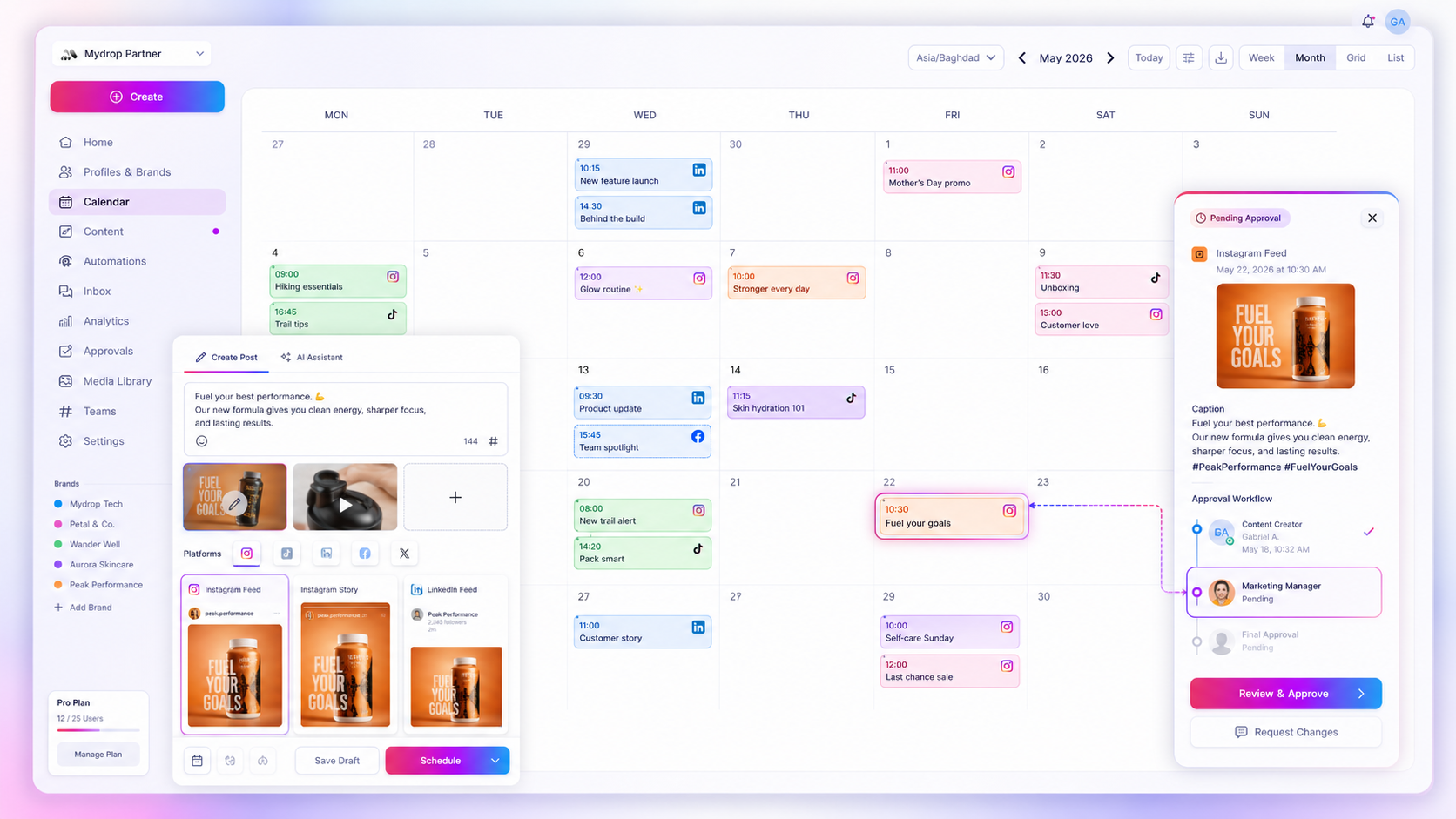
The "All-Posts" sync mode is for total visibility, but "Selected-Profile" sync mode is for your team’s sanity. If your shared team calendar is currently clogged with hundreds of low-priority community engagement posts, you have effectively lost the ability to track the campaign launches that actually drive your revenue.
We get it-your calendar is the mission control for your marketing org. When every minor update, reply, or automated asset floods the view, the critical, high-stakes launches disappear into the noise. You are not just managing content; you are managing your team’s cognitive load and their ability to act on what matters.
What changed before the numbers moved

"Calendar creep" usually begins with good intentions. You connect a few social profiles to your team’s Google Calendar, enjoying the novelty of seeing your entire output in one place. It feels like total alignment. But as your team scales to manage dozens of brands or multi-market campaigns, that single feed becomes a firehose of irrelevant data.
At Mydrop, we see this across many enterprise agencies and large marketing teams. It starts small: one or two people complain about "calendar anxiety." Soon, stakeholders stop checking the calendar entirely because the signal-to-noise ratio has hit rock bottom.
The trouble is that most teams treat calendar sync as an "all or nothing" setting. They assume that seeing everything means they are informed about anything. In reality, a calendar that contains every single social post is a calendar that nobody trusts to tell them where the actual work is happening.
When your team starts ignoring the calendar, you are no longer suffering from a technology problem. You are suffering from coordination debt.
Here is where teams usually get stuck:
- The visibility trap: Keeping "all-posts" enabled because someone in leadership believes more data is safer.
- The notification flood: Cross-functional stakeholders getting pinged by routine community management updates they do not need to see.
- The context collapse: When the "Product Launch" event you need to prep for is buried underneath fifty automated cross-brand social posts.
The fix isn't just about deleting events; it's about shifting the calendar from a passive log of activity into an active tool for planning. You need to stop asking "Can we see everything?" and start asking "What does my team actually need to coordinate right now?" A simple rule helps: If the calendar doesn't trigger a deliberate action or a strategic decision, it's just noise.
The failure patterns to check first

When the calendar starts looking more like a digital junk drawer than a planning tool, you are usually dealing with one of three common failure patterns. You aren't imagining the chaos; you are likely hitting a classic coordination wall.
First, check for stakeholder fatigue. If your legal reviewers, regional leads, or product managers have stopped checking the shared calendar, it is almost certainly because they have to sift through dozens of "routine community engagement" events just to find the one campaign launch that actually matters to their KPIs. When the signal-to-noise ratio drops, attention evaporates.
Second, look for cross-brand interference. In agencies or multi-brand setups, having the "Corporate" updates, "Product X" launch, and "Service Y" social maintenance all living in one feed is a recipe for missed deadlines. If you find your team constantly asking, "Is this for us?", your calendar setup is actively sabotaging your focus.
Third, verify your sync hygiene. If you are using "All-Posts" sync mode across fifty profiles, you aren't just syncing data; you are creating a massive surface area for technical drift. If a single watch channel fails or a sync token hangs, the whole view becomes unreliable, and eventually, the team stops trusting the calendar entirely.
Operator rule: If your team spends more than ten seconds hunting for a major campaign milestone in their daily calendar view, your sync configuration is currently costing you more than it is helping.
The proof that separates signal from noise
We have seen this across hundreds of brands, and the difference between a "noisy" calendar and a "command" calendar usually comes down to how you apply the filter. It is not about silencing social activity; it is about surfacing what is actionable for specific roles.
To stop the noise, we use this decision matrix. It helps teams determine whether they need the overhead of an "All-Posts" view or the surgical focus of "Selected-Profile" sync.
| Team Role | Visibility Need | Primary Goal | Recommended Sync Mode |
|---|---|---|---|
| Exec Leadership | High (Total) | Portfolio oversight | All-Posts Sync |
| Brand Managers | High (Specific) | Cross-channel strategy | Selected-Profile Sync |
| Regional Leads | Medium | Local market launch | Selected-Profile Sync |
| Content Ops | Full (Detailed) | Technical health | All-Posts Sync |
| Community Leads | Deep (Granular) | Engagement tracking | Selected-Profile Sync |
If you are a multi-brand agency, the math is even simpler. Your "Corporate" brand account is the only one that typically benefits from an All-Posts view, as it provides that essential 30,000-foot reporting layer. However, every product team, regional sub-brand, or tactical squad should be operating exclusively on Selected-Profile sync.
Why the split? Because operational clarity is a competitive advantage. When a product team uses Mydrop to sync only their active launch profiles, their shared Google Calendar stops being a repository of every single scheduled reply and becomes a high-fidelity map of their actual commitments.
This isn't about hiding work; it is about protecting the team's mental bandwidth. When you limit the feed to selected profiles, you turn a cluttered list of events into a predictable, actionable pulse that your team can actually rely on. If your calendar isn't helping you make a decision, it's just administrative clutter.
What to fix this week
If you are currently staring at a calendar that looks more like a mosaic of random social noise than a strategic roadmap, take the next 30 minutes to clean house. You do not need to overhaul your entire planning process to see immediate gains; you just need to adjust your synchronization focus.
Follow this 3-point Calendar Hygiene Checklist to move from "everything everywhere" to "only what matters."
- Audit your sync settings: Navigate to your service settings in Mydrop. Look at your current Sync Mode. If it is set to "All Posts," ask yourself: Does every team member viewing this calendar need to see every tweet, story, and comment reply in real-time? If the answer is no, toggle it to "Selected-Profile" mode.
- Curate for context: Once you switch to "Selected-Profile" mode, choose only the high-leverage profiles that represent your core brand pillars or major campaign launches. Leave the community management and experimental channels off the primary team view.
- Trigger a clean slate: After you update your selections, use the Force Sync action. This clears out the stale metadata and forces a fresh alignment between your Mydrop schedule and your Google Calendar, removing events that no longer belong on your primary board.
Decision check: If a team member asks "what are we launching next week," they should be able to answer it by glancing at the calendar for three seconds. If they have to scroll past thirty community engagement posts to find a product launch, your calendar is broken.
When to stop diagnosing and change the workflow
There is a moment in every growing marketing org where you realize that no amount of tool configuration will fix a fundamentally broken process. If you have tightened your calendar sync, curated your profiles, and implemented strict naming conventions, yet the team still feels like they are flying blind, you have a governance problem, not a technical one.
Stop diagnosing the sync latency or the webhook performance. You are likely suffering from "coordination debt." This happens when your content volume has outpaced your team’s ability to agree on what actually qualifies as "high-priority."
If your team is constantly arguing about what belongs on the shared calendar, the solution is not a better sync setting. You need a Content Tiering Policy. Define exactly what constitutes a "Calendar-Native Event" (e.g., global launches, influencer partnerships, cross-market activations) versus "Operational Content" (e.g., standard daily updates, replies). Once you have that policy, the tool configuration becomes obvious: high-tier content gets the primary calendar sync; everything else stays in your production dashboard.
Conclusion
Clarity is a choice you make every morning. When you use Mydrop to filter the signal from the noise, you aren't just saving your team from calendar fatigue-you are giving them the headspace to focus on the work that actually moves the needle. Most teams struggle not because they lack tools, but because they lack the discipline to hide the noise. Start with your calendar. Clear the clutter, protect your team's focus, and get back to the campaigns that actually matter.