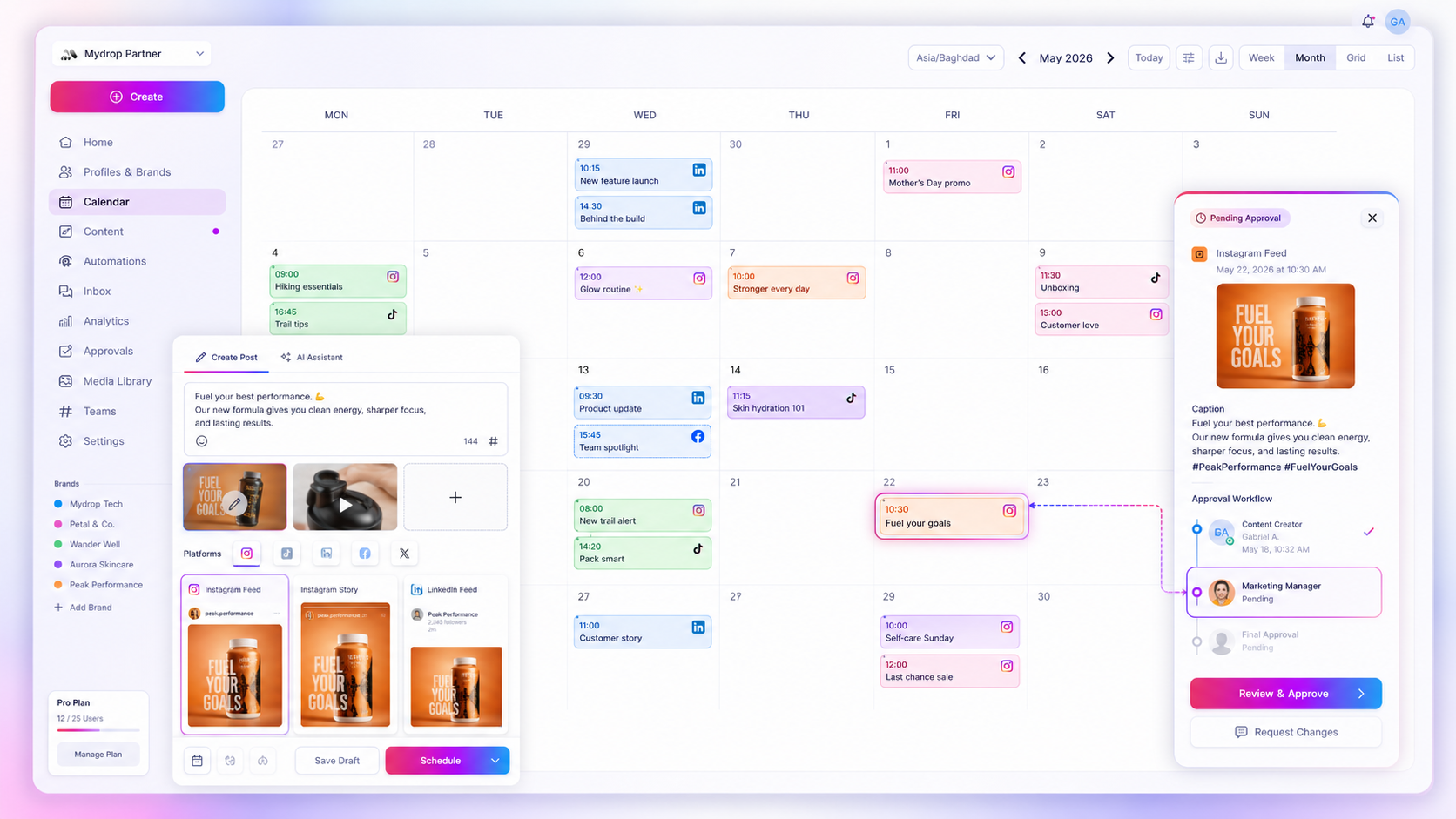
You should adopt selected-profile calendar sync if you manage more than one brand or handle sensitive client-specific tasks; save all-posts sync only for single-brand setups where total transparency is a benefit rather than a risk.
We have all been there. You are deep in the middle of a high-stakes campaign launch, and suddenly your client sends a frantic email: they are seeing a draft for a competitor's post or a string of internal "Reminder: Move to legal" tasks clogging up their shared team calendar. It is the silent trust-killer. You thought you were being transparent by syncing your workspace, but you actually just handed your client a chaotic view of your agency's messy, behind-the-scenes operational grind.
Stop treating your agency's content calendar like a junk drawer. If your stakeholders are seeing every internal draft, unfinished idea, and cross-brand placeholder, you are not being transparent-you are creating noise that erodes professional confidence. The goal of using a calendar-native planning bridge is to keep your partners aligned, not to overwhelm them with the daily sausage-making of your social team.
The decision each metric should trigger

At Mydrop, we have seen this across thousands of brand profiles: the teams that thrive are those that define their visibility boundaries before they ever click "Connect." A simple operating rule helps: If a stakeholder doesn't need to act on a post or task, they shouldn't see it in their daily calendar view.
Use the matrix below to stress-test your current sync mode. If your current setup does not match the needs of your client portfolio, you are likely accruing coordination debt that will eventually cost you a renewal.
| Factor | Choose "All-Posts" Sync | Choose "Selected-Profile" Sync |
|---|---|---|
| Client Portfolio | Single, dedicated brand | Multi-brand or agency-wide |
| Task Volume | Low; mostly high-level dates | High; daily operational tasks/reminders |
| Stakeholder Depth | Direct involvement in editing | Viewing only; approval-only access |
| Security/Privacy | Low (Internal) | High (Client-specific isolation) |
When you support dozens of stakeholders across different markets, "All-Posts" quickly becomes a liability. It forces your clients to filter through content that doesn't concern them, which creates a cognitive tax. They end up ignoring the calendar entirely because it no longer acts as a reliable source of truth.
Most agencies do not have a visibility problem. They have a filtering problem.
If you are currently syncing everything into one place, pause and run a quick audit of your Google Calendar service settings. Are you using forced sync to compensate for stale data? If you find yourself needing to constantly refresh the connection to keep events visible, it is usually a sign that your sync mode is too broad for the volume of data you are trying to push. Narrowing your scope to selected profiles is not just a security move-it is a performance upgrade for your team's sanity.
The scorecard that keeps reporting useful

Stop counting vanity metrics and start auditing your coordination debt. When your calendar sync is misaligned, your reporting becomes a cleanup project rather than a strategic review. We have seen teams waste hours every Monday reconciling "ghost" entries on their client calendars-events that were never published or were moved internally but never updated externally.
If you are using Google Calendar Sync, your reports should be validated against the actual state of your calendar, not just the state of your drafting environment. A clean calendar acts as the final sanity check before you pull data into a formal deck.
Calendar Reporting Integrity Scorecard
Use this simple rubric to determine if your reporting loop is healthy or if you are drowning in operational noise.
| Metric | High Integrity (Healthy) | Low Integrity (Risky) |
|---|---|---|
| Event Link Accuracy | 100% of calendar events link back to a post or task. | Orphaned events; no source context. |
| Sync Latency | Changes reflect in under 5 minutes. | Client reports issues hours after changes. |
| Profile Isolation | Only relevant brand content is visible. | Cross-brand "noise" cluttering the view. |
| Done-State Visibility | Reminder "done" states sync immediately. | Stale, unfinished tasks blocking views. |
Operator rule: If your reporting involves more than 10 minutes of "manual sync verification," you are not reporting; you are performing data entry. Use the
force synctoggle in your Mydrop service settings the moment you suspect the connection has drifted.
What to stop measuring by default
The most common trap we see in enterprise social teams is measuring the sheer volume of calendar entries. It feels productive to see a calendar filled with blocks of color, but that is rarely a signal of quality or performance.
Stop measuring Calendar Density-the total number of events synced-and start measuring Plan-to-Publish Reliability.
This is the percentage of calendar events that actually made it to the platform on time, without last-minute intervention or broken approval loops. When you stop obsessing over filling every time slot and start prioritizing the accuracy of the slots you do fill, your clients stop asking "why is this draft on my calendar?" and start asking "why is this campaign working so well?"
In our experience, teams that ruthlessly curate their synced events-only pushing what is finalized and ready for stakeholder eyes-see a 30% reduction in "Where are we on this?" emails. You are not paid to keep a calendar full; you are paid to keep a strategy on track.
The truth is simple: A sparse, accurate calendar beats a bloated, disorganized one every single time. If a post is still in the "messy middle" of ideation, keep it in Mydrop. Once it has cleared your internal governance, then push it to the shared calendar. Your client will appreciate the focus, and you will stop fighting the calendar for your own team's attention.
How to connect metrics to next actions
The secret to moving past vanity tracking is linking your calendar view to specific operational triggers. If you are syncing content to a client-accessible calendar, that entry should be an action item, not just a decoration.
When a post lands in a shared calendar, it needs a corresponding Status Indicator that signals the work behind it. In Mydrop, we often see teams use the Google Calendar Sync metadata to bridge this gap. If a post is still in a draft or "needs approval" phase, ensure your calendar sync is configured so that it either doesn't push, or pushes with a status prefix-like [DRAFT] Client Name.
If your team is managing hundreds of posts across various brand profiles, stop using the calendar as a status board for everything. Use it for milestones only.
Decision check: If you cannot define the action required the moment a client looks at the calendar event, delete it from the sync. You are creating coordination debt, not visibility.
The review cadence that makes the model stick
Operational habits fail because they are reviewed too late. You need a rhythm that forces a "sync check" before the week gets away from you.
- Monday (10:00 AM): The Hygiene Audit. Spend five minutes in your Mydrop service settings. Verify that your
selected-profilemodes haven't drifted. If a new brand profile was added, make sure it is explicitly included or excluded from your calendar sync. - Wednesday (2:00 PM): The Sync Pulse. Check the
event linklookups for your highest-priority posts. If the calendar event isn't linking back to the source of truth, your team is likely working from stale information. - Friday (4:00 PM): The Wrap-Up. Archive any completed recurring reminders. Leaving "done" tasks cluttering a shared client calendar is the fastest way to lose their attention for the following week.
Consistency here prevents the "Where did this post come from?" emails that inevitably derail your Monday morning.
Conclusion
Effective agency coordination isn't about giving everyone access to everything. It is about architectural boundaries-choosing exactly what shows up in a shared space and why.
If your calendar feels like a junk drawer, you have already lost the battle for focus. Use selected-profile sync to create professional-grade isolation, keep your internal noise inside Mydrop, and reserve your client calendars for what actually moves the needle: verified dates, clear milestones, and actionable tasks.
Take 10 minutes this week to purge the clutter. Your clients will thank you, and your team will finally stop answering questions about drafts that were never meant to be seen.