
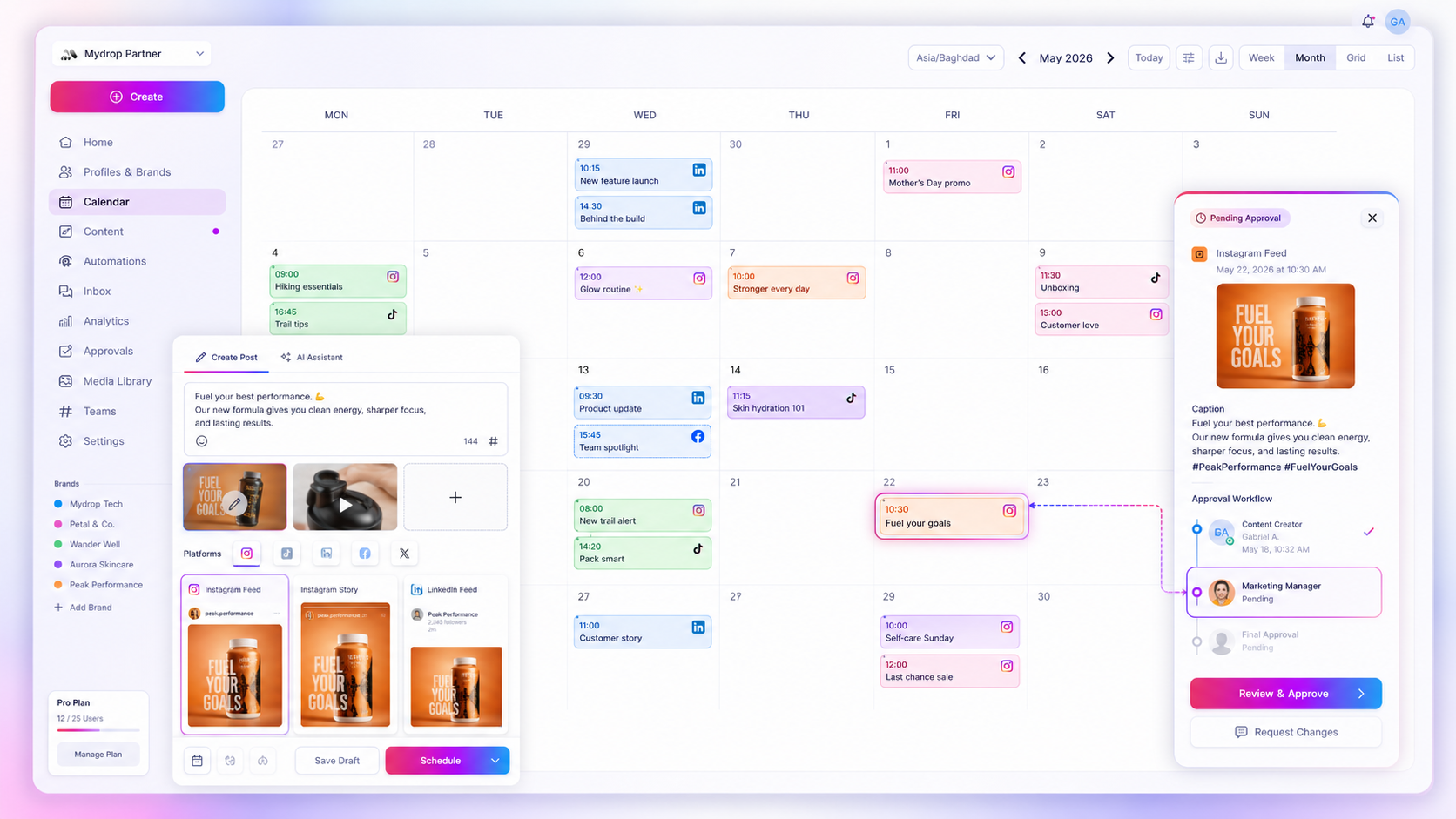
You should sync your social schedule to a shared Google Calendar only for campaigns that carry external dependencies, like sales promotions or cross-departmental product launches. Treat the calendar as a high-trust synchronization layer for stakeholders outside your immediate social team, rather than a place to dump every single tweet or daily engagement post. If you mirror everything, you create a firehose of noise that turns a useful team tool into a distraction, effectively burying the milestones that actually matter.
We have all been there. Your social calendar is a well-oiled machine of creative assets, approval cycles, and carefully timed posts, but the rest of the company sees it as a black box. Meanwhile, your Sales and Support leads are flying blind, asking about post timelines over Slack because they cannot see what is coming. This is not just a software gap; it is a fundamental coordination tax. You end up manually translating your social schedule into business-relevant updates just to keep everyone aligned. It is exhausting, repetitive, and entirely avoidable.
The decision teams usually frame too broadly

Most teams fall into the "All-or-Nothing" trap, treating social-to-calendar integration as a binary choice: either you keep your social plan entirely isolated, or you flood your team calendar with every single content piece you own. Both extremes fail. The former creates an information silo, while the latter inevitably leads to "Calendar Blindness"-where key cross-functional events get lost in the noise of daily community management and routine social updates.
To stop the drain on your time, you need a filter. Before you enable a sync, ask whether the content exists solely for social growth or whether it acts as a signal for another department to take action.
Operator rule: If a stakeholder needs to change their behavior based on the date of a post, it belongs on the shared calendar. If they are just "interested to know," keep it in the social tool.
Consider this impact-based rubric to decide what makes the cut:
| Content Category | Calendar Sync Eligibility | Reasoning |
|---|---|---|
| Major Product Launch | Always | Sales and Support need visibility to prepare for inbound volume. |
| Crisis/Corporate Update | High Priority | Executive visibility is required for rapid alignment. |
| Recurring Promo/Sale | Situational | Sync only if marketing alignment is needed for ad-spend or email timing. |
| Daily Community/Engagement | Never | Creates high noise-to-signal ratio; adds zero cross-team value. |
When you manage hundreds of brand profiles across different markets, this distinction becomes the difference between a team that trusts your data and a team that mutes your notifications. You are not building a map of every single social action; you are building a shared operational schedule for the business. Use the synchronization tools you have to selectively broadcast milestones, keeping the granular creative execution separate from the high-level business pulse.
What should stay manual and what can move faster

You do not need to fight for every inch of calendar space. In fact, the most effective teams we see treat the shared calendar as a premium communication layer, not a dumping ground for every scheduled post. When you try to mirror your entire social output into a shared team view, you inevitably trigger "Calendar Blindness." Within a week, the noise of daily community engagement buries the critical milestones that other departments actually need to track.
The goal here is high-trust visibility, which means curation is your best friend.
Manual coordination should remain the home for daily community interactions, low-stakes social listening, and reactive content that shifts by the hour. Trying to sync these into a shared Google Calendar creates endless churn; the moment you update a timestamp in your social tool, you are just firing unnecessary notifications to stakeholders who do not need that level of detail.
Automated sync is for strategic campaigns that create ripple effects across the business. If a post involves a landing page launch, a sales promo, or a public response to a crisis, it belongs on the team calendar. At Mydrop, we often see teams use selected-profiles sync for this exact reason. They pipe only their primary brand channels into the shared view while keeping high-volume, regional, or support-focused channels local. It keeps the core team informed without turning their daily planning view into a firehose.
The tradeoff matrix
Deciding what to sync is a classic exercise in balancing visibility against noise. Use this framework to audit your current workflow before you hit enable on any calendar integration.
| Content Type | Cross-Dept Impact | Sync Requirement | Operational Logic |
|---|---|---|---|
| Product Launches | High | Required | Ensures Sales and Support are prepped for volume. |
| Crisis Responses | High | Required | Provides immediate situational awareness for Legal/PR. |
| Brand Milestones | Medium | Optional | Sync only if cross-department visibility helps engagement. |
| Evergreen/Community | Low | Avoid | Adds unnecessary clutter; keep in social tool. |
| Retail Promos | High | Required | Keeps regional managers aligned on timing. |
Decision check: If a post failing to publish would trigger an "urgent" Slack message to someone in another department, it should be on the shared calendar. If the only people who care about the delay are on your marketing team, keep it local.
This isn't about control; it's about reducing the coordination tax your team pays every single morning. When you reserve the calendar for high-impact events, you train your stakeholders to treat those entries as actionable signals rather than white noise.
Most teams do not actually have a content problem. They have a decision bottleneck caused by poor information flow. By narrowing the scope of your calendar sync, you reclaim the team's attention for the work that actually moves the needle. Once you have cleared out the clutter, those few entries that remain become the heartbeat of your collaborative planning, allowing the rest of the team to see the big picture without needing a deep dive into your social dashboard.
How to pilot the workflow safely
You do not need to flip a giant switch to start syncing your calendars. In fact, if you just hit "enable all" and walk away, you will likely spend the next three days apologizing to your colleagues for the sudden influx of calendar clutter.
Start with a low-stakes pilot that respects your team's existing habits. Use these four steps to test the waters:
- Select the target: Choose one high-impact campaign or one regional brand profile. Avoid the "everything everywhere" approach.
- Apply profile filtering: Use the
selected-profilesync mode in Mydrop settings. This lets you isolate the calendar activity to just the channels your stakeholders actually track. - Set the cadence: Run the sync for one week. Check in with your peers in Sales or Support. Ask them: "Did this help you see what's coming, or did it just clutter your view?"
- Audit the metadata: Review a few synced events to ensure the titles and descriptions contain the info stakeholders need, like project codes or internal campaign names.
Workflow check: If your team has to open the calendar event just to see what the post is actually about, your sync metadata is failing. Use the event description field to push relevant internal notes from your planning tool directly into the calendar.
The operating rule to keep
Consistency is the only thing that separates a useful tool from a digital nuisance. Once you decide which campaigns belong on the shared calendar, you must treat those calendar events as the "source of truth" for status.
If a date changes in your master plan, it must change in the calendar sync. If you allow the two systems to drift, you recreate the very coordination debt you tried to fix. When your team stops trusting that the calendar matches reality, they will revert to their old habit of pinging you for status updates, and your calendar integration will become nothing more than expensive background noise.
| Sync Strategy | When to use | Primary Benefit |
|---|---|---|
| All-posts | Small teams, single brand | Total visibility |
| Selected-profiles | Multi-brand, agencies | Signal-to-noise control |
| Reminder-only | High-compliance, heavy approval | Operational guardrails |
Conclusion
At the end of the day, your calendar is not just a place to track time; it is a signal of what your team considers important. When you push social campaigns into that shared space, you are telling the rest of the business that these posts are part of the broader team strategy.
That is powerful when used selectively. It creates alignment without a single status meeting. But it becomes a liability when you lose the filter. Keep your shared calendar for the work that truly moves the needle for your wider organization, and leave the daily social pulse in your dedicated management tools.
Stop trying to force every piece of content into everyone's view. Instead, focus on building a transparent, high-trust calendar that lets your stakeholders see the milestones that actually impact their world. Your team will appreciate the clarity, and you will finally be able to stop playing "calendar negotiator" during every major launch.