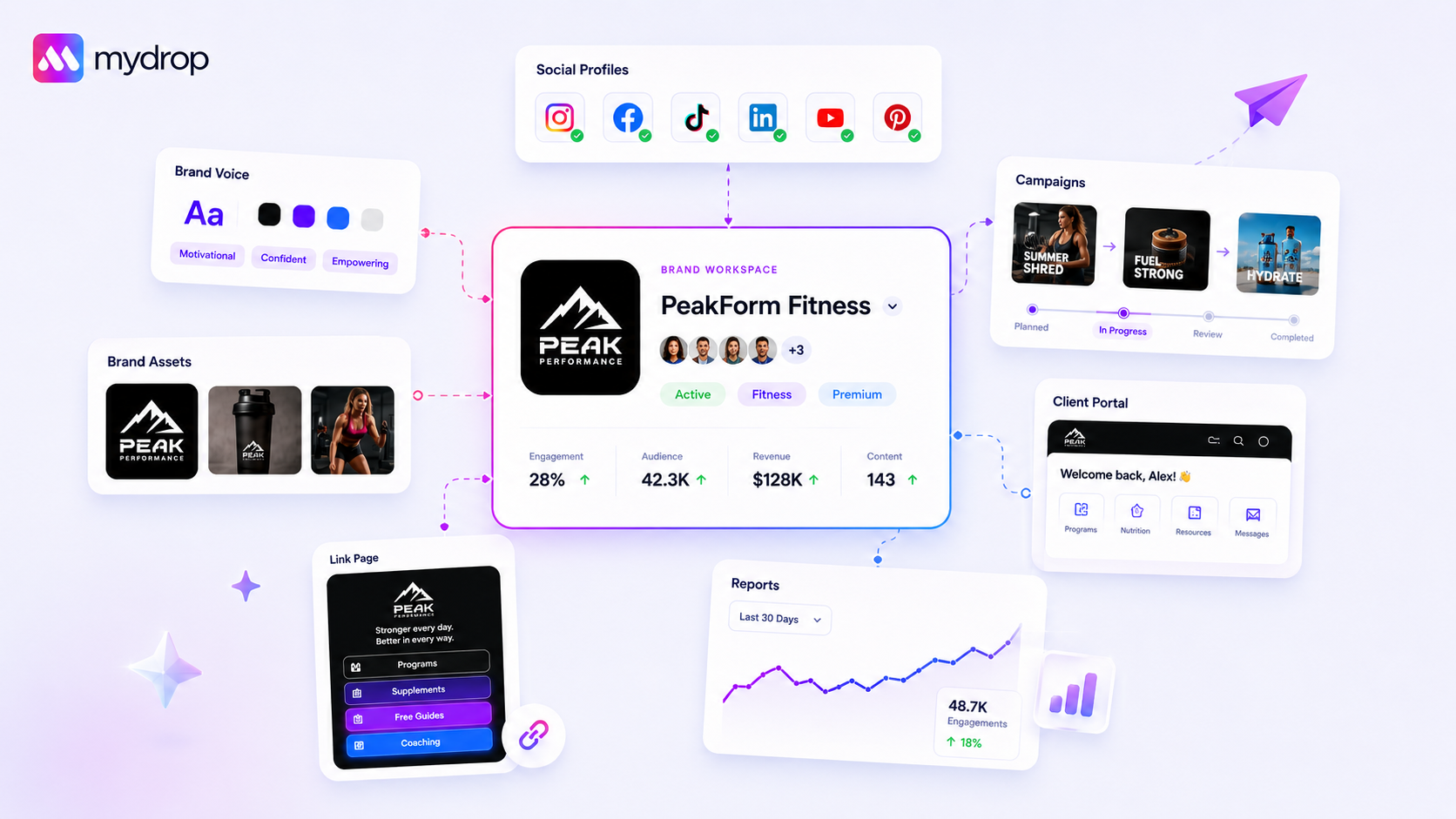
If you are still asking clients to email you their social account passwords, you are effectively trading your agency’s security posture for a few minutes of onboarding convenience. You should stop treating password sharing as a necessary evil; instead, move to secure, client-led OAuth portals. This shift replaces the manual, insecure handoff with a clean, platform-native authorization path that eliminates credential risk while actually speeding up your time-to-first-post.
We get it. Onboarding a new client is a race against time, and when a stakeholder just wants to "get started," manual workarounds feel like a helpful shortcut. But that initial friction is exactly where coordination debt takes root. When your team starts collecting passwords, you are not just building a technical liability; you are creating a permanent bottleneck that requires manual credential updates, password rotations, and constant internal re-authentication every time a platform security token expires.
The decision teams usually frame too broadly

The mistake most teams make is viewing social connection as a one-time "set it and forget it" technical task. In reality, connection is an ongoing operational lifecycle. Teams often oscillate between two extremes: either they insist on manual access to "own" the setup, or they throw the process over the wall to the client without providing clear guardrails. Both approaches usually fail the moment an account password gets updated or a secondary profile needs verification.
Instead of asking who should do the clicking, ask where the authorization boundary belongs. When you use secure portal-based connections, you aren't just offloading a chore; you are establishing a professional boundary. The client uses their own native social login to grant granular access-allowing your team to manage publishing, inbox, and analytics without ever touching their private credentials.
Operator rule: If you find yourself manually logging into a client’s social account to "fix" an expired token, you have already lost the operational battle. Secure, client-led OAuth is not just a feature-it is your primary defense against security compliance risks.
At Mydrop, we see teams managing hundreds of brand profiles across dozens of markets. The ones that scale effectively are those that default to a Connection Autonomy Matrix. By categorizing clients based on their internal technical maturity, you can distinguish between "low-touch" clients who are ready to self-serve through a portal and "high-touch" accounts that require a guided, team-assisted setup.
| Client Type | Connection Method | Primary Advantage |
|---|---|---|
| Enterprise / Multi-brand | Client-led OAuth Portal | Eliminates credential security risk entirely. |
| Boutique / High-Touch | Assisted Setup (Screen Share) | Balances high-quality support with security. |
| "Fire and Forget" | Agency-Led (Temporary) | High speed, but demands immediate rotation. |
The goal is to stop treating password management as a core agency competency. Your value lies in strategy and execution, not in managing a spreadsheet of passwords that has inevitably become a security crime scene.
What should stay manual and what can move faster

The golden rule here is simple: if you are touching a client's password, you have already lost the security battle. However, that does not mean every connection must be delegated. Some clients-like a local boutique owner or a busy executive-find platform interfaces genuinely intimidating. In those cases, the overhead of teaching them how to navigate a secure portal might cost you more in support time than the risk of a quick, supervised connection.
For your core enterprise clients, however, manual setup is a major operational bottleneck. Every time your team manually logs in to a client's X, LinkedIn, or Instagram account, you create a point of failure. You also risk triggering security alerts on the social platform that can lock you both out during a campaign launch.
Moving to a client-led workflow via a secure portal isn't just about security; it's about setting boundaries. You are handing them the keys to their own kingdom while ensuring your team retains the ability to publish and report without ever seeing their private credentials.
The tradeoff matrix
To decide which path to take, map your client against two variables: Account Complexity (how many moving parts and sub-brands they have) and Technical Literacy (their comfort level with standard web authentication).
| Client Profile | Connection Method | Primary Driver |
|---|---|---|
| High complexity, high literacy | Client-Led Portal | Security and governance |
| Low complexity, high literacy | Client-Led Portal | Operational speed |
| High complexity, low literacy | Hybrid Guided | High-touch white-glove setup |
| Low complexity, low literacy | Assisted Manual | Removing friction for the client |
When you use a platform like Mydrop, your Portal Profile Connection handles the heavy lifting by leveraging OAuth. Your client clicks a link, authorizes their accounts in a native environment, and the system handles the token exchange in the background. Your team just reviews the imported profiles. This ensures that you aren't storing sensitive strings, and the client never has to send their password through an insecure chat or email.
Decision check: Default to the portal for every new onboarding. Only move to manual setup if the client explicitly fails the authentication flow twice or requires a high-touch, concierge onboarding service.
The goal is to move your team away from being the "connection support desk." When a client connects their own profiles, they take ownership of the authorization. This means when a token expires or a platform updates its permissions, the notification goes directly to the person who holds the keys-not to your team to hunt down the client for updated credentials. It clears up your pipeline and keeps the technical debt exactly where it belongs: with the account owner.
How to pilot the workflow safely
You do not have to rip the bandage off all at once. If you are worried about overwhelming a client who is already struggling with their own dashboard, start with a "soft migration" approach. Choose one low-stakes channel first-maybe their secondary Instagram account or an underutilized LinkedIn page-and run it through the portal flow instead of asking for credentials.
When you walk them through it, frame it as a security best practice for their benefit, not just a technical requirement for yours. "We are moving our account management to a secure portal so that neither of us ever has to share login credentials via email," is a message that usually lands well with security-conscious stakeholders.
Here is the quick sequence to move a client from manual dependency to autonomous portal connection:
- The Audit: Identify which of your current manually-managed accounts have the most stable connection health and the least complex multi-user permission requirements.
- The Portal Prep: Enable the brand portal permissions in your Mydrop settings to ensure the client has the right access level before they even click the link.
- The Soft Handshake: Send the portal invite. When they land on the Connect profile screen, stay on the call or chat to guide them through the OAuth consent flow.
- The Validation: Once they authorize, use the Pending Profile Connection preview to confirm the system imported the correct pages.
- The Clean-up: Once the new, token-based connection is verified, you can safely remove the old, manually-managed credential from your list.
This approach lets you test the workflow and gives the client a chance to get comfortable with the interface without the pressure of a full-scale migration on day one.
The operating rule to keep
If there is one thing we have learned from supporting teams managing hundreds of brand profiles, it is that accessibility is not the same as security. Just because a client can share a password does not mean you should let them.
Workflow check: Default to client-led portal connections for every new onboarding. Use manual setup only as a high-touch, documented exception for legacy accounts where the client is technically unable to navigate an OAuth screen.
When you make portal-first the standard, you stop being a password wrangler and start being a partner. Your goal is to own the strategy and the execution, not the login credentials. By pushing the authorization responsibility back to the client via secure OAuth channels, you effectively offload the security risk and keep your team focused on the work that actually moves the needle.
Conclusion
The transition from manual account management to secure, portal-based connections is rarely about the technology itself. OAuth flows are robust, stable, and widely understood. The real challenge is internal: it is about shifting your agency culture to stop accepting "quick and dirty" as a viable long-term operating habit.
If you are still managing spreadsheets full of client passwords, you are carrying around a dormant security fire that could ignite at any moment. Move the account connection process out of the email thread and into a secure, persistent interface. Your clients will appreciate the professional boundary, your security team will sleep better, and your own staff will finally stop wasting hours chasing down expired logins every time a platform updates its authentication requirements. Stop the manual churn today, and start building a connection model that can actually scale.