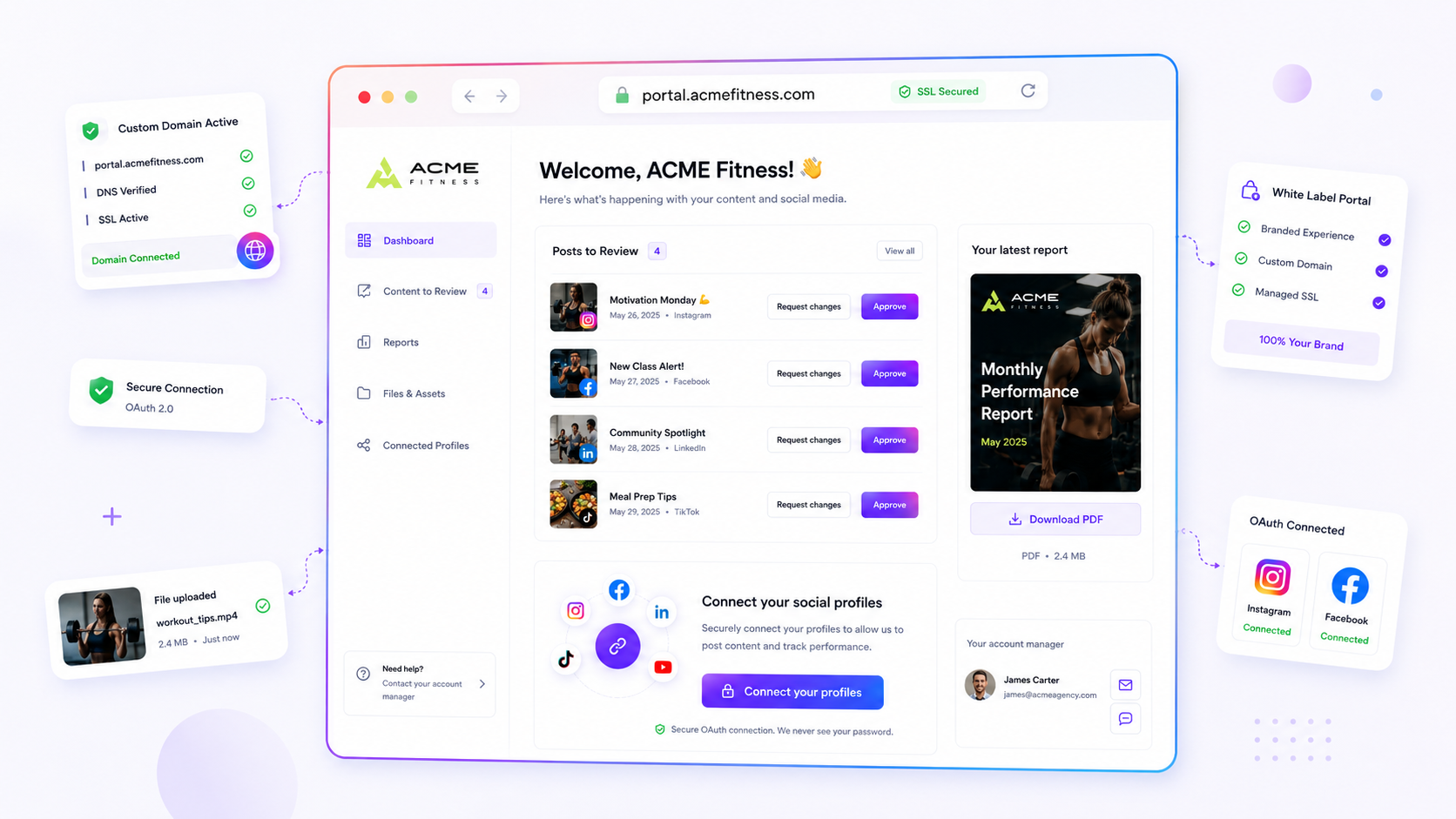
Stop manually emailing status updates and static reports the moment your client asks "What is the status?" more than twice per project phase. If your inbox is the bottleneck for file approvals or report delivery, you aren't providing white-glove service; you are providing a manual relay service that drains your team's most valuable hours and limits your agency's ability to scale.
We have all lived through that Friday afternoon scramble: the frantic search for the latest version of a brand asset, or the repetitive task of exporting PDFs for a client who needs them now. You are working hard, but your best energy is being swallowed by administrative busywork rather than strategy. Shifting to a self-service model isn't just about automation-it is about reclaiming your role as a partner rather than an inbox administrator.
When you treat manual reporting as a premium feature, you are actually building a hidden barrier to your own profitability and sanity. Most teams do not have a content production problem; they have a decision bottleneck.
The decision each metric should trigger

You should not move a client into a portal based on a calendar date or a project milestone. Instead, transition them when your team's "coordination debt"-the time spent manually relaying status updates, chasing file approvals, and formatting report links-consistently exceeds 15% of your total account management hours.
To help you diagnose this, use this 5-point scorecard to objectively measure if you are carrying too much manual weight. Score each item on a scale of 1 to 5, where 1 is "never happens" and 5 is "a daily source of pain."
| Metric | Scoring (1-5) | The Trigger for Action |
|---|---|---|
| Reporting Latency | If > 3, you are reactive, not proactive. | |
| File Version Chaos | If > 3, you are risking brand compliance. | |
| Approval Friction | If > 4, your creative pipeline is stalled. | |
| Auth-Fatigue | If > 3, you are burning time on IT support. | |
| Context Switching | If > 3, you are losing billable strategy time. |
If your total score is 18 or higher, you are losing money on manual coordination.
At Mydrop, we see teams use the Brand Portal to immediately offload this debt. By enabling specific permissions-like giving clients a secure space to download approved PDFs or review upcoming posts without needing a full account-you turn that "relay service" into a transparent dashboard.
The rule is simple: if the client needs to see it, they should be able to find it, download it, or approve it themselves. Anything else is just administrative friction disguised as service.
The scorecard that keeps reporting useful

You need a hard line between "valuable consultation" and "automated delivery." If you are spending your Monday mornings manually pulling CSVs and pasting charts into slides, you are not acting as a consultant; you are acting as a file server. Clients are rarely paying for the delivery of the data. They are paying for the insight-the "so what?"-hidden inside those numbers.
When you transition to a self-service model, you aren't removing yourself from the process. You are moving yourself up the value chain from "clerk" to "strategic advisor."
Use this 5-point readiness assessment to see if you have crossed the threshold where manual overhead is actively killing your profit margins.
| Metric | 1-2 (Manual is fine) | 3-4 (Approaching limit) | 5 (Immediate danger) |
|---|---|---|---|
| Reporting Latency | Client waits for your schedule. | Client asks occasionally. | Client asks before you send. |
| File Versioning | One master folder, no clutter. | Occasional email search. | "Final_v3_final" in threads. |
| Approval Friction | Quick Slack thumbs-up. | Back-and-forth edits. | Stuck in inbox for days. |
| Auth Overhead | Managed via standard tools. | Managing guest access often. | Exchanging passwords regularly. |
| Context Switching | Minimal status inquiries. | Daily emails about updates. | >60 mins/day on status mail. |
The Decision Rule: If your total score exceeds 18, stop negotiating for "high-touch" exceptions and move the client into a dedicated space. Every point above 18 represents an hour of your team’s week that is being flushed down the drain of administrative busywork.
What to stop measuring by default
The most common trap we see in agency life is the belief that "transparency" requires total, raw data exposure. It does not. In fact, dumping your entire internal workspace into a client’s lap usually results in more questions, not fewer.
When setting up a Mydrop Brand Portal, your goal is to curate exactly what provides clarity. You are managing their mental load, not just their files.
Stop defaulting to these "transparency" habits:
- The "everything folder" approach: Do not share your raw internal production folders. Only expose the final, approved asset library. If they need to see the draft, let them comment in the specific post review space rather than browsing your working files.
- The "real-time everything" feed: Clients do not need to see your internal campaign experiments or late-night brainstorm drafts. Only share what is ready for public view or client feedback.
- The manual "link-in-bio" shuffle: Stop emailing updated URLs every time a campaign launches. Configure the portal to expose live links so the client can find their own traffic drivers whenever they need them.
Operator rule: If a client asks for a file, you have failed to use the portal effectively. If a client asks for context about a file, you are doing your job.
The shift to a portal isn't about hiding work; it is about providing a sanitized source of truth. When you enable analytics viewing or PDF downloads directly in the Mydrop portal, you are giving the client the autonomy to answer their own questions at 9 PM on a Tuesday. That isn't just "tech"-that is buying back your team's sanity.
How to connect metrics to next actions
Once you have your scorecard result, stop treating every client the same. If you are scoring in the danger zone, the fix is not to hire more account managers to handle the email volume. That just buries the problem in more headcount. Instead, map your score directly to a workflow change.
- 10-15 Points: You have a sustainable manual flow. Stick to your current process but audit your file management every quarter.
- 16-20 Points: You are at the tipping point. Transition to a shared folder or a light client-facing dashboard to centralize assets.
- 21+ Points: You are bleeding operational profit. This is the moment to deploy a dedicated self-service portal and stop the email relay service entirely.
When you cross that 21-point threshold, you stop being a conduit and start being a platform. At Mydrop, we see teams struggle because they fear that removing themselves from the daily "relay" will make them seem less valuable. The reality is the opposite: when you stop acting as a human file-transfer protocol, you finally have the bandwidth to act as a strategic advisor.
The review cadence that makes the model stick
Transitioning to a portal fails if you don't adjust the client's expectations on where to look. You cannot simply hand over a link and expect them to stop emailing you. You must re-train them with a consistent cadence.
| Stage | Activity | Portal Role |
|---|---|---|
| Monday | Weekly sync | Review portal analytics & latest campaign status. |
| Wednesday | Approval wave | Client flags posts/edits directly in the portal space. |
| Friday | Report delivery | Client downloads final PDF report from the portal. |
Decision check: Never send a report link via email once a client has portal access. If they ask for it via chat or email, reply with the portal link and a polite note: "All updated assets and reports are live in your portal dashboard."
Consistency is your best friend here. If you break the habit and email a file once, you effectively reset their learning curve.
Conclusion
The transition to a self-service model is less about the technology and more about the boundaries you set for your own team's sanity. Your goal is to move from a "manual relay" service to an "operational partner."
If you are currently managing dozens of stakeholders or trying to keep a multi-brand strategy on rails, the manual inbox approach is the single biggest threat to your profitability. By moving clients into a configured Mydrop Brand Portal, you aren't just saving time on file versioning or report exports. You are giving your clients a single, secure source of truth where they can contribute their own approvals and profile connections without ever needing to ask "What is the status?" again.
Stop chasing the inbox. Start scaling the service.