
The most sophisticated social team is the one that knows exactly when to override its own automation. When a campaign’s launch depends on real-time cultural relevance, sensitive audience sentiment, or a high-pressure cross-platform integration, the best workflow isn't "hands-off"-it is a controlled, human-verified "publish now."
We get it. You have spent weeks perfecting the assets, coordinating influencers, and lining up the brand strategy. The idea of letting a bot handle the final execution is efficient, but for those make-or-break moments, a "scheduled" status can feel like a blindfold. That lingering anxiety isn't just paranoia; it is professional intuition telling you that your brand is currently out of your hands.
This guide provides a practical decision framework to help you distinguish between routine content that thrives on automation and high-stakes launches that demand human presence.
The decision teams usually frame too broadly

Most organizations treat the choice between manual and scheduled publishing as an all-or-nothing policy. They either mandate a "no touch" rule for every tweet to ensure efficiency, or they force every single asset through a manual gate, which crushes velocity and burns out the social team. The real problem isn't the tools-it is coordination debt. Teams often default to scheduling everything because the effort to organize a manual launch feels too high, even when the risk profile demands it.
Operator rule: If a post’s failure impact or technical nuance exceeds your team’s current risk appetite, it belongs in the manual bucket, regardless of how "advanced" your scheduling software is.
At Mydrop, we see this across hundreds of brands. Teams often rely on automated queues for evergreen content to keep profiles active, but when a new product drops or a PR-sensitive window opens, they pivot to our "publish now" trigger. This isn't a failure of the platform’s scheduler; it is the correct application of human oversight to a high-pressure moment.
You need to stop asking "Can we automate this?" and start asking "Does this post need a human at the wheel?" If the answer is yes, you are not failing at efficiency-you are succeeding at governance.
What should stay manual and what can move faster

Most teams default to automation because the sheer volume of content feels like an existential threat. But the truth is, not everything needs the efficiency of a scheduled job. When you treat a high-stakes, brand-sensitive announcement with the same "set-and-forget" mentality as an evergreen repost, you are essentially gambling with your reputation.
We have seen this across dozens of agencies: the moment a team stops auditing their own workflow, they start treating their social channels as a fire-and-forget conduit rather than a living, breathing connection to their audience.
Automation is for consistency; manual publishing is for presence.
If you are managing a crisis, a sensitive brand repositioning, or a cross-platform drop that involves influencers, a manual trigger is often your only safety net. Why? Because the moment you hit "publish now," you are confirming that the final asset, the local time, and the global mood are all aligned. You are not just pushing content; you are actively officiating the launch.
Decision check: If a post would require an emergency "delete and apologize" action within 15 minutes of going live, it should be a manual publication.
The tradeoff matrix
To make this decision easier for your team, we use a simple scoring framework. When your campaign complexity shifts toward the right, you need to pull that specific item back from your automated calendar and into a live, human-moderated session.
| Factor | Automated Scheduling | Manual Publishing |
|---|---|---|
| Brand Risk Profile | Low (Evergreen, generic tips) | Critical (Crisis, high-stakes launch) |
| Engagement Velocity | Moderate (Steady state) | High (Requires active, live monitoring) |
| Asset Complexity | Standard (Static images, standard video) | Heavy (Multi-part, interactive, live-linked) |
| Market Sensitivity | Low (Stable, long-term trends) | High (Real-time events, cultural shifts) |
| Team Capacity | Low (No one needs to be online) | High (Requires active, live presence) |
If you find that your project scores high in three or more of these manual-leaning categories, do not force it into your automated queue.
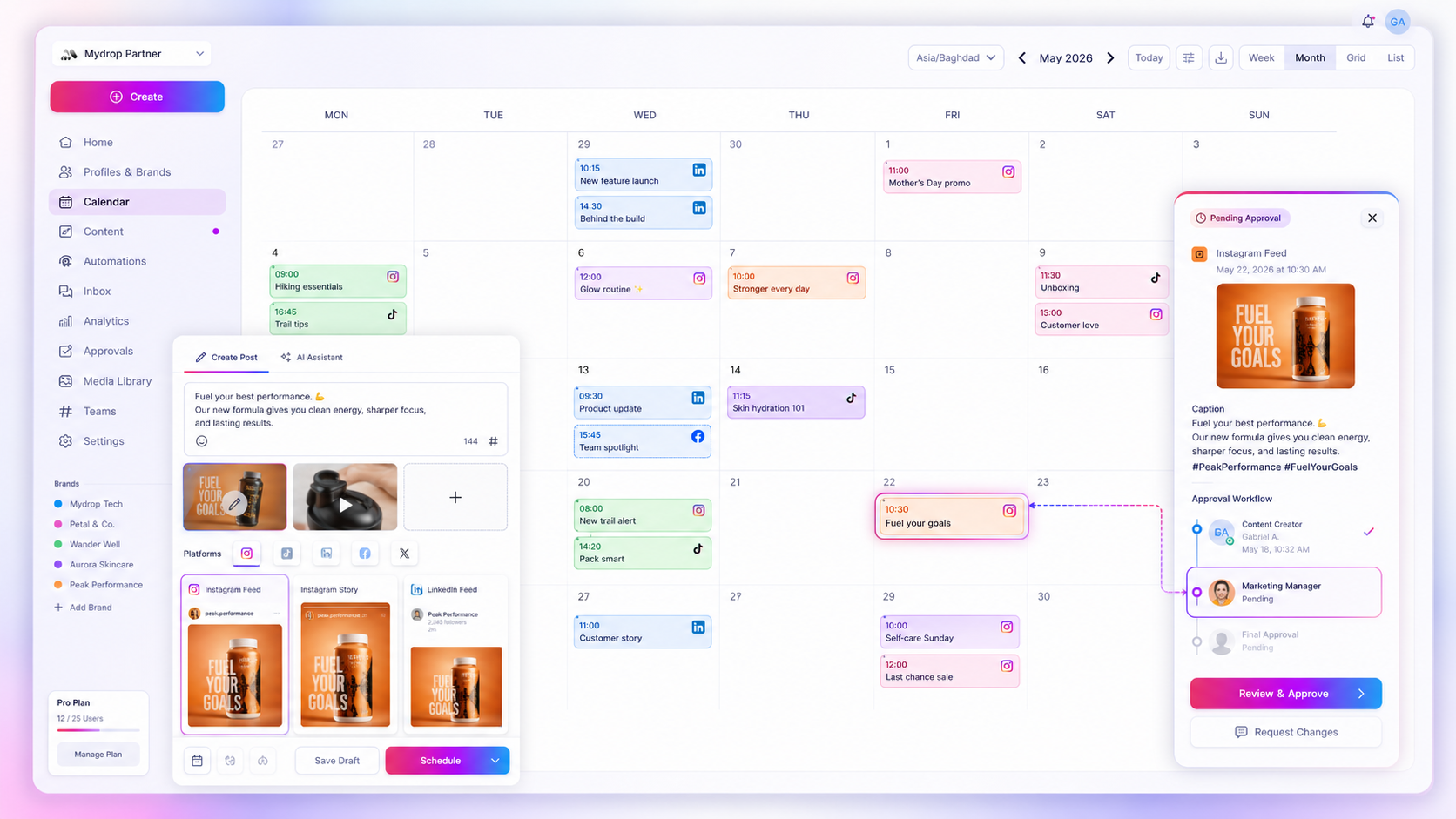
At Mydrop, we often see teams try to jam every single asset into the Calendar view because it makes their dashboard look tidy. But if your Q4 launch strategy involves complex, multi-platform assets that need immediate feedback, use the publish now trigger.
It is the difference between hoping your content lands well and ensuring that your team is ready to respond the moment it touches the platform. Automation is a tool for your day-to-day work, but manual control is what keeps your brand from becoming a headline for the wrong reasons.
How to pilot the workflow safely
Moving to a manual gate doesn't mean reverting to chaos. The goal is to move the final human sign-off from "sometime before the weekend" to the literal minute of distribution. For your high-stakes launches, treat the manual trigger as a surgical procedure rather than just clicking a button.
To keep this from becoming an administrative anchor, run a five-minute pre-publish huddle. This is not for copy edits; if you are still debating the copy five minutes before the post goes live, you have already lost the moment. This huddle is strictly for context and technical verification.
- Verify the landscape: Does the current news cycle conflict with our scheduled tone?
- Check the assets: Are we looking at the final, color-corrected file or a draft?
- Audit the links: Do all URLs point to the correct regional landing page?
- Confirm permissions: Are the right team members ready to jump into the comments the moment it drops?
When you use Mydrop for this, your scheduled post sits in a "ready" state, waiting for the human trigger. It moves from being an automated job to an active, controlled event under your direct oversight.
The operating rule to keep
We have seen hundreds of teams lose hours to panicked last-minute deletions. They schedule content across a dozen markets, only for a local event to make a planned campaign look tone-deaf globally. The most resilient teams manage this by separating their operational flow into two tracks.
Workflow check: Use the automated engine for your baseline volume and evergreen content, but move any campaign involving sensitive stakeholder approval or high-frequency engagement to a human-gate workflow.
This isn't about distrusting your software. It is about acknowledging that while your tools can handle the logistics, they cannot read the room. Automation is excellent at precision timing, but it is terrible at context. If you find your team is constantly overriding scheduled posts or rushing to delete them because the world shifted, that is a signal to pull those posts out of the automated lane and into a manual-trigger process.
Conclusion
The shift from "everything is scheduled" to a hybrid model isn't a regression; it is a maturity milestone. It signals that your team is no longer just chasing output, but protecting your brand’s reputation in real time.
Start by auditing your calendar. Identify the three posts next week that would cause the most friction if they went live during a crisis. Those are your candidates for a manual gate. By moving those to a human-led publish, you reclaim the control that automation often obscures, ensuring your team is driving the narrative rather than just watching it unfold on a screen. True efficiency is not doing more things with fewer people; it is being present when it matters most.