You should automate your recurring analytics reports the moment you spend more time formatting spreadsheets than interpreting them. If your Friday afternoon is dedicated to copying rows from a dashboard into a PDF template just to hit a "sent" button, you have effectively turned your high-value consulting team into a manual data pipeline. The fix is not to work faster, but to stop performing the data entry yourself.
We get it. You are worried that if the report arrives via an automated system, the client will perceive the value as lower. But the opposite is often true. A report that hits an inbox at 8:00 AM every Monday is a sign of a professional operation; a report that arrives at 4:30 PM on Friday because you were busy putting out fires is a sign of a bottleneck. When you automate the delivery, you aren't removing the human element-you are buying yourself the time to actually read the data before the client does.
The decision teams usually frame too broadly

Most agencies treat the choice between manual and automated reporting as an all-or-nothing proposition. They either stick to the soul-crushing manual grind or jump to a rigid, "set it and forget it" automation that leaves no room for nuance. The reality is that your reporting strategy should be tiered. You do not need to give every brand the same high-touch treatment, and you certainly should not be wasting hours on "data sync" tasks that a machine can handle reliably.
The real challenge is identifying the crossover point where the cost of human labor outweighs the value of custom formatting.
| Revenue Tier | Reporting Complexity | Recommended Path |
|---|---|---|
| High (Key Accounts) | High | Hybrid (Automated data + Manual expert analysis) |
| Mid (Growth Accounts) | Medium | Automated (Scheduled report + Highlight summary) |
| Low (Volume Accounts) | Low | Automated (Standard scheduled dashboard/PDF) |
At Mydrop, we see this pattern constantly. When teams manage hundreds of brand profiles across different markets, the bottleneck is almost never a lack of insight-it is the coordination debt accumulated by trying to keep every single client update manual.
The smartest teams use a simple rule: Automate the delivery, never the interpretation. If your report is purely a list of vanity metrics, automate it completely. If it requires a strategic narrative, use automation to send the data ahead of your scheduled check-in call. That way, when you do get on the phone, you are discussing the "why" behind the performance rather than wasting the first ten minutes explaining what the numbers actually are.
What should stay manual and what can move faster

The golden rule here is simple: Automate the data sync, keep the insight human. If your client just needs to see the numbers to know the campaign is alive, a machine does that better and faster than you. But the moment a report requires a narrative-like explaining why a specific engagement spike happened or how a competitor shift affects their strategy-that is where your expertise earns its keep.
Think of it this way: your client isn't paying you for a collection of charts that they could pull themselves. They pay for your judgment. If you spend your Friday manually updating a dashboard for a client who only checks it for a thumbs-up, you aren't doing consulting; you are just a high-priced file clerk.
Keep it manual when:
- The client expects a narrative: If your contact at the enterprise brand is presenting these numbers to their C-suite, they need your commentary, not just raw data.
- The context is volatile: During a crisis, a launch, or a major brand pivot, your human interpretation of the trends is the actual deliverable.
- The metrics are experimental: If you are testing a new hypothesis, the data might need a specific, non-standard layout that isn't worth building into a template yet.
Move it to automation when:
- The stakeholder just wants to monitor health: For regular check-ins or status updates where the client needs to see consistent performance metrics against targets.
- You have multiple stakeholders for one account: If you are emailing the same report to five different people, you have a delivery bottleneck, not a reporting problem.
- Consistency is the primary value: When the client relies on comparing week-over-week or month-over-month performance, an automated, standardized report ensures the data is always calculated the same way.
Operator rule: If you find yourself saying "nothing changed, I just copied the numbers over" to explain a report, you should have automated that task months ago.
The tradeoff matrix
It is tempting to think of automation as an all-or-nothing switch. In reality, it is a dial. You can set up a consistent, automated heartbeat of reporting for almost every client, then layer your human analysis on top only when the situation demands it.
To help your team decide which route to take for each account, we use a simple matrix. It balances the complexity of your client's needs against the revenue they bring to your agency.
| Client Revenue Tier | Reporting Complexity | Primary Workflow | Recommended Approach |
|---|---|---|---|
| High (Top 10%) | High | Strategy + Analysis | Manual (Use tools to prep data, then add custom commentary) |
| Mid | High | Performance Monitoring | Hybrid (Automated template + custom summary note) |
| Mid | Low | Data Hygiene/Sync | Automated (Scheduled PDF/link delivery) |
| Low/Growth | Low | Check-ins | Automated (Standardized recurring reports) |
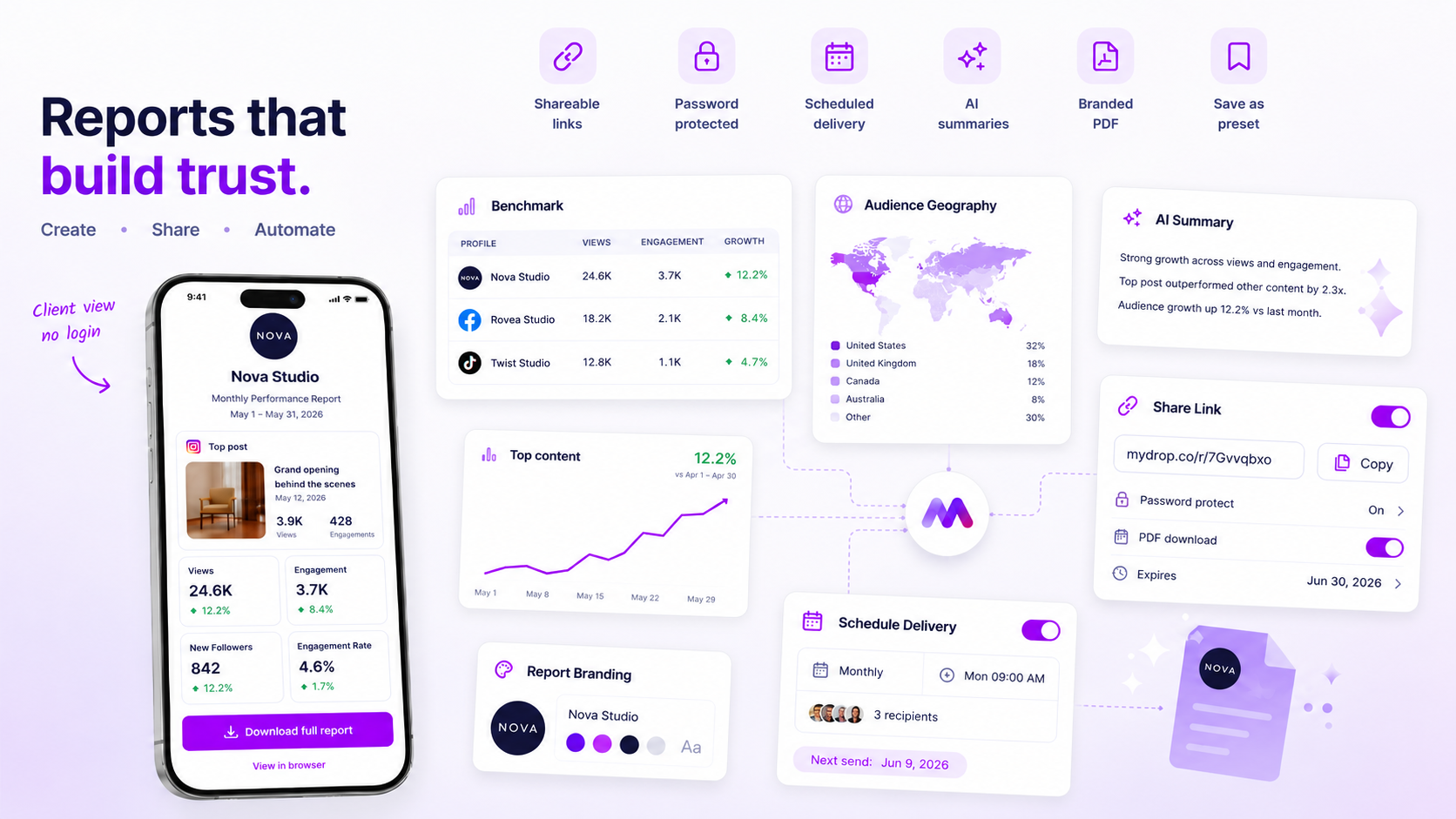
When you look at this, the goal for most agencies should be moving the "Mid-tier/Low-complexity" accounts into a fully automated pipeline. Using a tool like Mydrop allows you to set up these recurring schedules once. You define the cadence, the recipient list, and the format-like a clean, branded PDF or a live link-and then get your Friday afternoons back.
The real magic is that the client gets their data consistently, on time, every single week, without your team ever having to touch a spreadsheet. It turns a reactive, "did I remember to send that?" chore into a professional, predictable operating habit. You aren't just saving time; you are building a reliable, scalable foundation for your agency's client communication.
How to pilot the workflow safely
You do not need to flip a giant switch to start automating. In fact, doing so is a great way to trigger a minor panic when a report looks slightly off to a stakeholder. Instead, use a parallel approach. Pick one low-stakes client or a single internal brand profile and run the automation alongside your manual process for two weeks.
Before you make any schedule permanent, use Mydrop to test the output. The Run Now control in the Analytics Schedule modal is your best friend here. It lets you trigger a full report run immediately, sending it directly to your own inbox. Check the formatting, ensure the branding looks sharp, and verify that the data matches your expectations. If something feels off, you can adjust the report configuration and re-run it in seconds.
Here is a simple flight check for your first automated run:
- Recipient Audit: Are the right stakeholders included, or are you accidentally blasting the executive team with raw data they do not need?
- Summary Polish: If you have included a custom summary, is it actionable? Avoid "The metrics are up" and go for "The new campaign hit our efficiency target, giving us room to scale spend next week."
- Asset Verification: Did the PDF render clearly? Are the charts readable at a glance?
- Delivery Format: Is the public link enough, or does your client actually require the PDF attachment to drop into their own internal folders?
Decision check: Never set a schedule on a Friday afternoon. Aim for Tuesday or Wednesday. This gives you a clear window to fix any hiccups, check for delivery failures, and address client questions before the end of the week hits.
The operating rule to keep
Automation for data delivery, human time for insight generation. This is the only way to avoid becoming a spreadsheet bot. When you remove the mechanical labor of exporting, formatting, and emailing, you are not removing the human element of your work; you are freeing it.
Your value to an agency client is not the report itself. It is the ability to connect a line on a chart to a business outcome they care about. When the data arrives automatically and consistently, you stop being a delivery person and start being an advisor. Use the time you saved to actually pick up the phone, walk through the numbers, and tell the story behind the charts.
Most teams do not have a content problem. They have a decision bottleneck. When you automate the boring stuff, you clear the path to make the decisions that actually move the needle.
Conclusion
The "Custom Reporting Trap" is a choice, not a requirement. Staying trapped in manual, weekly data entry is a fast way to burn out your best talent while delivering less value to your clients.
Start by auditing your client list today. Identify the accounts that only need a consistent pulse check and transition those to an automated cadence. Use the extra hours to focus on your high-revenue, high-complexity clients where your human insight is the actual product. Your clients want your brain, not your ability to attach a PDF. Give them what they are actually paying for.