
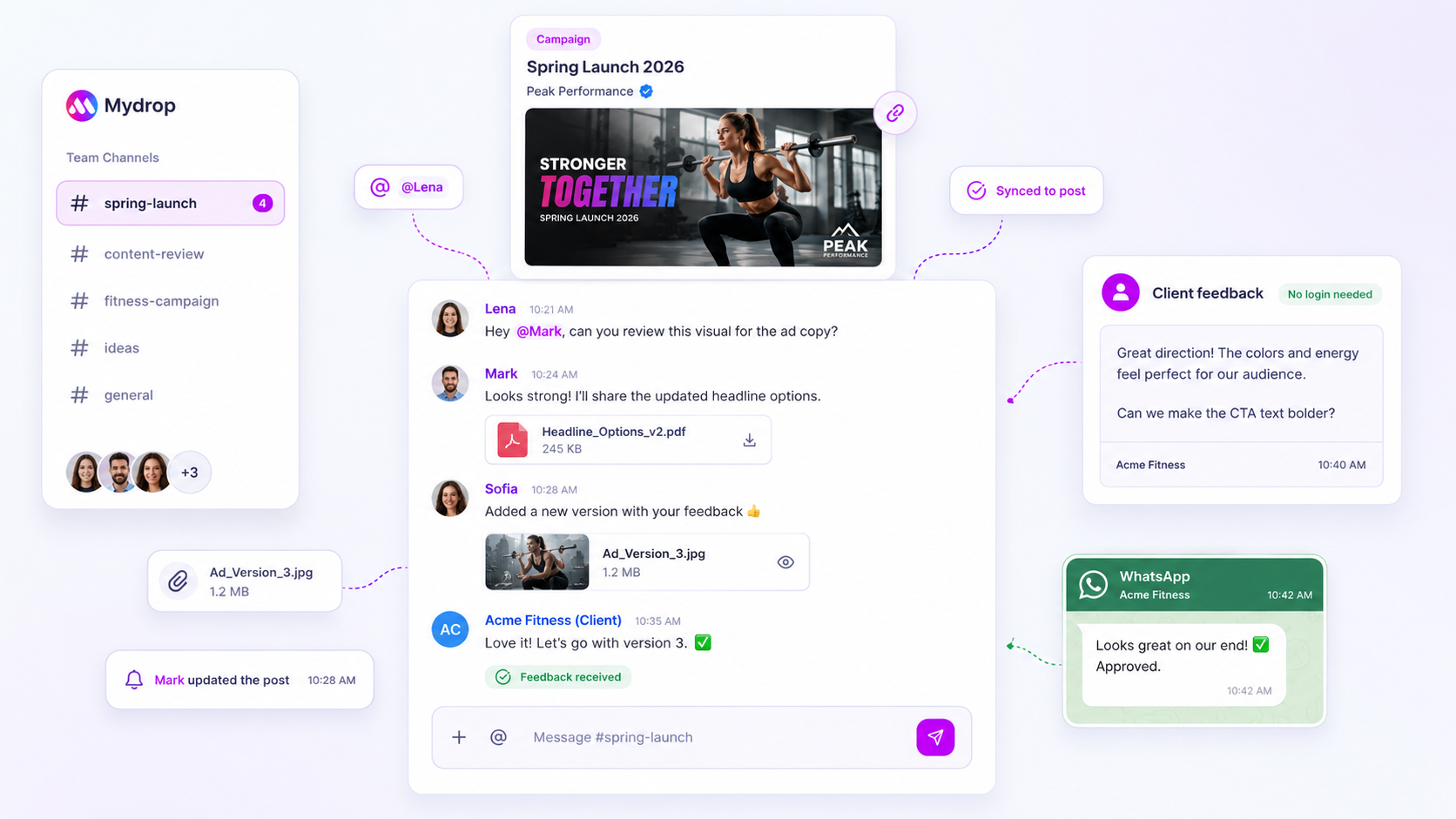
Stop hunting through Slack threads, email chains, and shared document comments to figure out why a social post was rejected. If you are piece-mealing feedback across multiple platforms, you are not managing a campaign; you are playing a high-stakes game of telephone where the only loser is your team’s velocity.
We get it. You are likely juggling dozens of versions of a campaign, a handful of stakeholders with conflicting priorities, and a client who needs a direct line to the work. When feedback is scattered, the time lost merely translating comments between tools is often higher than the time spent on the actual creative work. This coordination tax is the silent killer of campaign timelines.
The fix is straightforward: centralize every comment-from internal creative directors to external client approvals-into a single, context-aware conversation thread attached directly to the asset. If the feedback isn't linked to the specific iteration, it effectively does not exist.
The decision teams usually frame too broadly

Most managers try to solve this by mandating a new tool or standardizing on a single chat app. But tool fatigue isn't the problem; context fragmentation is.
When you ask a stakeholder to leave a comment on a post, you are essentially asking them to perform a series of technical chores: find the right document, open the correct tab, and write a note that they hope someone else will see and action. When they inevitably default to the easiest path-like sending you a DM or a quick email-you end up with "feedback leakage." This leakage is what creates the coordination debt that causes review cycles to drag on for days.
Teams managing dozens of brand profiles often fall into the trap of thinking they need "more communication." In reality, they need fewer places for that communication to hide.
| The Cost of Fragmentation | Friction Level | Typical Time Loss |
|---|---|---|
| Email/Slack Threads | High | 30-60 mins/day chasing context |
| Shared Spreadsheets | Very High | 1-2 hours/day syncing versions |
| Centralized Asset Comments | Low | < 5 mins/day to verify status |
Operator rule: If a reviewer cannot provide feedback without leaving the platform where the creative lives, your process is already broken.
At Mydrop, we see that the most effective teams treat the conversation thread as a primary campaign asset, right alongside the copy and media. By bridging client feedback directly into these threads, you remove the need for authenticated logins-letting your clients chat with you without creating new barriers to entry. This simple shift stops the "did you see my comment on V2?" confusion before it starts, keeping your team focused on shipping work rather than managing the inbox.
What should stay manual and what can move faster

The biggest mistake teams make is treating every piece of feedback as a high-priority meeting. If you are scheduling a thirty-minute Zoom call to discuss a minor tweak to a social copy caption, you are effectively paying a premium tax on simple execution.
Keep the manual, high-touch syncs for strategic alignment, crisis management, or when creative direction feels genuinely off-base. If the team is debating the core why of a campaign, stay on the phone. You need the nuance of voice and tone to reset that compass.
Everything else-the tactical edits, the "can we change this photo?", the minor approval-should move as fast as the conversation thread allows. This is where most teams get caught in the trap of "coordination debt." They leave the platform to go to email, wait for a reply, and lose the context of the asset entirely.
At Mydrop, we see teams struggle when they force every single interaction into a formal, synchronous format. If the feedback is about a pixel-perfect edit or a comma change, it should live right alongside the asset. This keeps the review moving without anyone needing to hunt for the latest version in a buried email chain.
Decision check: If a feedback cycle takes more than three back-and-forth emails, it is an absolute signal that you need to move that specific conversation into a dedicated thread tied to the asset.
The tradeoff matrix
Not every review loop requires the same level of security or access. Balancing team velocity against the need for governance is the secret to avoiding the "account request" bottleneck. When clients have to create logins just to leave a comment, they will stop giving feedback or, worse, bypass your system entirely to DM your team on Slack.
The following matrix helps you decide when to use authenticated workspace access versus public, token-based collaboration.
| Scenario | Feedback Channel | Access Type | Primary Benefit |
|---|---|---|---|
| Internal Creative | Workspace Thread | Authenticated | Full audit history and team mentions. |
| Direct Client Edit | Approval Portal | No-login / Token | Zero friction; feedback captured in context. |
| External Stakeholder | Brand Portal | Sanitized / Link | Controlled access without workspace bloat. |
| Deep Strategy Sync | Live Meeting | Manual Sync | High-fidelity nuance for core messaging. |
When to use the portal bridge: If you have an external partner who needs to see the work but doesn't need to manage your entire social media operation, use a portal conversation. It captures their reactions and edits as if they were in the room, but it keeps your workspace clean of unnecessary permissions.
When to stick to the workspace: For your core team or agencies with deep, long-term involvement, keep them in the workspace. You want that full visibility into notification triggers and historical task states.
The real issue is rarely the tool; it is the friction you introduce when you force external stakeholders into an internal workflow. A simple link that lets them jump straight into a conversation thread is often the difference between a campaign that stays on schedule and one that stalls because of a forgotten password or a lost login invite.
How to pilot the workflow safely
You do not need to overhaul your entire operation by Monday morning. In fact, if you try to## How to pilot the workflow safely
You do not need to overhaul your entire agency or enterprise operation on a Monday morning. That is the quickest way to cause a localized revolt. Instead, pick one brand or campaign that has a high volume of back-and-forth feedback but is not currently in a "launch critical" window.
Treat this pilot as a controlled test of your new communication hygiene. Use a Mydrop brand portal to bridge that specific client or stakeholder group directly into your workflow. If they have been accustomed to sending their "final" feedback via email or Slack, show them how to use the approval link instead.
Workflow check: Only count feedback as "received" if it is logged inside the asset-linked conversation. If someone sends an email, reply with the link and a simple note: "Hey, can you drop that into the portal? It keeps the history attached to the creative so we don't lose the context."
This does two things: it protects your team from version drift, and it trains your stakeholders to use the tool that actually makes their lives easier. Once one brand feels the relief of a singular, auditable trail of feedback, the rest of your portfolio will start asking why they are still digging through their inbox for comments.
The operating rule to keep
Consistency is the only thing standing between a well-oiled team and a chaotic fire drill. If you let the process slip-even once-the entire system loses its gravity. People will immediately revert to the path of least resistance: sending a quick DM, an "off-the-record" Slack message, or a separate email chain.
To prevent this, you must institutionalize one golden rule across your entire social operation: If the conversation isn't attached to the asset, the task is effectively incomplete.
Here is a simple audit checklist to help your team maintain this standard throughout the week:
| Step | Action | Success Threshold |
|---|---|---|
| 1. Bridge | Are all external comments funneled into the portal? | No project-related emails in personal inboxes. |
| 2. Notify | Is the full team tagged in the conversation thread? | Everyone sees the edit request in real-time. |
| 3. Audit | Is the conversation history visible to the client? | No hidden "internal-only" threads that exclude the stakeholder. |
| 4. Resolve | Is the feedback resolved within the Mydrop thread? | No "Okay, replied via Slack" messages. |
When you enforce this, you stop playing the game of telephone. You stop wondering which version of the creative the client approved. You stop the "I never saw that" excuse. It sounds rigid, but in practice, it is actually the ultimate form of creative freedom. Your team stops spending their mental energy on status updates and coordination tax, and they get to spend it on the actual work.
Conclusion
Most social media operations are not failing because of a lack of creative talent. They are failing because of a catastrophic lack of central visibility. You are likely losing hours every day just reconciling different versions of the truth scattered across email, chat, and document comments.
Stop the fragmentation. Bring every stakeholder, every edit, and every approval into one place. When the communication is as transparent as the creative, the "coordination debt" that plagues your campaign reviews simply evaporates. Start with one brand, bridge the feedback, and watch how quickly your team finds its rhythm again. The goal is not just to move faster-it is to move without the constant fear that someone, somewhere, is working from the wrong version.