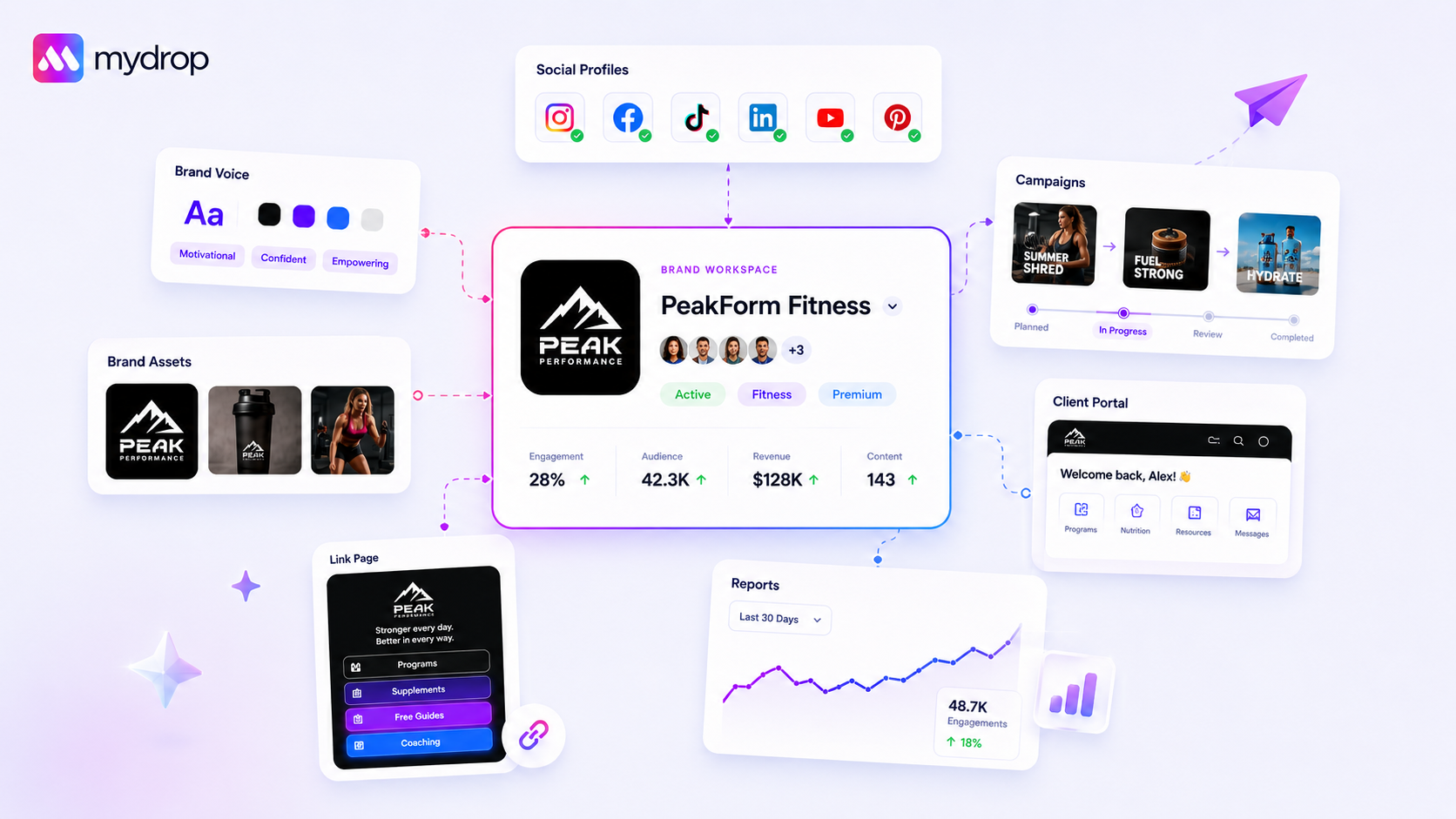
Social media teams lose up to 40% of their productivity to cognitive friction: the mental reset required every time you switch from a luxury skincare brand's tone to a B2B SaaS voice. The solution isn't more discipline or a third monitor. It is an interface that physically locks your focus to one brand at a time, hiding every irrelevant profile until the job is done.
We get it. Your browser tabs are a graveyard of 15 different brand guidelines, and you have likely lived the nightmare of almost posting a personal meme to a corporate client's LinkedIn. It is messy, exhausting, and leads to what we call selector fatigue. If you feel like you are vibrating with anxiety every time you hit "Publish," you aren't alone. This is the hidden cost of multi-brand management in tools designed for solo creators.
Where the handoff is actually breaking

Most social tools brag about "all-in-one" views. They want you to see every profile, every inbox, and every draft in one giant stream. For enterprise teams, that "all" is a liability. When you can see 100+ profiles in a single dropdown, every click carries a micro-panic: "Am I on the right account?"
This is where the handoff breaks. We often assume teams slow down because they are "lazy" or "unorganized," but the reality is much more technical. Every time you switch contexts, your brain has to unload one set of rules (Brand A's stance on emojis, legal disclaimers, and voice) and load a new set.
At Mydrop, we have seen this across thousands of workflows. When a workspace is "noisy," teams build "defensive habits" to avoid mistakes. They double-check handles five times. They keep separate spreadsheets just to track which brand is which. This is coordination debt, and it eats your morning before you even write a caption.
Operator rule: Visibility is not the same as focus. Seeing everything at once usually means seeing nothing clearly.
The "all-access" dashboard creates a specific type of friction we call the Context Switching Tax. As you add more brands to a single view, the time it takes to reach a "flow state" for any single brand increases exponentially.
The Context Switching Tax Table
| Brands in View | Transition Type | Cognitive Load | Avg. "Reset" Time |
|---|---|---|---|
| 1 Brand | Deep Focus | Low | 0 minutes |
| 2-4 Brands | Frequent Pivot | Medium | 5 - 7 minutes |
| 5-10 Brands | Constant Context Juggling | High | 10 - 12 minutes |
| 20+ Brands | "Selector Fatigue" | Extreme | 15+ minutes |
Note: Reset time is calculated as the gap between finishing a task for Brand A and reaching full drafting speed for Brand B.
The myth of the "Unified Inbox" as a productivity booster is the first thing we have to dismantle. For a solo influencer, it is a dream. For an agency operator managing five clients who each have four social channels, it is a recipe for voice-bleed and accidental posts. Efficiency comes from a workspace that says "no" to distractions, not one that invites them all to the party at once.
The coordination debt checklist

If you have ever stared at a half-finished caption for three minutes because you could not remember if the client likes the "rocket" emoji or the "sparkles" emoji, you have paid the tax. Coordination debt is the interest you pay on a messy workspace. It is the friction that happens when your tools force you to be a librarian instead of a creator.
We have seen this across hundreds of agencies and enterprise teams: the larger the portfolio, the more time you spend just trying to find the right door to walk through. Here is how to tell if your team is currently drowning in context-switching noise.
- The Three-Second Stare: A team member opens a "Create" window and pauses for three seconds just to make sure they have selected the right profile.
- The Ghost Draft: You find a draft meant for a B2B tech brand sitting in the folder for a lifestyle apparel client because the creator was "pretty sure" they were in the right spot.
- The Selector Scroll: Your dropdown menu for profiles is so long that people have started using
Cmd+Fjust to find the right Instagram handle. - Voice Bleed: You catch a "Best regards" in a TikTok caption or a "no cap" in a LinkedIn post for a law firm.
- Security Anxiety: The team double-checks every "Publish" button with a level of intensity usually reserved for launching a satellite.
To get a real handle on this, you can run a quick audit. We usually suggest looking at the "Noise-to-Signal" ratio of your current dashboard. If 80 percent of what you see on your screen belongs to brands you are not currently working on, you are losing money.
The Context Switching Tax Matrix
| Symptom | Cognitive Load Impact | Weekly Time Leak (per person) | Decision Rule |
|---|---|---|---|
| Profile Selection | High: Selecting from 50+ profiles | 90+ minutes | If selection takes > 2 seconds, lock the workspace. |
| Asset Discovery | Medium: Seeing all brand assets at once | 60+ minutes | Hide irrelevant assets based on active brand. |
| Notification Noise | High: Pings from 10 different clients | 120+ minutes | Filter alerts to only show the "active" brand focus. |
| Approval Hunting | Medium: Sifting through a master calendar | 45+ minutes | View should default to one brand's approval loop. |
Total Estimated Leak: ~5.25 hours per member, per week.
How to move decisions closer to the work
The most effective way to kill context switching is to stop asking your team to "be careful" and start making it impossible to be wrong. This is the Rule of One: at any given moment, the interface should only show you what matters for the task at hand.
At Mydrop, we approach this through a workflow we call Brand Lock. Instead of giving you a giant, "unified" mess where everything is visible all the time, we built a sidebar selector that physically filters the entire app. When you toggle Brand Lock for a specific client, the rest of the workspace simply vanishes.
This moves the "Which account is this?" decision from the point of publishing (where mistakes are expensive) to the start of the session (where focus is built).
Here is how that shift changes a typical morning:
- Selection: You pick the "Luxury Skincare" brand from your sidebar.
- Filtering: Your calendar, your asset library, and your profile selectors immediately hide everything else. You are now "locked in" to that brand's world.
- Execution: You write, schedule, and analyze without ever seeing a notification or a profile handle for your B2B SaaS client.
- Transition: When the work is done, you clear the lock and move to the next brand.
The beauty of this is that it is personal. At Mydrop, we know that while you are focusing on Brand A, your teammate might be deep in the weeds for Brand B. Brand Lock persists for each member individually, so you are never forcing your own focus onto anyone else.
This does more than just prevent typos. It lowers the "activation energy" required to start a new task. When you do not have to fight through a cluttered interface to find your tools, you get to spend that mental energy on the actual work. You move decisions closer to the work by making the environment reflect the goal.
Decision check: Your tool should act like a set of blinkers, not a megaphone. If your dashboard is shouting about 20 different things at once, it is not helping you manage; it is just adding to the noise.
Stop asking your team to manage 20 brand identities at the same time. Give them a workspace that lets them be great at one brand at a time. The productivity gains are not just in the speed of the clicks; they are in the quality of the focus.
The roles and rules that reduce rework
If your workspace is a free-for-all where every team member can see every single brand draft and profile, you are not being "transparent." You are being dangerous. In our experience, the "all-access" trap is where most agency rework begins. When an operator has to scroll past 40 unrelated profiles to find the one they need, the chance of a "wrong-brand post" goes from a remote possibility to a statistical certainty.
The goal is to align your workspace architecture with the way humans actually think: one brand at a time. We have seen that the most efficient teams use a tiered visibility model. Instead of fighting the interface, they use Brand Lock to physically remove the distractions.
At Mydrop, we designed the Brand Lock feature to be personal to each member. While an admin enables the toggle in Workspace Settings > General, the actual focus is per-user. This means your lead designer can be locked into the luxury skincare brand while your copywriter stays focused on the B2B tech account. They are in the same workspace, but their "noise" is completely different.
To help you decide how to segment your team, we use this simple rubric for assigning focus modes:
| Role Type | Focus Requirement | Visibility Rule |
|---|---|---|
| Specialist (e.g., Copywriter) | High / Single-Brand | Lock to 1 Brand + 4-6 specific profiles. |
| Account Manager | Medium / Client-Group | Lock to a Brand Group (e.g., "Automotive Clients"). |
| Global Admin | Low / Audit-Only | Clear lock to "All Profiles" for reporting runs only. |
| Junior / Intern | Maximum / Restricted | Strict Brand Lock to prevent "accidental posting" errors. |
Workflow check: If a task takes less than 30 minutes, it does not deserve a context switch. Batch your "locked" time so you stay in one brand voice for at least a two-hour block.
The weekly habit that keeps the system honest
Systems have a natural tendency to drift toward chaos. You start the month with a clean workspace, and by week three, you have 15 "urgent" tabs open and your sidebar looks like a junk drawer. To fight this, we recommend a 10-minute "Friday Reset" for your social ops lead.
This isn't about deep cleaning; it is about auditing the noise. The goal is to ensure that the filters being used actually match the current workload. If a brand campaign ended on Tuesday, that brand should be cleared from the active focus list by Friday.
- Clear the snapshot: Reset any manual profile selections that were made for "one-off" posts.
- Update the Brand Lock: Ensure any newly connected profiles are correctly mapped to their parent brands. (Mydrop does this automatically, so you just need to check that the brand group itself is still the right focus).
- The "Voice Check": Ask your team if anyone felt "selector fatigue" this week. If they did, it is a sign their Brand Lock is too wide.
This habit prevents what we call "interface bloat." When the interface stays lean, the team stays fast. You want your team to open their browser and feel a sense of calm because they only see the work that matters right now.
Conclusion
The "Context Switching Tax" is the single largest hidden expense in modern social media management. You can hire the best creatives in the world, but if you force them to navigate a cluttered, high-noise environment, their output will eventually suffer from "voice bleed" and mental fatigue.
Efficiency at scale is not about working harder or drinking more coffee; it is about building a protective barrier around your team's focus. By moving away from the "all-in-one" chaos and toward a "Single-Brand Focus" workflow, you eliminate the micro-panics that slow down your publishing pipeline.
At Mydrop, we believe your tools should work for your brain, not against it. Whether you are using our sidebar brand selector to hide the noise or simply manual discipline to batch your tasks, the goal remains the same: lock the brand, find the flow, and stop the switch. The best work happens when the rest of the world is hidden.