
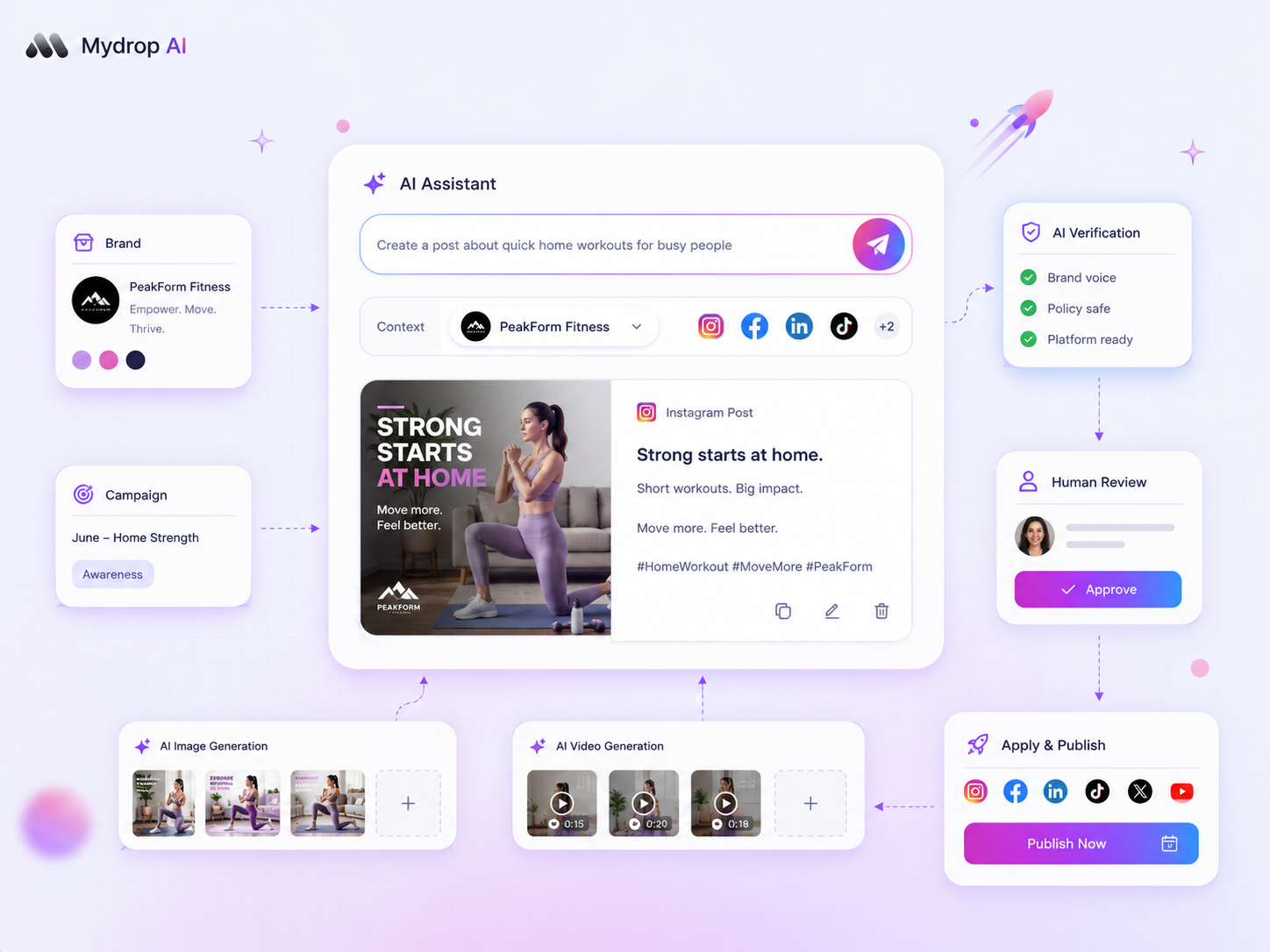
The fastest way to scale your brand portfolio without spiraling into chaos is to stop treating every AI-generated asset as a high-stakes design project. Instead of running everything through a central approval committee, shift your workflow to a model of verification-by-protocol. By embedding brand guardrails directly into your generation process, you can empowerThe secret to scaling AI-generated media across a portfolio of brands is shifting from approval-by-committee to verification-by-protocol. When you move your media plan review process into an agent-verified workflow, you push decision-making as close to the content creator as possible without losing brand integrity. You stop treating every asset as a potential crisis and start treating them as data points in a pre-approved system.
We get it. You are balancing the high-velocity promise of AI generation against the stubborn, granular reality of brand-specific visual requirements. You are likely caught between the manual bottleneck of constant oversight and the chaotic risk of brand dilution. It is messy, and the overhead of managing these handoffs feels like a tax on every post you ship. The good news is that you do not need more hours in the day; you just need to automate your trust boundaries.
Where the handoff is actually breaking

The awkward truth is that your manual "final check" is the primary source of your creative drag. When human review becomes the only gatekeeper for AI quota usage and visual accuracy, your best teams are effectively throttled by your slowest approval. We see this across hundreds of brands: a creator waits three hours for a response on a simple hero image, only to have it returned with a minor color tweak, forcing them to re-run the generation and burn another cycle of their monthly quota.
Here is the pattern we see when workflows stall:
- Invisible Queues: The reviewer is buried in email or Slack, and the media generation task is sitting in a "pending" state on a dashboard no one is watching.
- Context Deficit: The creator has the brand prompt, but the reviewer has the brand strategy. Without a bridge, the AI produces technically perfect but strategically hollow work.
- Quota Waste: Without a pre-check, teams generate dozens of variations for a single post, hitting workspace limits early and leaving no room for urgent, mid-month campaigns.
- Feedback Lag: The time spent waiting for a "Yes" often exceeds the time it takes to actually generate the asset.
If you have ever had a project stall because of a media-callback delay, you know exactly how this destroys momentum. You are not fighting a lack of creative ideas; you are fighting a broken handoff.
Operator rule: If a human has to manually verify a standard post asset, your process is already failing. Reserve your senior talent for campaign-level creative, not pixel-policing.
To stop the cycle of rework, you have to audit where your team is over-indexing on manual reviews versus where they should be trusting the guardrails.
The coordination debt checklist
Most teams do not have a content generation problem; they have an approval bottleneck. When every AI-generated asset requires a human to manually verify brand colors, tone, and compliance, your best creative teams are effectively throttled by your slowest reviewer. If you want to see if your current setup is draining your velocity, look for these five signals:
| Signal | What it actually means |
|---|---|
| The "6 p.m. scramble" | Your team is waiting on a final sign-off for a morning post, creating constant, preventable stress. |
| Version sprawl | You have more than three iterations of the same file in your shared drive before it ever goes live. |
| Approval-by-committee | Every stakeholder feels the need to leave a comment, even on low-risk assets like routine event reminders. |
| Tool switching | Creative work happens in an AI tool, but verification happens in a separate doc or email thread, breaking the flow. |
| Quota uncertainty | You do not know how much of your AI budget is being spent on "failed" drafts that never make it to the feed. |
If you hit three or more of these, you are paying a high tax on every post. You are essentially paying for work that stays locked in a queue instead of reaching your audience.
How to move decisions closer to the work
To stop the cycle of rework, you need to stop treating every single AI-generated asset as a high-stakes campaign. You need a clear decision framework that distinguishes between routine assets and those that truly need a human eye.
At Mydrop, we suggest mapping your media requests to an "Autonomy Spectrum." This allows you to set guardrails that let your team move faster while keeping the brand safe.
The Autonomy-Verification Matrix:
- Self-Service Generation (Low Risk): For recurring social updates, routine graphics, or internal community posts. If the prompt follows approved brand guidelines, the system logs the usage and proceeds. No manual review is required.
- Agent-Verified (Moderate Risk): For campaign-aligned assets or product launches. Here, you use an automated verification flow-like the one we built in Mydrop-to check against your stored brand metadata before production. If the media plan checks out, the AI completes the task without a human middleman.
- High-Stakes Review (High Risk): For major hero images, celebrity partnerships, or public-facing announcements. These always hit a human desk for a final polish, but because they are the only things that do, the reviewer can actually focus on them instead of getting buried in hundreds of minor requests.
The real trick is automation as an audit trail. When you use a system that tracks your AI media jobs, polls for completion, and automatically attaches the output to the correct workspace, you stop wondering if the media is "right" or "ready." The system does the heavy lifting, ensuring the asset is tagged, tracked against your quota, and ready for the final, human-guided touch.
When you move decision-making this close to the source, the creative process stops being a gauntlet and starts being a routine. You aren't just making content faster; you are building a predictable, repeatable rhythm that lets your brand scale without the usual chaos.
The roles and rules that reduce rework
The fastest way to stop the constant back-and-forth is to assign clear swimlanes for AI media generation. When everyone is responsible for everything, nobody is actually accountable for the visual quality.
Define these three roles to protect your output:
- The Creator: Owns the prompt and the initial output. They are empowered to generate assets as long as they stay within pre-approved campaign themes.
- The Verifier: A peer or manager who reviews AI-generated media not for "taste," but for alignment with the brand scorecard.
- The Admin: Monitors your workspace quota usage and ensures that AI tasks are not piling up in a
mediaJobsqueue without being resolved or discarded.
Decision check: If an AI asset requires more than one round of feedback to match brand guidelines, the underlying prompt is broken, not the content. Stop editing and rewrite the source prompt.
Use this simple logic to decide if an asset needs a formal review:
| Asset Type | Risk Level | Approval Path |
|---|---|---|
| Standard Post | Low | Self-service; verify at batch level |
| Promoted Ad | Medium | Peer review required |
| Campaign Hero | High | Agent-verified, manual sign-off |
If you are using Mydrop, the Media Plan Review flow acts as your final gatekeeper. By requiring the agent to verify these items before they hit your calendar, you catch alignment issues before they ever reach a human desk.
The weekly habit that keeps the system honest
High-performing teams do not rely on hope. They rely on a Monday morning sync to audit the previous week of AI-generated content. If you aren't looking at your quota usage and your "failed-state" generation logs, you are flying blind.
Take 15 minutes each week to run a System Hygiene Check:
- Quota Audit: Check how much of your AI image and video allocation was consumed. If you are hitting limits, identify which team or brand is over-generating and adjust their access.
- Status Review: Look for AI media tasks that never completed. Providers occasionally have hiccups, and a stalled job shouldn't block your publishing pipeline.
- Template Update: If you notice a consistent visual drift across a specific brand, update your prompt templates immediately.
At Mydrop, we often see teams save hours of work by treating their AI media pool as a living library. When a prompt yields a perfect result, save that configuration. Do not make your team invent the wheel every time they need a generic social asset.
Conclusion
Standardizing your media plan is not about clamping down on creativity. It is about removing the friction that keeps your best people from doing their best work.
When you shift from manual, "I'll know it when I see it" feedback loops to an objective verification protocol, you stop managing tasks and start managing brands. Your team gets the freedom to move fast, your stakeholders get the consistency they require, and your brand finally scales without the constant threat of visual chaos.
The goal is a system where the AI does the heavy lifting, your team provides the creative vision, and your operational habits ensure that the quality never dips. Start by auditing your current review process this week. You will likely find the bottleneck is not your tools or your ideas, but simply the number of unnecessary hands involved in the final polish.