To stop burning through your AI media budget, you need to stop counting generations and start counting attach-to-post conversions. Most enterprise teams treat AI image generation like a bottomless office supply closet, only to hit hard technical ceilings mid-campaign when their async processing queues-and their actual monthly quotas-suddenly collapse under the weight of unmetered, speculative prompt engineering.
We get it. You are juggling ten different brand identities, a dozen agency partners, and a content calendar that never sleeps. Coordinating AI assets across that much sprawl feels like trying to choreograph a hurricane. But that unexpected quota hit at the end of a high-stakes release week isn't a bad luck streak; it is a signal of coordination debt.
At Mydrop, we see this constantly: when teams don't account for the async latency of AI generation, they end up paying for the same asset three times over in failed tasks, duplicate requests, and panicked manual retries.
The decision teams usually frame too broadly

Most creative leads start the conversation by asking, "How many images can we generate this month?" That is a dangerous question. It treats the AI as a creative sandbox rather than an operational utility. The moment you frame your quota around total generation capacity, you lose control.
Instead, start with your Generation-Consumption Ratio.
Your goal is to align your output with your actual publishing capacity. If you have the quota to generate 1,000 images but your social team only has the bandwidth to review, approve, and schedule 200 posts per month, you are effectively paying for 800 images that will never see the light of day. This isn't creative exploration; it is just generating expensive digital landfill.
Operator rule: Never authorize an AI media task that does not have a confirmed post-attachment probability. If your generation volume exceeds your publishing capacity by more than 20%, you are over-leveraged.
Here is how you can start measuring your actual efficiency:
| Metric | Calculation | Why it matters |
|---|---|---|
| Generation Tax | Total Images Generated / Total Posts Published | Shows your waste-per-post ratio. |
| Poll-to-Use Latency | Avg time from Task Start to Attachment | Highlights where async delays kill your team's momentum. |
| Retry Ratio | (Successful Tasks - Unique Attachments) / Total Jobs | Tracks quota lost to duplicate jobs or failed status callbacks. |
Teams that ignore these metrics are essentially flying blind. They hit their quota limits because they are generating ten high-fidelity variants for a single slot that only ever needed one.
When you move the focus from creation to completion, you shift from being a spectator of your own budget to an operator of it. This isn't just about saving credits; it is about ensuring that when you need a high-impact asset for a major campaign, your team isn't locked out because you spent the previous three weeks generating "test" assets that no one ever actually used.
What should stay manual and what can move faster

The biggest mistake enterprise teams make is treating all assets as equal candidates for automation. If you try to automate your cornerstone brand campaign or high-stakes product launch graphics, you are just asking for a coordination headache that will stall your approval workflows.
Manual workflows are for assets where brand identity is non-negotiable or where the "human touch" is the actual product. Think of your annual report covers, executive photography, or high-concept creative that requires tight art direction. AI generation is for the "filler"-the hundreds of social posts, variations, and supporting visuals that fill the gaps between your major beats.
Decision check: If an asset takes more than two rounds of internal legal or brand review, it is too complex for an initial AI generation pass. Keep it manual, save your quota, and reserve your AI budget for high-volume, low-stakes iteration.
At Mydrop, we often see teams fall into the trap of using AI for everything. When you automate the "easy" stuff, your team gains speed. When you force AI into complex brand governance, you just create more work for your stakeholders who have to clean up the result.
The tradeoff matrix
To calibrate your allocation, use this decision matrix to evaluate whether a media task belongs in the AI queue or a human-led design sprint.
| Asset Type | Primary Need | Generation Strategy | Quota Weight |
|---|---|---|---|
| Cornerstone Brand | Precise Identity | Human Design (Manual) | 0% |
| Campaign Variants | Scale & Iteration | AI + Human Edit | Medium |
| Supporting Content | Volume & Speed | Automated AI (Mydrop) | High |
| Platform-Specifics | Formatting | AI Resizing/Adaptation | Low |
The "invisible debt" here is the cost of human attention. If your team is spending more time fixing AI-generated artifacts than it would have taken to build the asset from scratch, you have failed the generation-consumption ratio.
Before authorizing any AI generation task, apply this simple audit:
- Identify the post target: Is this media attached to an approved, scheduled post?
- Define the output count: Do we need one final asset, or are we testing five variants for performance?
- Check the human bottleneck: Will an editor be able to review this output within the next 4 hours?
If the answer to the first question is "no," stop. Generating images for a "maybe" post is the fastest way to turn your quota into digital landfill.
Most teams do not have a content problem. They have a decision bottleneck. If your AI-generated assets are sitting in a mediaJobs queue or a draft folder for days, you are paying for the generation, but you aren't getting the return. By shifting to a "verify before generate" model-using tools like media plan verification to lock in your strategy before the pixels are even rendered-you stop the leak and regain control over your enterprise calendar.
How to pilot the workflow safely
You cannot fix quota leakage just by setting a cap in a dashboard; you have to change how your team requests and verifies assets. The smartest teams we work with stop treating "generate" as a single-click habit and start treating it as a multi-stage commitment.
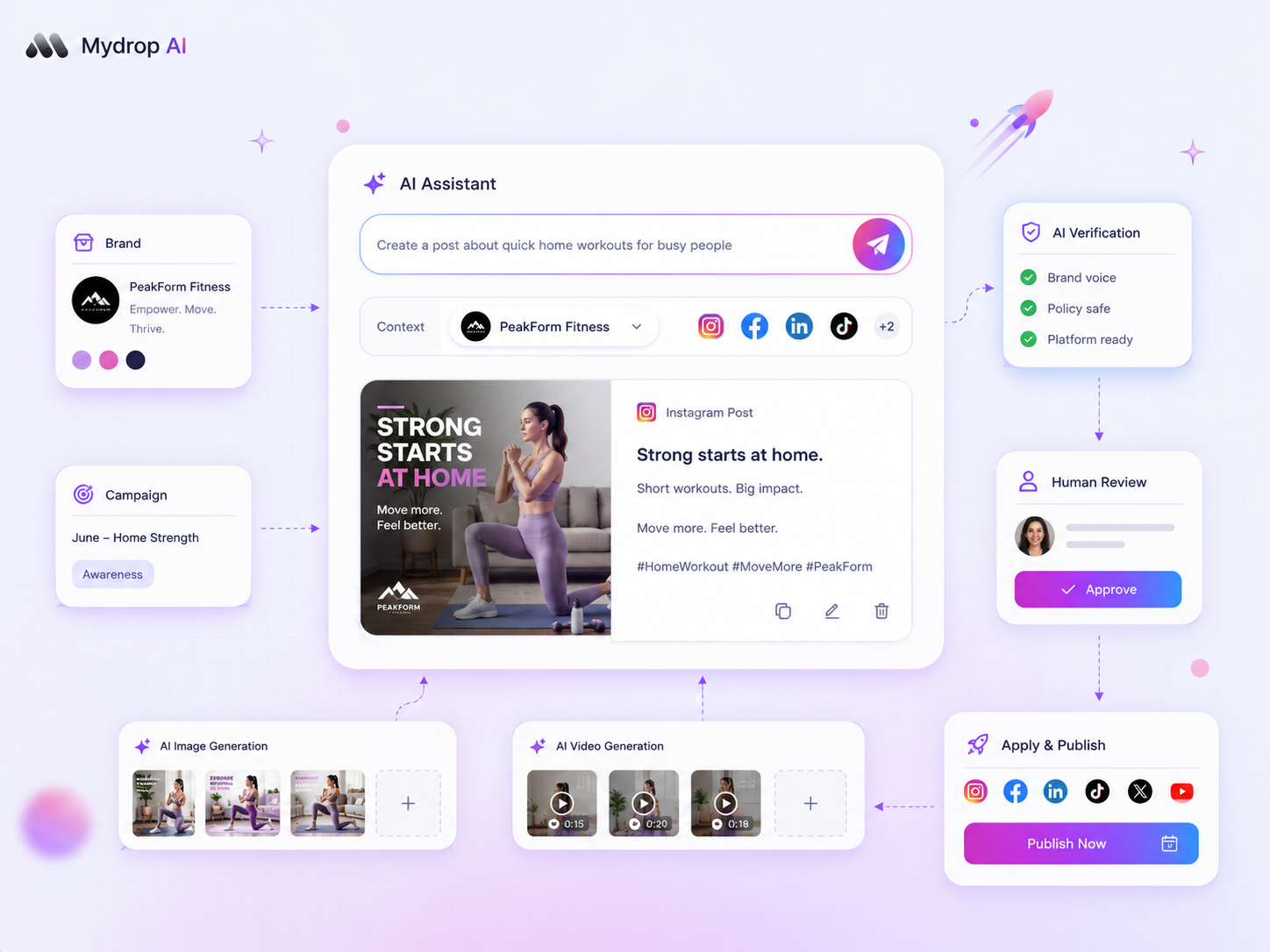
If you are running an enterprise operation, you need a "verify-before-consume" loop to ensure your AI spend actually makes it to a live post.
Here is a simple 3-step protocol to pilot this without burning your team’s patience:
- Mandatory Review Gate: Require that all AI media requests pass through an agentic verification stage before final storage. At Mydrop, we see high-performing teams use a
Media Plan Reviewcheck to confirm the AI asset matches the intended post strategy before it hits the library. - State-Aware Polling: Ensure your team understands that clicking "generate" four times because a job takes 10 seconds is just throwing money away. Use platforms that support
callback-based updatesorpolled status checksto handle provider latency. This prevents duplicate jobs and redundant quota hits. - Consumption Audits: Every Friday, check your
workspaces.ai_images_usedagainst your actual publishing volume. If you generated 500 images but only posted 50, your team is likely over-indexing on creative exploration-or worse, hitting "generate" and forgetting to download the result.
Common mistake: Treating the AI Media Panel as an infinite sandbox. If you don't anchor generation to a specific
mediaJobstask tied to a calendar item, your quota will disappear into a void of abandoned drafts.
The operating rule to keep
If you want to maintain scale without losing control, you have to adopt a strict Generation-Consumption Ratio.
We recommend an initial threshold of 1.2x. This means for every single asset you plan to publish, you authorize at most 1.2 generation attempts. This allows for a small margin of error (a slight mismatch in lighting or a failed render) while aggressively punishing the "just let me generate ten more variants" behavior that drains enterprise budgets.
If you find yourself exceeding this ratio, you are not creating content; you are suffering from coordination debt. It means stakeholders are not aligned on the brief, or your creative teams are using AI to avoid making a design decision.
| Role | Responsibility |
|---|---|
| Content Strategist | Defines the asset need within the media plan before triggering generation. |
| Brand Manager | Verifies media output against brand guidelines in the Media Plan Review stage. |
| Operations Lead | Monitors the Generation-Consumption Ratio to catch quota leaks weekly. |
Conclusion
Managing AI quotas for large teams isn't about finding the cheapest provider; it is about eliminating the waste hidden in your own manual retry loops. When you stop counting how many images you can make and start measuring how many completed assets your workflow actually consumes, you gain control over both your brand identity and your budget.
Stop the "generate-and-discard" cycle. Shift to a plan-verify-attach workflow, and you will find that your existing quota goes much further than you ever thought possible. Success in high-volume social media operations is rarely about having more ideas; it is about having fewer bottlenecks.