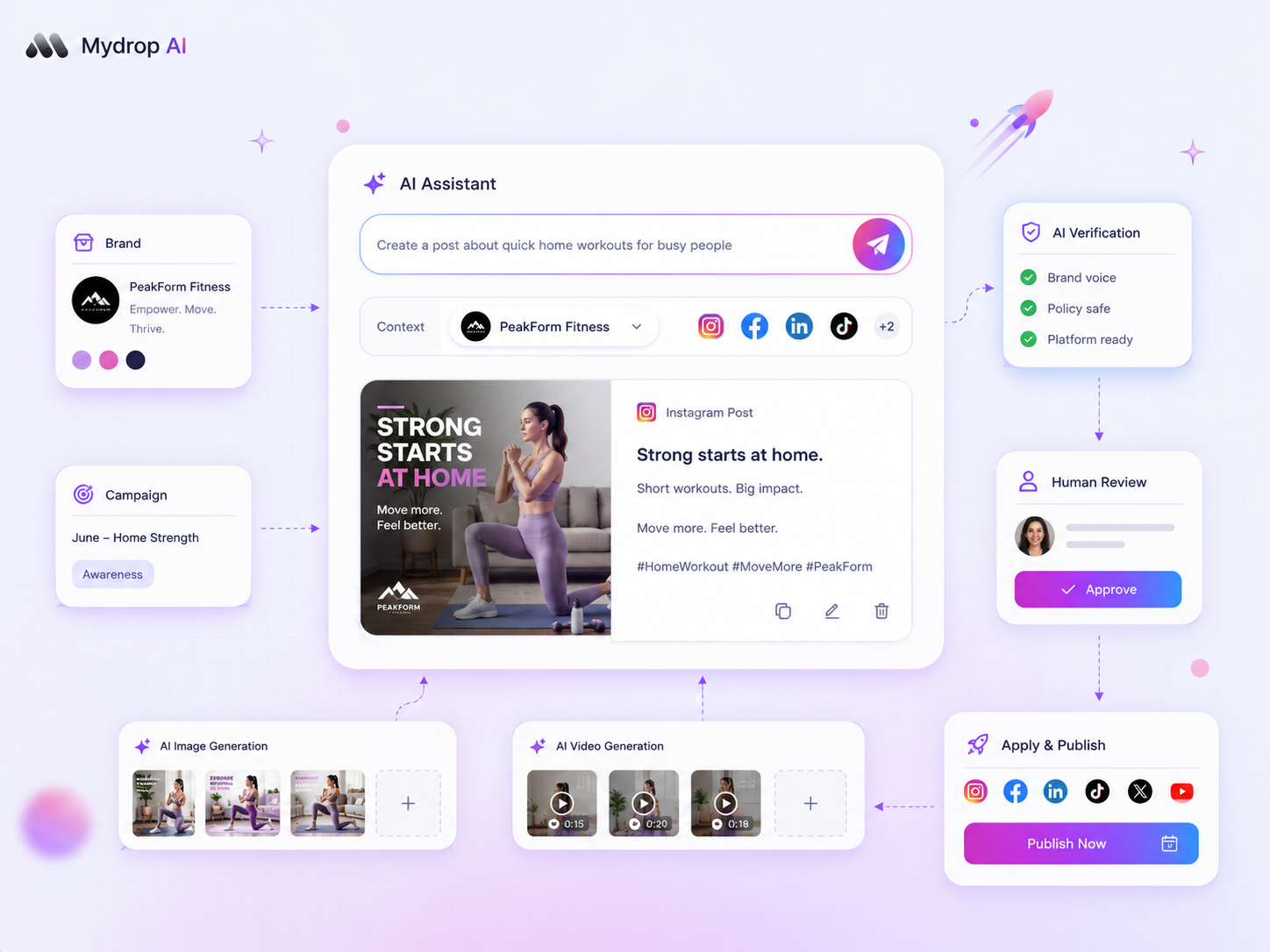
Your AI image generator is not "bad" at following your brand guidelines. It is simply operating without a guardrail. When generated media looks like an outlier, the root cause is rarely the generative model; it is almost always the lack of a standardized verification loop between your creative intent and the final render.
We get it. The speed of AI is addictive, but the cleanup is exhausting. You have spent more time retrofitting almost-right images than it would have taken to build them from scratch. It feels like the tool is working against your brand identity, not for it, and nobody enjoys chasing down design approvals at 6 p.m. to fix a tone-deaf color palette.
The operating problem this solves

Most brand drift in AI-generated assets stems from treating the generator as a standalone creative machine rather than a component of your broader media plan. Teams often fall into the "prompt-chasing" trap, wasting hours tweaking keywords in isolation when they should be auditing the operational environment that feeds the model.
In our experience at Mydrop, where we support teams managing hundreds of brand profiles, the most consistent creative errors aren't prompt failures-they are coordination debts. When your AI media panel is disconnected from your actual media plan, the AI is effectively guessing your brand preferences. You need a verification loop that forces alignment before your assets are finalized, not after they have been pushed to a post.
Here is the awkward truth: most teams do not have a content problem. They have a decision bottleneck. If your media plan is not verified before the generator starts, you are just automating inconsistency at scale.
To move from "prompt-chasing" to reliable output, run your process through this 5-point audit scorecard.
Brand Integrity Audit Scorecard
Use this checklist before finalizing any AI-generated asset. If you cannot check all five boxes, the media is not ready for publication.
| Point | Diagnostic Question | Failure Mode |
|---|---|---|
| Media Plan | Is this asset tied to a verified plan record? | Unchecked generation leads to off-brand content. |
| Context | Are brand constraints set in the AI panel? | Default settings ignore your specific color/tone rules. |
| Quota Status | Is the workspace limit active and healthy? | Forced degradation when quotas are hit. |
| Callback | Did the job trigger a status confirmation? | Assuming completion without a verified signal. |
| Render Review | Does the output match the plan intent? | Accepting "good enough" instead of "on brand". |
Operator rule: If an asset cannot be mapped back to a verified media plan entry, it is unauthorized content. Stop the flow, reset the context, and re-verify the plan.
By formalizing this cadence, you stop treating AI media as a "hit-or-miss" creative exercise and start treating it as a managed asset class. The goal isn't to be a better prompt engineer; it is to be a better operator of your creative governance system.
The minimum system that works

The secret to stopping brand drift isn't a better prompt; it is enforcing a rigid media-plan verification loop before your AI hits the "render" button. Think of it as a quality-gate for your creative. At Mydrop, we see teams that stop fighting the model and start managing the process thrive. They stop treating every image generation as a one-off creative miracle and start treating it as a standard supply-chain step.
Your minimum viable system requires a hard stop between content ideation and media generation. If the media isn't in your verified media plan, it shouldn't exist. By forcing your AI media generation to hook into an existing plan, you stop the chaos of individual creators guessing what the brand requires. You aren't just "generating content"; you are executing a defined requirement.
Decision check: Never generate AI assets from a blank composer window. Always link your generation task to a pre-verified media plan item to ensure your colors, dimensions, and subject matter align with the approved campaign strategy.
The Brand Integrity Audit Scorecard
Use this checklist every time an asset leaves your staging environment. If you hit a no on any item, stop and reset the context.
| Audit Item | Purpose | Pass Criteria |
|---|---|---|
| Media Plan | Alignment | Matches the exact asset tag in your campaign plan. |
| Context | Environment | Generation settings include brand-approved style constraints. |
| Quota | Availability | Workspace budget is sufficient to avoid low-fidelity fallbacks. |
| Callback | Integration | AI media job returned a success status, not a timeout error. |
| Final Render | Oversight | Visuals pass a human "eyeball test" for brand tone. |
Where teams overbuild
Here is where it gets messy: teams love to over-engineer their AI setup. We see marketing leaders buy expensive fine-tuning consultants or try to build custom model wrappers because their current output looks "off." It is almost always a mistake. You don't need a custom-trained model; you need better operational discipline.
Most teams overbuild by trying to fix the model's intelligence instead of fixing their own context management. They treat the AI as a human junior designer who needs endless training, rather than a precision tool that needs a clear, constrained input. If you find your team constantly tweaking prompts for every single post, you have failed to build a library of reusable context settings.
The most common trap is the "infinite iteration loop." A creator generates ten variations, picks one, and moves on. They ignore the fact that the chosen image drifted from the brand guide because it looked "cool enough."
Common mistake: Treating AI media as a "search for inspiration" tool rather than a "production" tool.
When you allow iteration without accountability, you create a massive coordination debt. Eventually, someone has to audit those thousands of posts for compliance, and you will find hundreds of tiny brand violations that require expensive rework. You are not saving time by skipping the verification step; you are just deferring the cost of fixing the mess until your team is already exhausted and the legal department is asking uncomfortable questions.
Keep your generation process lean. If a prompt needs more than three variations to hit your mark, your context settings are broken, not your creativity. Tighten your constraints, verify against your media plan, and move to the next item.
How to run the cadence
To stop brand drift, you have to move away from the "generate and pray" method. It is exhausting and, honestly, it is not sustainable when you are managing dozens of brand channels. Instead, treat your AI media generation like any other high-stakes creative asset. Build a weekly rhythm where verification happens before the post gets scheduled.
In our experience at Mydrop, the teams that stop seeing "off-brand" AI images aren't the ones with the best prompts; they are the ones with the best verification hygiene.
Follow this operational rhythm to keep your AI output aligned:
- Monday Planning: Audit your upcoming content calendar. Identify exactly which posts require AI support.
- Media Plan Review: Inside the Media Plan tab, define the generation environment for the week. Set your required color palettes, aspect ratios, and brand context there before you let anyone touch the AI panel.
- Mid-Week Generation & Poll: Run your generation jobs. Do not rely on "instant" results. Use a polling cadence to check completion status. If a job hangs or doesn't meet the brief, flag it for re-generation immediately.
- Final Render Review: Before any asset is attached to a live post, pull it into the final preview. If the image is a visual outlier, it doesn't get published-it gets pulled from the queue for a setting adjustment.
Workflow check: If an AI asset requires more than two manual re-generation attempts, stop. You have a configuration gap in your context settings or media plan, not a "bad" AI model. Fix the setup first.
The proof that the habit is working
You don't need a massive data science team to know if this is working. You need to track your re-generation rate. This is the single best metric for "coordination debt" in your AI workflow. If your team is constantly re-generating the same assets, your operational setup is failing.
Use this simple scorecard to track your progress week over week.
| Metric | Target Threshold | Why it matters |
|---|---|---|
| Re-generation Rate | < 15% | High rates indicate poor context settings or vague media plans. |
| Verification Lead Time | > 24 hours | Rushing the verification loop is where compliance risks hide. |
| Human Edit Intervention | < 5% | If you are manually editing AI output, your generation constraints are misaligned. |
| Quota Utility Ratio | 80-90% | Tracking your workspace quota prevents unexpected service degradation. |
If your re-generation rate is above 20%, stop trying to "fix it in post." Go back to the Media Plan review. Check your workspace settings. Ensure your team is actually verifying the plan against the brand guidelines before hitting the request button.
Conclusion
At the end of the day, AI-generated media is just another part of your supply chain. It doesn't magically solve brand consistency; it just scales the speed at which you can make a mistake.
The secret to a high-performing social team isn't finding the "perfect" AI tool. It is building an operational environment that makes it hard to be off-brand. When you treat generation as a verification step, the drift disappears, and you stop wasting your afternoon fixing images that should have been right the first time.
Stop chasing the perfect prompt. Start perfecting the process. Your brand identity is worth more than a faster render.