
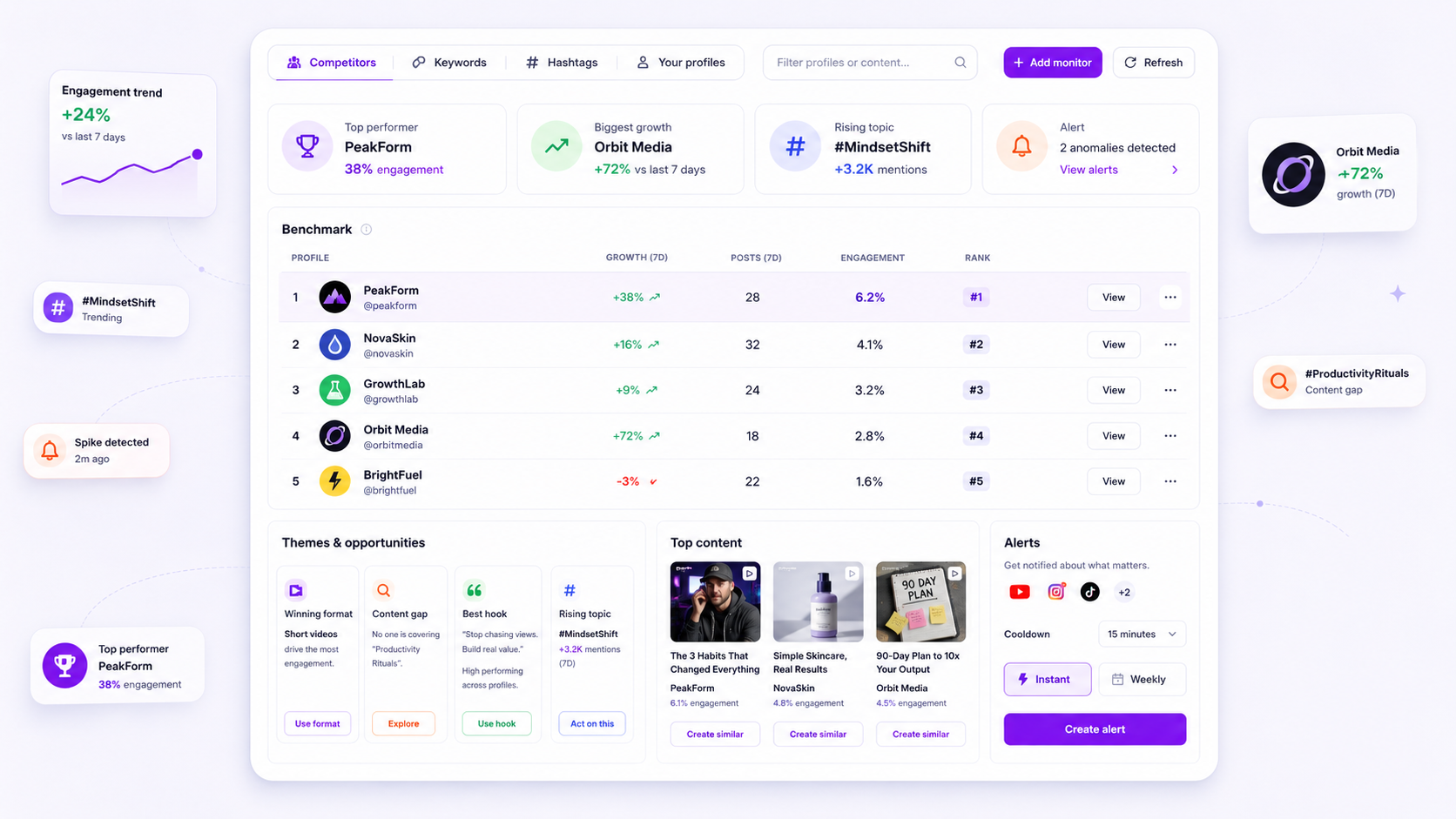
Competitive intelligence isn't a dashboard problem-it is a communication problem. When social teams across multiple brands work in silos, your most valuable insights die in a spreadsheet or a one-off Slack message, leaving your strategy fragmented while your competitors move in lockstep. To fix this, you must move from passive reporting to active intelligence routing. If your current workflow doesn't trigger an immediate, coordinated action across your team, you are just paying for expensive noise.
We get it-this work is messy. Between managing multiple brand voices, platform algorithm shifts, and the constant pressure to produce, keeping a pulse on the industry often feels like chasing shadows. You aren't failing; your current "report-and-forget" loop is just built for speed, not scale. The good news is that by standardizing your intelligence routine, you can reduce rework and ensure every brand in your portfolio benefits from the same high-level strategic wins.
Operator rule: The 24-Hour Action Rule. Every intelligence insight, such as a new trend or competitor hook, must have an assigned owner and a next-step decision within 24 hours, or the tracking for that topic should be paused.
Where the handoff is actually breaking

The reason most multi-brand teams struggle isn't a lack of data-it is "coordination debt." You are likely drowning in alerts, yet your content calendar remains static. In our experience, intelligence usually dies in one of four specific transit zones.
| Handoff Stage | Where it fails | The "Inbox Rot" Symptom |
|---|---|---|
| 1. Sourcing | Monitoring tools are unconfigured | Alerts trigger for everything; managers ignore all of them. |
| 2. Translation | No bridge to brand strategy | Analysts post raw charts; creators have no idea how to adapt the hook. |
| 3. Approval | Insights lack a stakeholder owner | The "who decides" question causes a 48-hour delay that kills relevance. |
| 4. Execution | Knowledge is trapped in one brand | Brand A discovers a winning recipe, but Brand B never sees it. |
This is where the handoff usually shatters. Your social media strategist sees a rising competitor hook on YouTube, but by the time it lands in a weekly report, the trend has already peaked. At Mydrop, we see teams solve this by using shared intelligence monitoring to create a single, unified source of truth. Instead of each brand manager manually refreshing their own feeds, the data is normalized and shared. When a competitor's content theme shifts or a new hashtag explodes, the alert isn't just a notification-it is a signal for the entire portfolio to pivot.
The awkward truth is that if your data doesn't force a decision, you are just performing busywork. The most successful teams don't track metrics; they track the gaps between their content and the market. If you cannot pinpoint exactly where your intelligence loop is stalling, start by auditing your last three "critical" insights and asking who was actually empowered to act on them.
The coordination debt checklist

Most intelligence work creates more noise than value because we treat it as an individual research task rather than a shared team asset. If you are struggling to move from data to action, you are likely carrying heavy coordination debt. Run this checklist against your current process to see where the friction is hiding.
| Indicator | Yes | No | The Consequence |
|---|---|---|---|
| Isolated Sources | [ ] | [ ] | Insights stay locked in personal tabs or local spreadsheets. |
| Manual Translation | [ ] | [ ] | You spend more time copy-pasting than actually strategizing. |
| Alert Fatigue | [ ] | [ ] | Your team ignores generic notifications until they become white noise. |
| Delayed Handoff | [ ] | [ ] | By the time you share a trend, the competitor has already captured the wave. |
| Zero Ownership | [ ] | [ ] | Insights arrive in Slack but no one is specifically tasked to execute. |
If you checked "Yes" for more than two of these, your intelligence loop isn't a strategy engine; it is a storage closet. At Mydrop, we often see teams fall into this trap because they focus on collecting information rather than distributing it. Intelligence is only an asset if it arrives in the hands of the person who has the authority to change the content calendar today.
How to move decisions closer to the work
The most effective multi-brand teams stop managing intelligence from the top-down and start pushing decision-making to the front line. When you centralize everything in a weekly "leadership sync," you are essentially waiting seven days to react to a market change that happened on a Tuesday.
To fix this, you need to turn your monitoring into a shared, actionable feed. Here is how to structure that flow so your team stops waiting for permission to be agile:
- Define your Monitoring Clusters: Don't track everything. Group your competitors and industry leaders by niche-beauty, tech, retail, or local market-and assign a "Channel Lead" for each.
- Set the Alert Threshold: Use tools like Mydrop’s Intelligence Monitoring to move away from "email us everything" to "alert us only when the signal shifts." Configure notifications to trigger only for top-performing posts or major content format changes, so your team doesn't lose focus.
- The 24-Hour Rule: Every shared insight needs a mandatory "Next Step." If someone tags a brand manager in an interesting new hook format, the recipient must either drop it into the "Test" pile or archive it within 24 hours. No lingering.
- Inspiration as an Audit, not a Suggestion: Instead of vague creative meetings, pull your
suggestedProfilesperiodically to see if your current benchmark list is actually still relevant. If your competitors have pivoted their style, your benchmarking should pivot immediately to match their new reality.
Decision check: If an intelligence insight doesn't force you to change your calendar, your posting cadence, or your creative brief, delete the alert. You aren't losing information; you are regaining focus.
When you move decisions this close to the actual content work, you remove the "inbox rot" that plagues so many enterprise teams. You aren't just reporting on the market anymore; you are reacting to it in real-time.
The roles and rules that reduce rework
Intelligence dies when it becomes everyone’s side job. To stop the cycle of hoarding insights in isolated spreadsheets, you need to turn research into a dedicated role, even if that person spends most of their time on other tasks.
The Lead Researcher is your primary point person. They don't just watch the feeds; they act as the curator. Their goal is to identify which trends or competitor moves actually matter to your brand portfolio, filtering out the noise that doesn't align with your strategic goals.
The Brand Owners are the practitioners who take those curated insights and translate them into their specific voice. They are responsible for the "so what?"-deciding how a competitor's hook format could be adapted for their channel or why a rising topic is worth an experimental post.
To keep this from becoming a bureaucratic nightmare, install these three operational guardrails:
| Rule | The Logic |
|---|---|
| No-Repeat Clause | If a competitor move is documented in the shared intelligence tracker, no other team member is allowed to spend time "discovering" it again. |
| The 24-Hour Action Rule | Every insight marked as a "priority" in the intelligence feed must have a next-step decision or a dismissal note attached within one business day. |
| Benchmark Ownership | One person updates the cross-brand benchmark dashboard on the first Monday of the month; it is not a group activity. |
At Mydrop, we often see teams get tripped up by alert fatigue. When you monitor dozens of competitors across YouTube and Instagram, a "set it and forget it" approach leads to an inbox filled with useless pings. We suggest setting your thresholds to material shifts only-like a sudden spike in engagement on a specific content theme-rather than every minor post a competitor drops. This ensures that when a notification hits the team, it actually demands a decision.
The weekly habit that keeps the system honest
If you aren't reviewing your intelligence work together, you aren't doing intelligence; you’re just reading news. The most successful teams we work with treat their weekly intelligence digest as a high-stakes, 20-minute operational huddle, not a long-form slide deck presentation.
Use this checklist to structure your brief:
- The Trend Filter: Review the top 3 rising topics identified by your monitoring tools. Did any of these shift our audience sentiment or engagement trends this week?
- The Hook Audit: Examine the single best-performing competitor post from the last 7 days. Is the format reproducible? If yes, who is assigned to draft a version for our brands?
- The Missed Beat: Identify one opportunity we identified last week that we failed to act on. Why did it stall? (Be honest here: Was it approval? Lack of resources? Lack of clarity?)
- Inspiration Refresh: Use AI-driven inspiration suggestions to pull in a fresh set of industry leaders. Are there new accounts we should be watching? Add one, delete one.
This rhythm prevents the "analysis paralysis" that plagues so many large teams. By the time the meeting ends, everyone should know exactly what they need to adapt, ignore, or test.
Conclusion
The difference between a team that is constantly chasing shadows and one that sets the industry pace isn't better tools; it’s a better operating habit. You have enough data. You have enough inspiration. You probably even have enough talent. What you are likely missing is a structure that forces you to choose what to ignore and what to build together.
Start small. Stop the individual deep-dives, create a single shared view of your competitive landscape, and enforce the 24-hour action rule. If you can move your team from "tracking numbers" to "aligning decisions," the competitive advantage will follow. Intelligence is only as good as the speed of your next move.