When a high-stakes campaign post fails to go live for an enterprise brand, the default reaction is usually panic, followed by hours of manual investigation. But the real failure isn't the API rejection; it is the lack of a standardized diagnostic path that tells your team exactly what to do next. You can turn publishing errors from emergency events into simple, repeatable tasks by categorizing every failure by its specific Repair Path before your team touches a single key.
We get it: your dashboard is a sea of notifications, and the "Failed" alert is the bane of every social media manager’s existence. You are balancing platform constraints across a dozen accounts, and when the system breaks, the manual work of fixing coordination debt feels like a full-time job. You are not alone in this, but you can get out of the loop of reactive firefighting.
The decision teams usually frame too broadly

Most agencies treat "post failed" as a singular, binary problem. They see an error, sigh, and jump into a manual "retry everything" cycle. This is where your team loses the most velocity. By grouping a temporary network timeout in the same bucket as a permanent media constraint or an expired authorization token, you turn a three-second fix into a thirty-minute hunt for the cause.
The truth is that social media scale fails from coordination debt, not a lack of ideas or effort. When you are managing hundreds of profiles, the sheer volume of platform-specific rules-character limits, regional restrictions, or token expirations-means that errors are inevitable. Treating them as individual mysteries rather than data points is what keeps your team in panic mode.
A simple shift helps here: stop asking "Why did this fail?" and start asking "What is the repair path?"
Operator rule: Every warning or failure status must be categorized by its repair path before any manual action is taken.
In our experience, most failures fall into one of four buckets. Categorizing them this way allows you to stop guessing and start processing:
| Status | Likely Cause | Repair Path |
|---|---|---|
| Access Denied | Token expiration or permission change | Refresh OAuth / Re-authorize |
| Constraint Violation | Aspect ratio, character limit, or region lock | Modify media/text and re-upload |
| Operational Limit | Platform daily API or media quota hit | Wait for cycle / Scale back frequency |
| Workflow Block | Unfinished approval or scheduling collision | Finalize approval / Correct calendar date |
By building this diagnostic map into your team's daily review, you move from "everything is broken" to "this is a simple token refresh." It stops being an emergency and becomes just another line item in the daily health check.
What should stay manual and what can move faster

The secret to a fail-safe workflow is recognizing that not all failures are created equal. If your team treats a missing Instagram token with the same manual urgency as a rejected TikTok thumbnail, you are effectively setting yourselves up for burnout.
To move faster, we have to stop manualizing the routine. Automation should handle the detection and rerouting of known platform constraints, while your team stays firmly in the driver seat for strategic remediation.
Move to Automation:
- Notification triggers: Never wait for a human to refresh a dashboard. If an API quota is hit, your team should get an automated email or Slack ping instantly.
- Status categorization: Let your systems flag the "why"-is it a temporary rate limit or a permanent account disconnection?
- Approval reminders: If a post is stalled, automate the nudge to the legal or brand lead. Stop the "hey, did you see this?" email chains.
Keep Manual (for now):
- Content strategy tweaks: If a platform rejects a video format, a human needs to decide: do we edit the aspect ratio, swap the asset, or skip the channel for this campaign?
- Crisis/Compliance overrides: When a post is pulled for sensitive reasons, don't let a "retry" script touch it. That needs human judgment.
Decision check: If a fix requires a creative or policy decision, it stays manual. If it requires a mechanical reset or a status check, it moves to automation.
The tradeoff matrix
Every time you decide to "publish now," you are playing a game of chicken with platform APIs. Agencies often err on the side of speed, resulting in coordination debt that costs more to fix later. Use this matrix to evaluate your next move when a post hits a warning state.
The Repair Path Matrix
| Failure Type | Urgency | Repair Path | Manual vs Automated |
|---|---|---|---|
| Token Expiration | High | Refresh OAuth connection | Automated (System Refresh) |
| Platform Quota | Medium | Adjust send time / Backoff | Automated (Scheduled Retry) |
| Asset Rejection | Low | Swap media file | Manual (Content Edit) |
| Policy/Compliance | High | Review / Edit content | Manual (Stakeholder Review) |
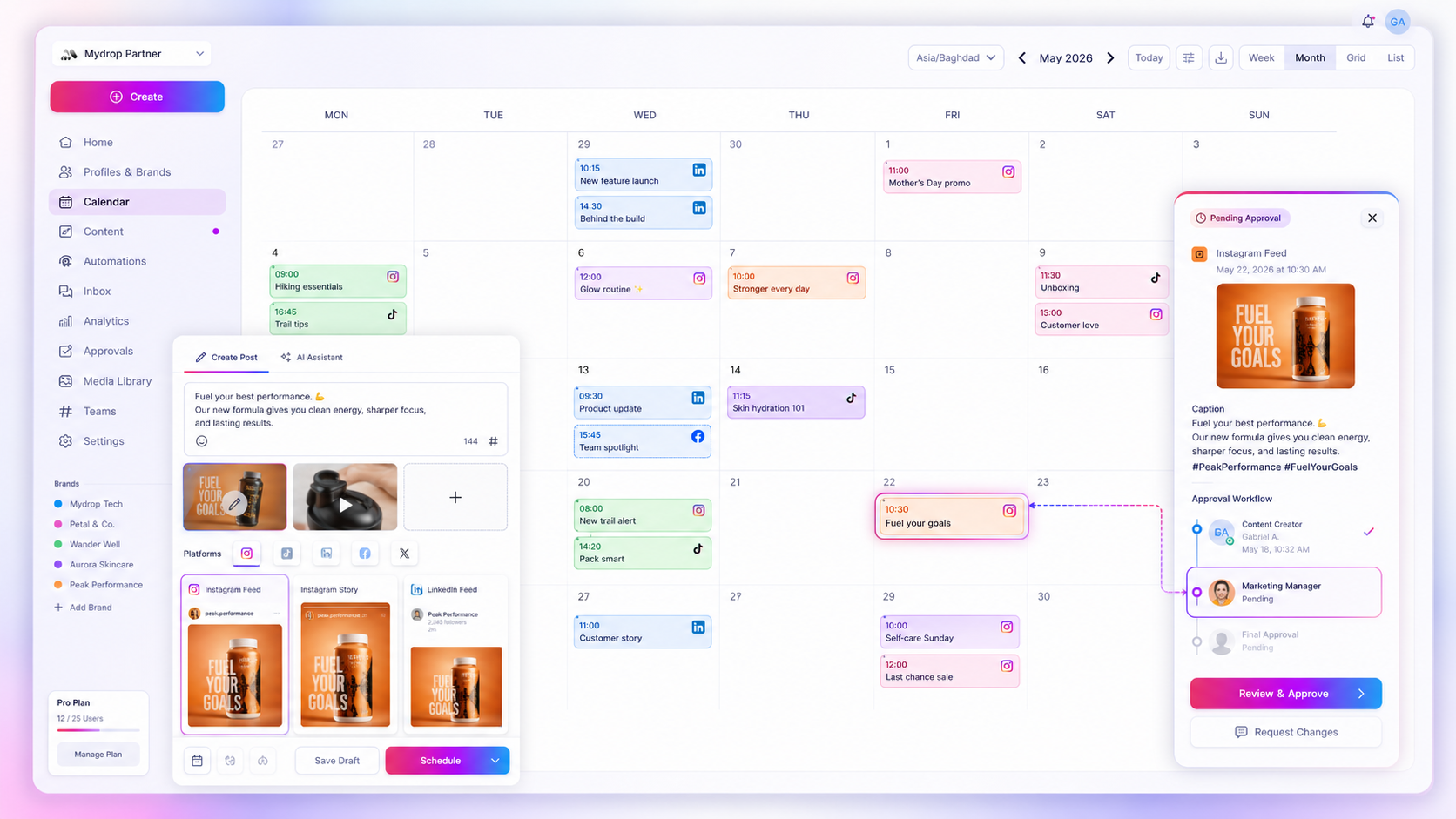
This matrix changes how you approach the Mydrop Calendar. When a post shows a warning status, don't rush to hit "publish now." Check the errorInfo first. If it's a quota issue, the platform will likely allow a retry in 30 minutes. If it's a media format rejection, you have a structural problem that a thousand retries won't solve.
The goal isn't to force the post through; it's to force the diagnostic to happen before the team panics. In our experience, teams managing hundreds of profiles find that 80% of "emergencies" are actually just mechanical delays that the system can resolve if you let it breathe.
How to pilot the workflow safely
You do not need to overhaul your entire publishing process on a Tuesday morning. The safest way to transition from reactive firefighting to a diagnostic-led workflow is to pilot it through your existing Mydrop Calendar. Start by carving out one specific brand or low-risk channel-maybe a secondary regional account-and treat every "Warning" or "Failed" state as a data point rather than a fire to be put out.
By isolating a pilot, you can build the muscle memory of checking the status logs without the pressure of a global product launch. Look at the post preview for any flagged items. In Mydrop, the system often surfaces specific provider-side errors. Instead of immediately hitting retry, use these as your diagnostic indicators to verify if the issue is a temporary blip (like a rate-limit hiccup) or a structural problem (like a thumbnail format rejection).
Use this 5-minute health check to keep your pilot on track:
- Scan the Queue: Open your Calendar and filter by status (Warning/Failed) for the last 24 hours.
- Classify the Log: Match the error message against our Repair Path Matrix (Access, Compliance, Governance, or Quota).
- The "Wait-and-See" Rule: If the error is a platform-side API delay, wait 15 minutes. Most transient errors clear themselves without you touching a thing.
- Action: If the error is permanent, modify the asset or re-authenticate the token, then manually trigger the sync.
- Close the Loop: Document the resolution type so you know if you need to adjust your internal content guidelines for that platform.
The operating rule to keep
We have seen this across thousands of posts: the teams that maintain the highest velocity are the ones that ruthlessly separate technical failure from creative error.
If a post fails because of an expired token, that is a system hygiene task. If it fails because the video ratio is rejected, that is a production quality check. The moment you start treating them as the same "emergency," you dilute your ability to identify where the real bottleneck lies.
Workflow check: Never treat a platform API warning as a creative failure. If the system flags a quota error, it is a task for your Ops lead to review the scheduling cadence, not a reason for the social team to panic-rework the content.
Keep this distinction rigid. When the whole team understands that a "Failed" status is just a signal to pick a specific, pre-defined path, you stop losing hours to the uncertainty of "what just happened?" You move faster because you are no longer guessing; you are operating.
Conclusion
Resilient social publishing isn't about building a system that never breaks. It is about building a team that knows exactly what to do the moment it does. When you stop fearing the "Failed" notification and start treating it like a standard operational input, you reclaim the hours previously lost to manual investigation and frantic Slack threads.
Stop panic-refreshing your dashboards. Categorize your errors, standardize your repair paths, and let your team focus on the work that actually moves the needle. You have enough to manage-don't let the plumbing of social publishing be the thing that keeps you up at night.