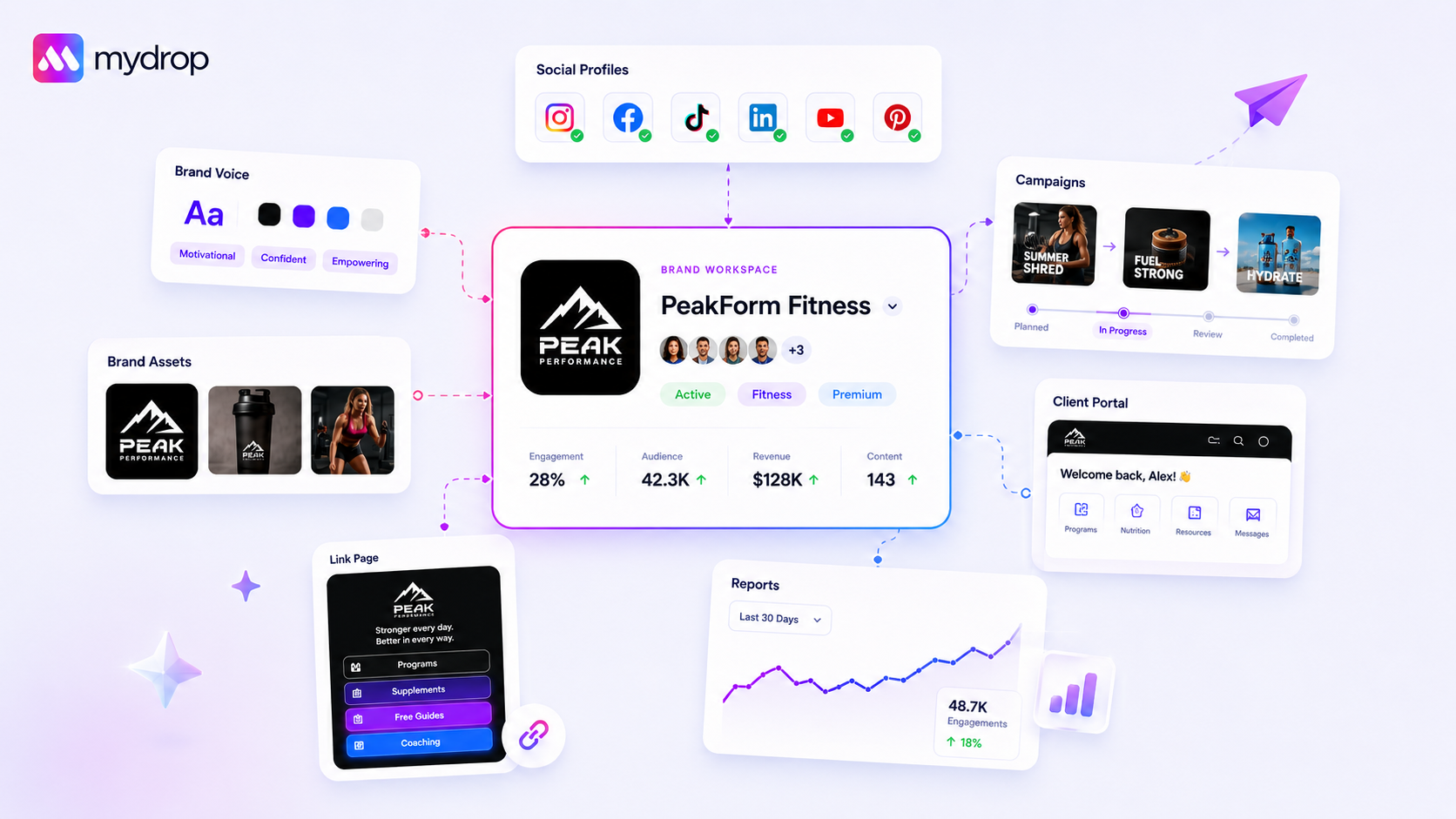
The fastest way to eliminate off-brand content is to shift brand governance from a final review step to a pre-publishing guardrail. By centralizing your Brand Groups and Assets-logos, color palettes, tone prompts, and target audience data-you transform your brand identity from a static PDF manual into an active prerequisite for every post. When these assets are baked into the software where your team works, they become the default, not an afterthought.
We get it. You have ten people touching the calendar, five different brand voices to juggle, and an AI generator that wants to turn everything into a generic brochure. The stress of wondering if a post is really us isn't just you; it is the natural friction of scaling a brand in a fast-paced social stack. You are not failing the brand; your current workflow is simply built for a slower era.
The operating problem this solves

The hidden cost of brand inconsistency isn't just one bad post; it is the coordination debt of constant manual oversight. If your team is still spending hours checking hex codes, cross-referencing logos, or debating tone in Slack threads before hitting publish, your workflow is the bottleneck.
Most brand "guidelines" fail because they live outside the production environment. When a designer, a copywriter, or an AI tool has to toggle between a document and the composer, context gets lost. This gap is where most off-brand errors hide.
Common mistake: Treating brand identity as a document to be referenced rather than a configuration to be enforced.
When brand identity is disconnected from your publishing tool, you encounter three predictable failure modes:
| Failure Mode | The Reality | The Result |
|---|---|---|
| Asset Drift | Team uses outdated logos or wrong color versions from local folders. | Inconsistent visual identity across channels. |
| Tone Bleed | AI tools generate content without specific audience context. | Generic, off-brand copy that lacks a human point-of-view. |
| Coordination Gap | Profile groupings are siloed from campaign or link-in-bio assets. | Fragmented brand experience for the end user. |
At Mydrop, we see this across hundreds of brands and agencies: the most successful teams don't have a "creative" problem, they have a system design problem. They stop relying on human vigilance to catch errors at 5:00 p.m. and start relying on a configured environment where the "right" asset is the only easy one to select.
When you group profiles under a defined Brand-with its own color palette, media library, and AI tone guidance-you turn the act of publishing into a repeatable process. You stop chasing approvals and start governing the system.
The minimum system that works

The secret to stopping brand leakage is simple, but it requires unlearning the habit of storing identity in a disconnected PDF. Instead of treating your brand guidelines like a historical document, you need to turn them into an active configuration layer inside your publishing environment.
At Mydrop, we see the most successful teams consolidate their identity into a single Brand Group. Think of this as your source-of-truth container that holds everything from your color palette and logo assets to your specific AI tone settings and target audience data. By tethering your profiles to these groups, you aren't just tagging posts; you are forcing every piece of content-human or AI-generated-to live within the boundaries of your established identity.
When you bake these guardrails into the software, the "is this us?" conversation moves from an exhausting, 6 p.m. manual review to a quiet, invisible check during the creation process.
The Brand Readiness Scorecard
Use this audit to see if you are truly integrated or just playing catch-up with static assets.
| Capability | Static PDF Mode (The Leak) | System-Integrated (The Guardrail) |
|---|---|---|
| Asset Access | Stored in folders; manually attached. | Native to composer; auto-enforced. |
| AI Guidance | Generic prompts; inconsistent tone. | Locked brand tone and audience data. |
| Group Integrity | Profiles loosely managed in sheets. | profilesGroups define identity scope. |
| Website Import | Manual color/logo updates. | Auto-extracted; synced with live site. |
| Approval Flow | Human check for every minor error. | System check for core identity assets. |
How to score: If you have more than two items in the "Static" column, your team is likely absorbing high levels of coordination debt just to prevent basic brand drift.
Where teams overbuild the process
We have seen teams with hundreds of brand profiles spend months building a 50-page brand manual that no one actually reads. They hire consultants to write elaborate governance policies, yet they still find themselves chasing down incorrect hex codes on a Friday afternoon.
Operator rule: If your brand governance requires a human to open a PDF, copy a hex code, and paste it into a post, your software is doing zero work for you.
Most of these elaborate processes are just band-aids for a failure in system configuration. You do not need a massive bureaucracy if your tooling is set up to handle the heavy lifting. When your Mydrop Brand Groups are configured correctly-with your target audience, marketing goals, and tone guidance already defined-your team can generate content that is "on-brand by default."
The irony is that as your team grows, the complexity of your manual "Brand Police" effort scales linearly with every new hire. But when you move that effort into your software environment, your maintenance costs remain flat. Stop building more manual review layers. Instead, audit your Brand Groups to ensure they accurately reflect the latest brand identity. If your software knows who you are, your human team can spend their time on strategy rather than policing pixel-perfect logos.
How to run the cadence
Establishing brand guardrails is not a one-time project. It is a weekly heartbeat. If you do not touch your system, your team will inevitably drift toward stale assets or "default" AI tones. We recommend a simple 15-minute sync every Friday to maintain your Brand Intelligence.
Use this operational checklist to ensure your brand setup stays crisp:
- Sync Profile Membership: Scan your
Brand Groupsto ensure that every active social channel is mapped. If a new region launches, add it here first. - Asset Rotation: Audit your
Brand Foldersfor seasonal assets. Archive the files from last quarter so nobody accidentally pulls an outdated logo or promo graphic. - Tone Calibration: Review your
AI prompt guidancein the brand settings. If your recent feedback shows the tone is becoming too formal or too casual, tweak the keywords and CTAs to pull the AI back to center. - Color Verification: Ensure your extracted color palettes match the latest design pivot. If a specific campaign uses an accent color, add it to the palette to make it available to the whole team in the composer.
Decision check: If a brand asset takes more than three clicks to find in your publishing flow, your team will stop using it. Keep your
Brand Groupslean.
The proof that the habit is working
You do not need an expensive audit to know your brand governance is working. You simply need to watch your internal friction metrics. When you transition from PDF-dependency to a System-Integrated model, the drop in "revision cycles" happens fast.
This scorecard helps you track your progress. If you are still relying on humans to spot hex-code errors, you are effectively paying a premium for manual labor that software should be handling.
| Metric | PDF-Dependent (Legacy) | System-Integrated (Mydrop) |
|---|---|---|
| Asset Location | Email/Shared Drive | Integrated in Composer |
| AI Tone | Vague "Professional" | Specific Brand Context |
| Error Discovery | Post-Publication | Pre-Publishing Guardrail |
| Approval Loops | 3+ rounds (Heavy) | 1 round (Validation) |
| Brand Drift | High (Frequent) | Negligible |
Example Calculation: If you average 3 revision cycles per post across 50 posts a month, you are spending 150 cycles chasing ghost errors. Getting that number to 50 is a direct result of automating your brand constraints.
When you see those revision requests drop, do not just take the win. Use the reclaimed time to push the creative quality higher. Your goal is to stop being a brand police officer and start being a creative editor.
Conclusion
The reality of social media scale is that you will never have enough time to manually check every post for brand compliance. The pressure to publish more will always outpace your team's ability to review every asset. Stop treating your brand identity as a set of rules for humans to memorize and start treating it as the software configuration for your publishing stack.
When you group your profiles, pin your assets, and guide your AI with structured brand context, you stop managing coordination debt and start managing creative output. It turns out the best way to protect your brand is to make it impossible for your team to accidentally work outside of it.