Managing social media access for more than two brands is a recipe for "permission creep" that eventually grinds your operations to a halt. When you rely on rigid, blanket roles like "Admin" or "Editor," you are forced into a lose-lose situation: either you over-provision access and risk a catastrophic brand error, or you restrict access so tightly that you become the only person capable of hitting "publish." To scale your social operations without the chaos, you need to transition from role-based management to a granular permission scorecard that evaluates your tool’s actual flexibility.
We have all been there. You are scrambling to get a client approval on a Thursday afternoon, only to realize the only person with the right level of access is currently on a flight or entirely offline. The work is messy, and trying to balance client deadlines, internal team bandwidth, and compliance requirements shouldn't feel like a high-stakes game of Tetris. If your current tool isn't helping you navigate this complexity, it is not just an inconvenience; it is a silent, scaling bottleneck.
What the best tools need to handle

The best tools treat permissions as a granular map of capabilities, not just a static tag. When you are managing dozens of profiles across multiple markets, a "one-size-fits-all" role approach breaks down immediately.
To scale without constant administrative overhead, look for a system that separates work-creation rights from final-approval authority. Your team needs the autonomy to draft, ideate, and collaborate, while the core brand governance remains secure.
Here is the framework we look for when auditing a stack for multi-brand readiness:
| Capability | Why It Matters |
|---|---|
| Resource-Level Control | Can you restrict a user to only one specific profile or brand? |
| Action Granularity | Can they create a draft but not approve it for publishing? |
| Scalable Invites | Can you apply role templates to new members automatically? |
| Audit Trail | Can you see exactly who has access to which asset at a glance? |
The goal is Least Privilege at Scale. Your tool should allow you to define what a person can do based on the specific resource-be it a post, an automation, or an inbox thread-rather than pinning them to a generic role.
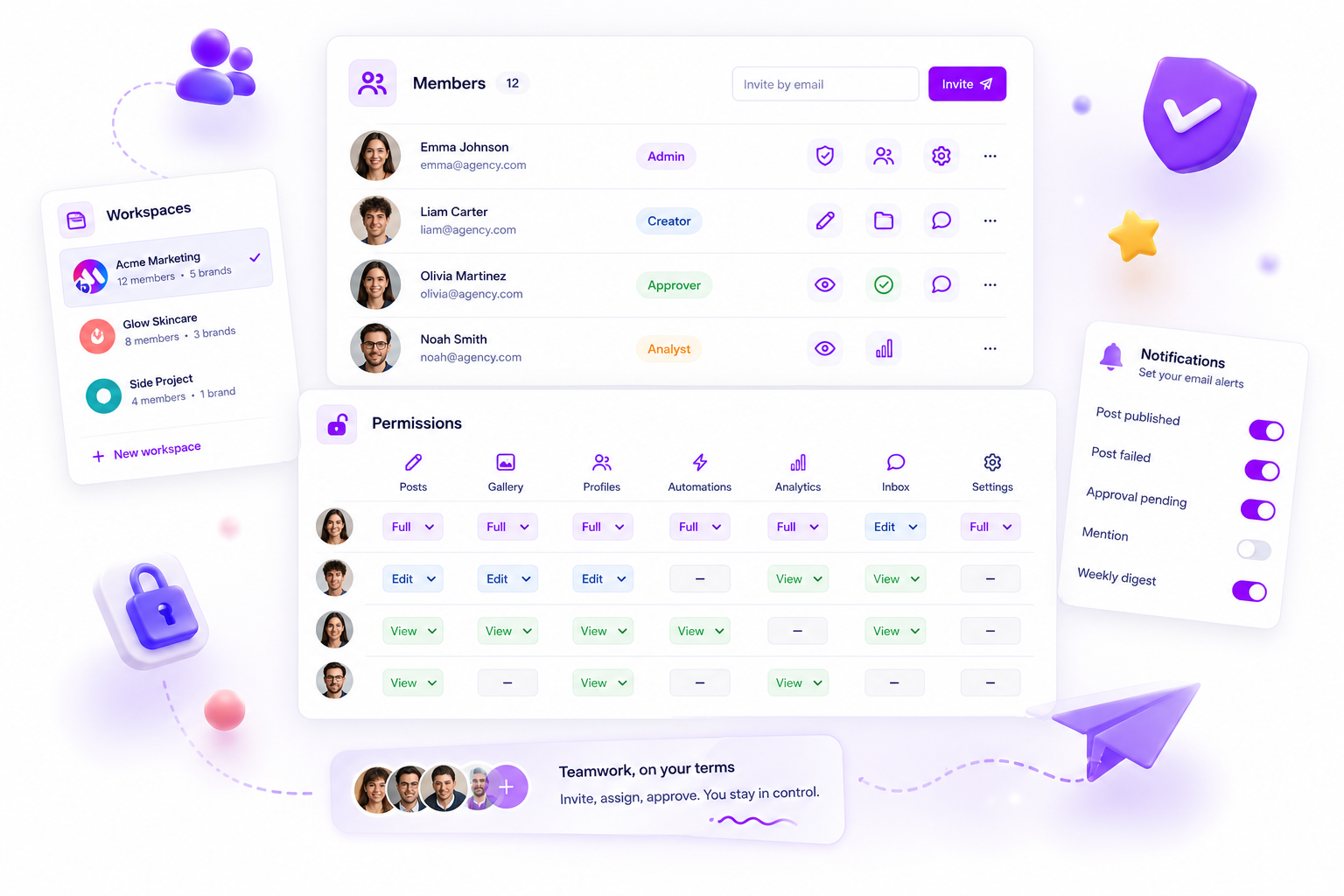
At Mydrop, we approach this by storing permissions as an arbitrary member resource/action map. Instead of hard-coding roles that rarely fit the nuances of real-world agency work, each user document acts as a unique permission footprint. This means you can add a new resource or a new brand to your workspace without needing to reinvent your entire user hierarchy from scratch.
When you open the Settings > Members and permissions view, you shouldn't see a giant wall of static checkboxes. Instead, look for a system that gives you the flexibility to toggle specific action permissions-like "approve" versus "draft"-without disrupting the rest of that member’s access. This is how you stop managing roles and start managing work.
This shift turns your permission system from a static barrier into a flexible, operational advantage. When you stop worrying about who has access to what, you can finally focus on actually managing the content.
Where basic tools start to break
When your team grows past a handful of people and a couple of profiles, the "Admin-or-nothing" permission model becomes a liability. You likely feel the friction when a simple request-like asking a local market manager to review their own drafts-triggers a request for full workspace access.
This is where the "Role Bloat" tax hits your operations. You end up with 15 people tagged as Admins because it was the only way to get them the right level of visibility. Suddenly, your security footprint is massive, and one accidental deletion from a well-meaning teammate could derail your entire weekly campaign.
Basic tools usually fail in these scenarios:
- The Approval Bottleneck: Only a few users have the "Approve" permission. They become the single point of failure for everything, turning a senior director into a glorified bottleneck who has to manually click "approve" on 50 routine posts a week.
- Permission Creep: Since there is no way to restrict access to specific brands or regions, everyone sees everything. You cannot safely bring in a client or a seasonal contractor without giving them keys to your entire agency portfolio.
- Notification Fatigue: When you cannot configure granular notification preferences, users just turn everything off to escape the noise. That is how urgent approval requests get missed and deadlines slide.
In our experience, most teams do not have a content production problem. They have a decision bottleneck caused by tools that treat "access" as a binary switch rather than a spectrum.
The buying criteria that matter
When you are auditing your current stack or evaluating a new one, don't ask if it has permissions. Ask how it stores and applies them. You need to know if the tool can handle the messy reality of enterprise social operations.
Use this decision matrix to determine if your current setup is built for scale or if it’s destined to break when you add your next brand.
Permission Scalability Matrix
| Feature | Basic Tool Logic | Scalable Enterprise Logic |
|---|---|---|
| Role Definition | Hard-coded Enums (Admin/Editor) | Resource-Action Maps (Per-resource control) |
| Onboarding | Manual setup per user | Template-based role application |
| Visibility | All-or-nothing access | Brand/Profile-specific isolation |
| Action Control | Global "Create/Delete" | Granular "Approve vs. Draft" |
| Maintenance | Manual "Permission Audit" days | Implicit access via team membership |
Operator rule: If you have to create a new, custom role every time you add a new regional manager or client stakeholder, your tool is not scaling-it is just creating more management debt for you.
To make an informed decision, ensure your shortlist checks these boxes:
- Resource-Level Granularity: Can you restrict a user to only seeing drafts for Brand A while keeping Brand B completely hidden? If the answer is "no," you are one error away from a data leakage incident.
- Decoupled Approvals: Does the tool allow someone to create content without the ability to approve it, and-crucially-can you assign different approvers per specific brand?
- Self-Service Preferences: Does the tool overwhelm users with noise, or can individual members manage their own notification settings? Reducing notification noise is a feature, not a setting.
- Auditability: Can you quickly see who has access to what, or are you relying on a spreadsheet that hasn't been updated in six months?
At Mydrop, we treat permissions as a dynamic map rather than a static role. We see thousands of workflows across brands and agencies, and the teams that thrive are the ones that apply "Least Privilege at Scale." They don't want to manage users; they want to define access once and let the system handle the enforcement, ensuring that the right stakeholders see exactly what they need-and nothing more.
How Mydrop supports this workflow
At Mydrop, we approach permission management not as a top-down mandate, but as a granular, resource-driven map. We see teams managing hundreds of brand profiles hitting a wall because their tools force a binary choice: either grant full admin access to keep work flowing, or lock people out and stop the work entirely. We built Mydrop to bypass this false trade-off.
Because we treat permissions as a dynamic resource-action map-where you can define exactly who can create, read, update, delete, or approve for specific objects like posts, gallery assets, or inbox threads-you finally get to practice true Least Privilege at Scale.
Instead of struggling with "Role Bloat" where everyone ends up as an Admin, you can provision access that matches the actual operational need. If a contractor in the German market needs to draft content for local profiles but shouldn't touch analytics for the North American division, you set that mapping once. Missing keys default to false for security, so there is no risk of accidental "permission creep" as you onboard new users or add new brands.
Decision check: If your tool requires you to create a new, distinct "Admin" account just to bypass a restriction, you have already lost control.
A simple shortlist checklist
Before you commit your team to another year on a platform that creates more coordination debt than it resolves, run this quick check against your current stack. If you can’t tick at least four of these, you are managing a platform, not a social media operation.
| Requirement | Why it matters |
|---|---|
| Profile-level isolation | Can you restrict users to only the specific brands they own? |
| Action granularity | Does a user have draft rights without the ability to publish? |
| Notification triage | Can team members toggle email/system alerts per operational event? |
| Template-based roles | When a new brand is added, can you apply a role template to 10 users at once? |
| Audit visibility | Is there a single view of who holds which permission keys? |
Conclusion
The bottleneck in your social media machine is rarely a lack of creative talent or platform insights. It is almost always a lack of clean, scalable governance. When your permissions are tied to static, rigid roles, you aren't just slowing down content; you are building a system that requires human intervention for every single change.
Stop settling for tools that make "Admin" the only way to get work done. A modern social media stack should get out of your way, allowing your team to move fast without exposing the business to unnecessary risk. If you are ready to stop managing bottlenecks and start managing your brand portfolio, it might be time to look at how a truly granular, map-based permission system could actually function for your team.