The biggest drain on your agency's efficiency is not the content calendar or the approval process: it is the silent, ongoing "credential tax" you pay every time you ask a client to share their social media passwords. It is unprofessional, it creates unnecessary security risks for both of you, and it turns a simple onboarding task into a 48-hour game of email tag. If your current setup involves gathering credentials via insecure spreadsheets or unencrypted messaging apps, you are already behind. You need a rigorous operational audit of how you connect client profiles, moving toward a total zero-credential onboarding model. This post will help you diagnose where your current workflow is leaking trust and efficiency, and give you a framework to fix it.
We have all been there: it is 2:00 a.m. and a critical LinkedIn Page connection breaks. You cannot fix it because you do not have the client’s login, and they are definitely not awake to help you. That is not just a nuisance: it is a failure of your operational infrastructure.
| Workflow Type | Password Sharing | Security Risk | Team Time Cost |
|---|---|---|---|
| Direct Login | Required | High | High (manual entry) |
| Basic OAuth | Sometimes | Medium | Moderate |
| Portal OAuth | Never | Low | Minimal |
What the best tools need to handle

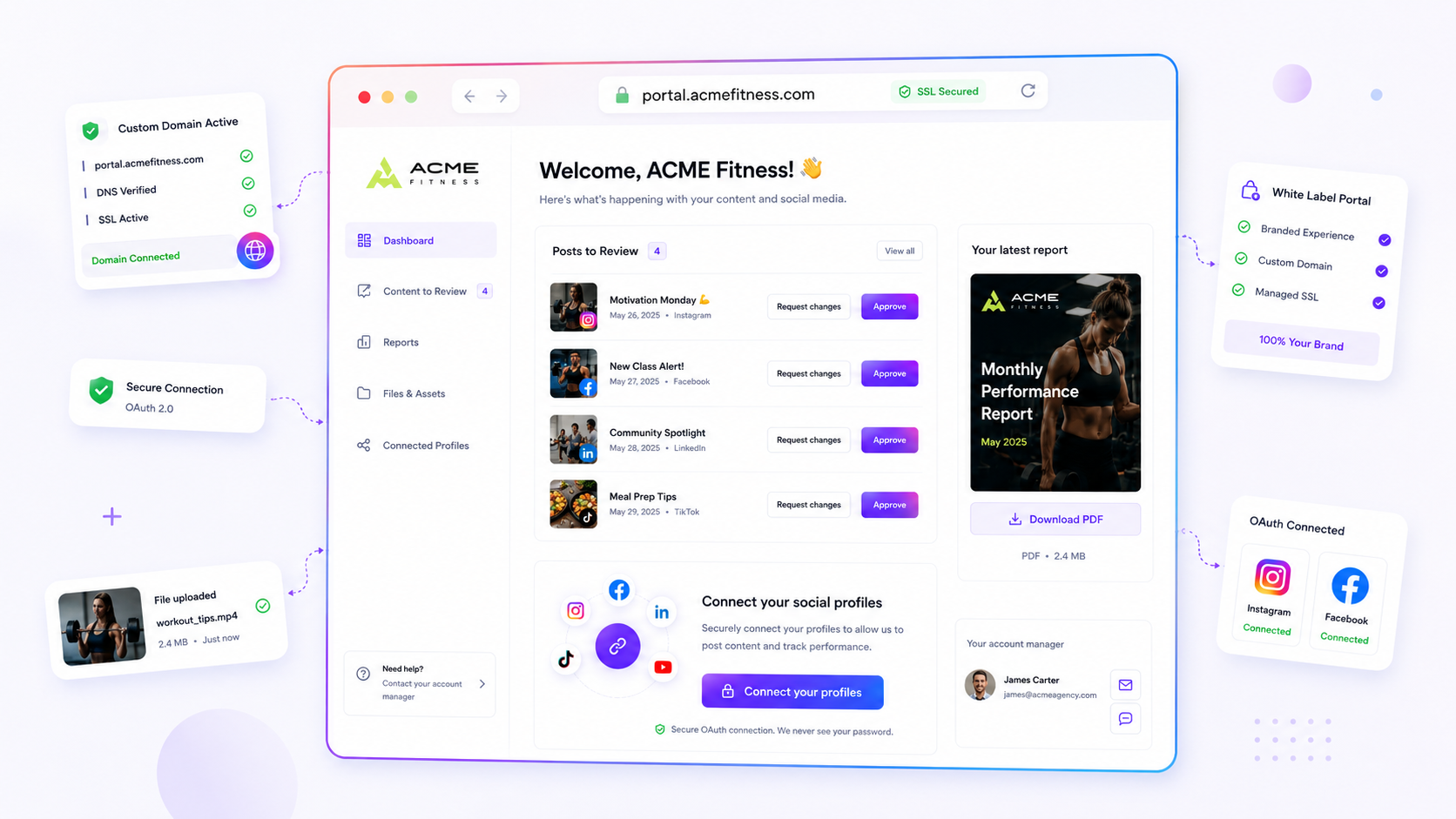
When you are managing dozens of brands, you cannot rely on manual, fragile processes. Any tool aiming to support professional teams needs to handle profile connections with structural integrity, not just convenience. If your platform does not support a portal-based approach that allows clients to authorize access without you ever touching their credentials, you are setting yourself up for future outages and compliance headaches.
Beyond just avoiding password sharing, the best connection workflows must handle the messiness of real-world enterprise accounts. They need to provide a clear, pending review step where you can preview and select the exact pages or channels returned by an OAuth provider before they hit your system. Without this, you end up accidentally importing private profiles or irrelevant pages that clutter your dashboard and confuse your team.
Furthermore, a robust setup requires proactive token management. Your platform should handle token refresh cycles quietly in the background, rather than forcing you to reach out to clients every time an authentication token nears its expiration date. At Mydrop, we have found that the most successful agencies treat profile connectivity as a set-and-forget operational component, relying on portal-based flows that keep the agency out of the security loop while keeping the client in control.
Ultimately, the goal is to transform onboarding from a high-friction hurdle into a seamless, trusted component of your service delivery. If you cannot authorize a new brand channel in minutes without needing a client's password, your infrastructure is not built for scale.
Where basic tools start to break

Your agency starts to feel the "password-sharing tax" the moment you move from managing a single, boutique brand to juggling a portfolio. Basic tools that rely on direct credential entry or simplistic, one-and-done OAuth flows quickly become operational liabilities.
Here is where the cracks begin to show:
- The Credential Fragility Trap: If your tool requires a permanent login or a weak OAuth setup, one client changing their password-or even just toggling a security setting-breaks your entire publishing bridge. You are suddenly chasing down a client at 2 AM for a re-auth before a campaign launch.
- The Scope Creep Risk: Older platforms often ask for "everything or nothing" permissions. You might only need to post to a LinkedIn Page, but the tool requests access to the client’s entire personal network. This is a non-starter for enterprise brands with strict compliance mandates.
- The "Account Soup" Problem: When you connect a corporate Facebook account, the provider might return twenty pages, groups, and ad accounts. If your tool doesn't let you review and filter this list, you end up with an unmanageable mess of disconnected profiles that clutter your dashboard and confuse your team.
This is not just a minor inconvenience. It is a fundamental lack of governance. When your tools cannot isolate what you can access, they turn you into a risk factor rather than a strategic partner.
The buying criteria that matter
Stop evaluating social tools based on just the number of platforms they "support." That is the baseline expectation, not a differentiator. Instead, evaluate the onboarding integrity of the tool by testing how it handles complex, multi-party connections.
If you are a team managing dozens of brand profiles, use this scorecard to evaluate your next platform.
| Capability | Legacy Approach | Enterprise Requirement |
|---|---|---|
| Credential Handling | Requires client password sharing | Zero-Credential: Portal-based OAuth only |
| Account Import | Imports all available accounts | Review & Confirm: Filter before creation |
| Permission Scope | Broad, persistent access | Least-Privilege: Granular, revokable scopes |
| Token Resilience | Manual re-auth on expiry | Automated Health Checks: Proactive alerts |
| Connection Flow | Direct login (High friction) | Portal-led: Client manages their own access |
Operator rule: Never treat a "successful connection" as a static event. It is a dynamic state that requires automated health monitoring and zero-touch re-authentication workflows.
When you look at this scorecard, the differentiator isn't the list of supported platforms; it is the administrative control you retain. Does the tool treat the client as a partner who authorizes access, or as a source of passwords? The former creates a sustainable agency workflow. The latter builds up coordination debt that will inevitably lead to a broken, high-pressure crisis when an integration finally expires.
A tool that forces you to hold the keys to the kingdom is a tool designed for a solo creator, not an enterprise operation. You need an architecture that allows the client to grant access through a secure portal, ensuring your team has the specific permissions required to perform their jobs without ever seeing or storing a password. When you shift to this model, you don't just gain efficiency-you regain the trust of your clients.
How Mydrop supports this workflow
When you stop asking for client passwords, you immediately neutralize the biggest security risk in your agency. You have to make this transition because your liability footprint grows linearly with every password you store in a spreadsheet or a shared document.
At Mydrop, we designed the portal-based connection flow to solve this coordination mess without forcing your team to act as an IT help desk. Instead of the back-and-forth hunt for login credentials, your client logs in to a secure portal, initiates the OAuth handshake directly with the network, and your team only ever receives the publishing token. You never see the password, and the client retains full control over their own authentication state.
This is the part people underestimate: it is not just about the security, it is about the onboarding speed. In our experience, teams managing hundreds of brand profiles lose hours every week simply chasing down re-authentication requests for expired tokens. Because we store the OAuth state locally and monitor token health, Mydrop allows your team to trigger refresh requests directly from the dashboard, without waking a client up at 2 a.m. for a routine credential update.
Furthermore, we know the "accidental import" is a common failure mode. When a client authenticates a business page, you often get a long list of associated accounts, some of which might be personal or irrelevant to the campaign. Mydrop makes this mandatory by adding a "pending profile" review step. You see a clear preview of all associated profiles, and you select only the ones relevant to the contract before any profile is actually created. It turns a chaotic guessing game into a structured, reliable onboarding step.
A simple shortlist checklist
Audit your current onboarding against this five-point framework to see if your agency is currently leaking trust or wasting billable hours.
- [ ] Password-Free Onboarding: Can a client connect a new page without your team ever knowing or handling their social account password?
- [ ] Token Health Monitoring: Does your tool automatically notify you when a token is about to expire, or do you only find out when the posts fail to publish?
- [ ] Pending Profile Review: Is there an explicit step where you review and approve specific profiles before they are added to your agency’s workspace?
- [ ] Granular Scope Control: Can you limit the client’s authorization to only the specific profiles you need to manage, or are you forced to request full account access?
- [ ] Self-Service Reconnection: If a token expires, can the client fix it via a secure link without you having to re-run the entire onboarding flow?
If you answered "No" to three or more of these, you are not just inefficient, you are operating with unnecessary risk.
| Audit Metric | The "Quick & Dirty" Way | The Modern Operator Standard |
|---|---|---|
| Credential Handling | Shared spreadsheets, plain text | OAuth via secure brand portal |
| Token Refresh | Manual, often broken | Automated, proactive alerts |
| Onboarding Step | Batch import, audit later | Selective review, approve first |
| Client Effort | High, constant friction | Low, one-time setup |
Conclusion
The truth is, most agencies do not have a connectivity problem. They have a trust problem. Every time you ask a client for a password, you are asking them to prioritize your convenience over their security, and that is a conversation you do not want to keep having.
The move to portal-based, OAuth-first connections is not about upgrading your software stack; it is about maturing your agency’s operations. It changes the dynamic from a scramble for access to a professional partnership where your tools handle the heavy lifting of compliance and connectivity. Your team should be spending their time on strategy and creative execution, not chasing down expired tokens or managing password security for their clients. Start the audit today, identify the friction points, and build a workflow that actually scales with your client list.