
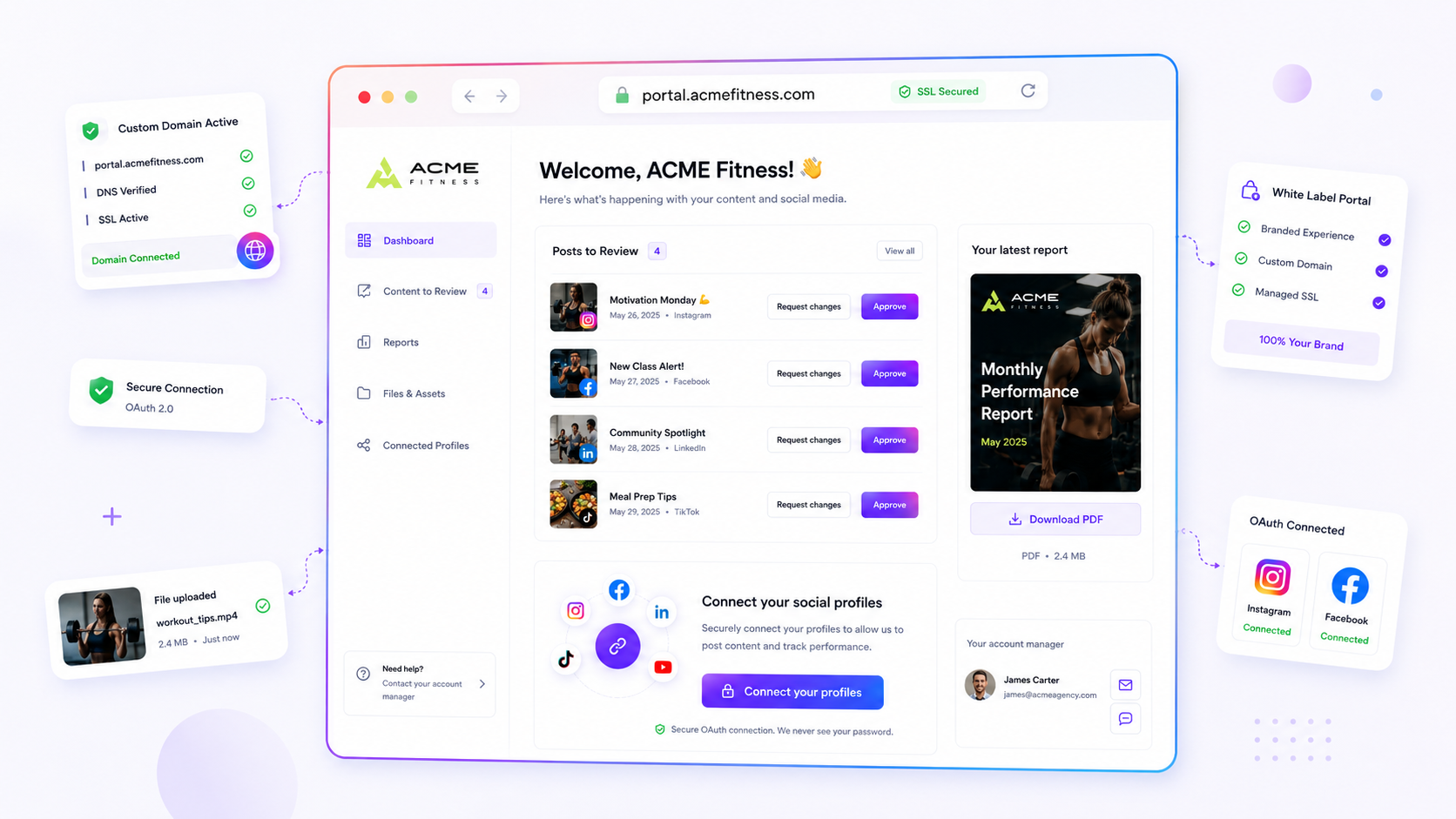
Stop handing over social media assets that point to your software provider's domain. If your agency is building the strategy, the infrastructure-down to the link-in-bio-should live on your client's property.
We get it. You are managing dozens of accounts and chasing tight deadlines. Adding DNS propagation and SSL certificate management to your checklist feels like one more administrative headache you do not have time for. But that "convenience" is leaking your agency's value. Using generic, platform-hosted URLs for client work isn't just a branding oversight; it is a fundamental breakdown in trust that signals "vendor" status rather than "strategic partner."
By hosting on a platform URL, you aren't just directing traffic; you are telling your client's customers that your agency is a transient service, not an essential infrastructure partner. It’s time to stop treating client digital touchpoints like temporary staging sites.
Where the handoff is actually breaking

The friction usually starts with a simple, well-intentioned decision: "Let’s just get the campaign live today, we’ll swap the domain later." That temporary state becomes permanent, and suddenly, you have a fleet of client pages living on your provider's domain.
This is where the psychological shift occurs. When a client sees their premium campaign funnel directed through a generic, third-party URL, their confidence in your agency’s ownership of their brand subtly dips. It feels like an afterthought.
Here is how the perception shifts when you rely on platform-provided URLs:
| Metric | Platform-Hosted URL | Client-Owned Custom Domain |
|---|---|---|
| Brand Authority | Low; looks like a free, temporary tool. | High; signals enterprise-level permanence. |
| Audience Trust | Variable; users may hesitate at unknown redirects. | High; matches the primary brand domain. |
| SEO Spillover | Zero; equity stays with the software provider. | Full; builds authority on the client's own domain. |
| Professionalism | Feels like a "vendor" service. | Feels like an integrated, strategic partner. |
When you share a link-in-bio that screams "free tier software," you are inadvertently telling your client that their brand identity is secondary to your internal operational speed.
Teams often avoid custom domains because of a perceived technical mountain. They imagine long email chains with the client’s IT department, failed SSL handshakes at midnight, or broken links mid-campaign. In reality, most of that friction is just legacy overhead. Modern tools like Mydrop allow you to manage this white-label infrastructure-handling DNS verification and managed SSL provisioning-without needing to be a systems engineer.
If your team is still sending clients links that don't match their brand, you are creating a branding gap that no amount of beautiful creative can fully close. The goal is to move those decisions closer to the work, empowering your team to set up these branded surfaces as a standard part of onboarding, not as a technical exception.
The coordination debt checklist

Most agencies stop at the "nice-to-have" phase of client onboarding, treating custom domains as a task for the client to handle later. This creates a hidden friction point where your team spends weeks chasing IT departments for DNS records or manual SSL renewals. By the time the brand portal is actually live, you have already lost the momentum of the launch.
To stop the recurring scramble, treat domain readiness as a foundational step. If the link-in-bio isn't on the client property before the first post goes live, it doesn't exist.
Use this audit to see if your onboarding process is actually ready for prime time:
| Audit Item | Risk Level | Action Rule |
|---|---|---|
| DNS Access | High | Request CNAME/A-record instructions during contract signature, not post-setup. |
| SSL Provisioning | Medium | Use automated management tools to avoid manual certificate lifecycle tracking. |
| Ownership Logic | Low | Verify the client owns the domain registration to prevent "vendor lock-in" claims. |
| Routing Plan | Medium | Map the link-in-bio vs brand portal path before any domain assignment occurs. |
Operator rule: If you need to involve a client IT team more than once to set up a URL, your workflow is broken. Choose platforms that allow asynchronous DNS verification and auto-provisioning so you can "set and forget" the infrastructure.
How to move decisions closer to the work
When your junior team members cannot update a client URL without an internal ticket or an engineering sprint, your agility dies. The goal is to distribute the authority to manage digital touchpoints to the people actually shipping the social strategy.
At Mydrop, we see the most successful teams treat custom domain setup as a self-service task rather than a technical escalation. When your software handles the heavy lifting-like mapping certificate IDs to workspace targets or refreshing expired SSL states-you remove the gatekeepers.
You can shift your team culture by following these three steps:
- Standardize the Handoff: Create a shared workspace template for every client that includes a predefined placeholder for their custom domain.
- Remove the Escalation: Use tools that let operators verify DNS and initiate managed SSL lifecycles directly from the settings panel. If an SSL error pops up, they should be able to trigger a refresh manually without waiting for a developer to check the server logs.
- Automate the Governance: Use background jobs to monitor domain health across your entire client portfolio. If a certificate is nearing expiry or a DNS record goes dark, the platform should notify the account lead immediately.
The real cost of a "simple" link-in-bio is not the software subscription, but the time spent fixing broken redirects. If your team spends more than two hours a month on link maintenance, you are paying for an infrastructure that should be managing itself. Empowering your team to own the infrastructure lets them focus on the work that actually generates client growth.
The roles and rules that reduce rework
The reason custom domain setups often stall is that everyone assumes someone else is handling the DNS verification or checking the SSL certificate state. We have seen this across dozens of agencies; when ownership is diffuse, every small technical snag becomes a week-long blocker. You need to assign these roles clearly to move faster.
Assign a Domain Owner for each client account. This person doesn't need to be an engineer, but they must be the one responsible for the final "check DNS" click in Mydrop. If they are a social media manager, give them the credentials to the client's registrar or a clear internal handoff path so they aren't waiting on IT for every update.
Decision check: Never treat a domain setup as a background task. It is a launch milestone. If the SSL status is still pending, the campaign is not live.
Define a clear escalation path for when things go sideways. If the SSL provisioning fails because of an expired DNS record or a misconfigured target, don't leave it to the client to figure out. Empower your team to spot the error in the dashboard and provide the client with a single, copy-pasteable DNS update. This turns a technical failure into a quick, professional service interaction.
The weekly habit that keeps the system honest
You are juggling hundreds of links across multiple clients, and manual auditing is a recipe for broken experiences. Instead of spot-checking every link on a Friday afternoon, build a 15-minute "infrastructure health" habit into your team's Monday morning sprint.
Use this simple audit list to ensure your portfolio remains professional:
| Task | Indicator | Action if Failed |
|---|---|---|
| SSL Status Check | Active state in portal |
Refresh SSL certificate manually |
| DNS Propagation | Mydrop target resolves correctly | Re-verify target and DNS records |
| Asset Consistency | No generic mydrop.me URLs in bios |
Update to client-owned branded URL |
| Portal Access | Internal brand portal loads on custom host | Re-assign target or update routing |
This routine prevents the embarrassing moment where a client clicks a link during a board meeting only to find an expired certificate. Consistency here isn't just about technical hygiene; it is how you build a reputation for reliability that keeps enterprise clients renewing year after year.
Conclusion
The difference between a vendor and a partner often comes down to the ownership of digital touchpoints. By moving client link-in-bio surfaces to their own domains, you stop being a tenant on your software provider's infrastructure and start building permanent, trusted assets for your clients.
It is rarely a lack of technical skill that stops this from happening; it is the habit of taking the path of least resistance. The next time you onboard a new client, skip the public URL. Connect their domain, verify the path, and deliver a piece of property that actually belongs to them. In this business, those small shifts in ownership are exactly what make the partnership last.