
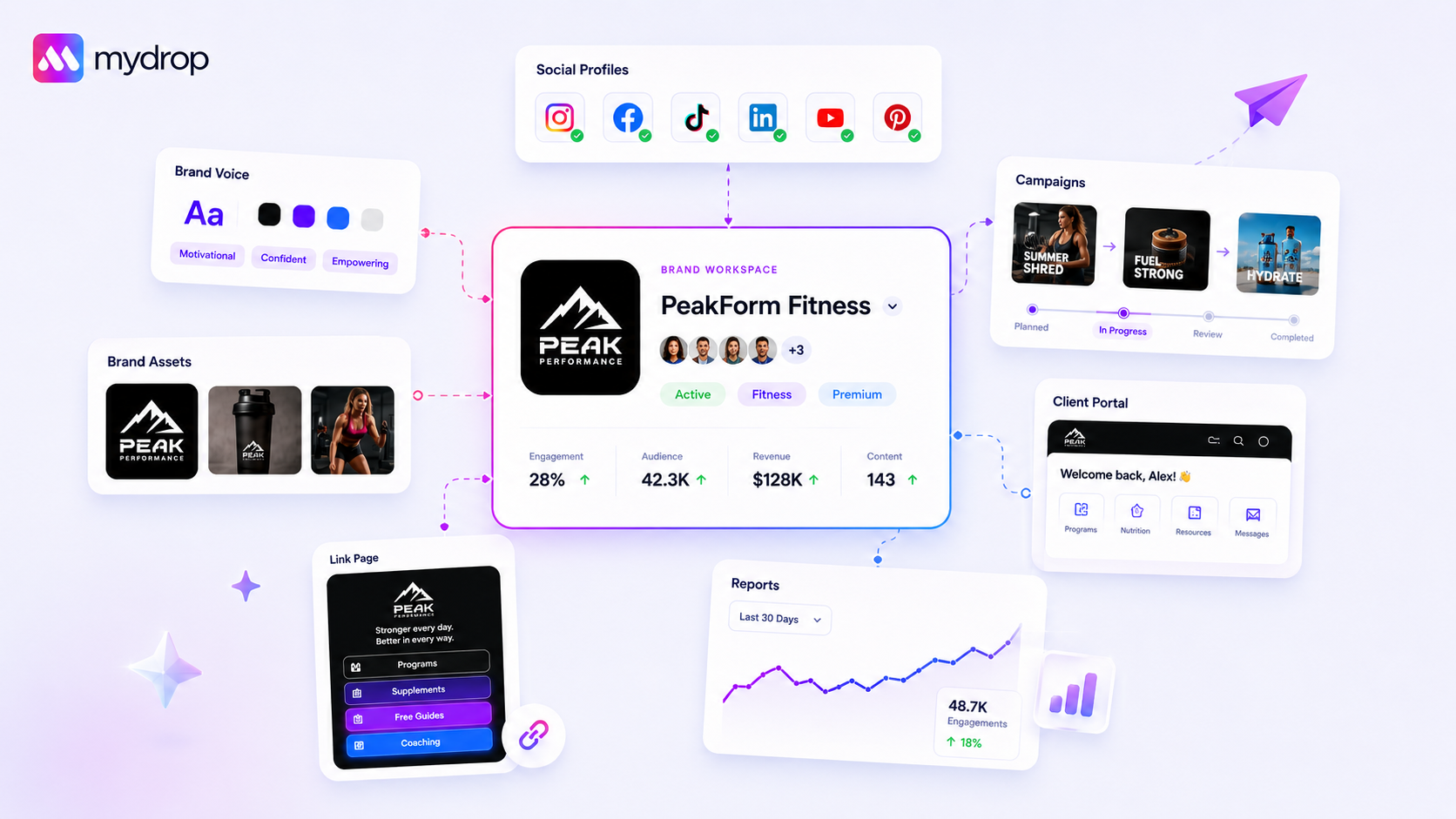
The best social media grouping software for agencies must move beyond simple folder structures, centering instead on a unified Brand object. You need a platform that treats your client's identity-colors, logos, tone, and goals-as a primary operational entity that persists across every post, report, and inbox reply, rather than forcing you to manually re-apply these settings for every single channel.
We know the agency-client shuffle is exhausting. You are likely toggling through disconnected profiles, hunting for the right logo, and manually checking if a post matches the client's current voice. This isn't just annoying; it is a hidden tax on your team's sanity and a massive compliance risk. When your tool treats every profile as a silo, every task becomes a potential point of failure.
The transition from managing a list of handles to orchestrating a unified client brand is the single biggest step toward reclaiming hours of overhead.
What the best tools need to handle

To stop paying the Context Switching Tax, your software must support an "identity-first" workflow. If you are still manually selecting color palettes or hunting for the correct brand folder every time you build a campaign, your tool is working against you.
The best platforms act as a single source of truth for the entire brand ecosystem, not just a relay for content.
Operator rule: If your team has to re-authenticate or manually re-map assets when adding a new channel to an existing client, you are using a legacy silo-based tool. Stop.
Here is the diagnostic checklist for the features that actually matter when you are evaluating software for a multi-brand agency:
| Capability | The "Siloed" Failure Mode | The Identity-First Standard |
|---|---|---|
| Asset Inheritance | Manual upload per platform; high risk of outdated logo use. | Centralized brand media automatically available in every composer. |
| Identity Context | Tone and goals stored in a separate, disconnected doc. | Structured AI prompt data embedded directly in the brand record. |
| Profile Management | Adding a channel requires rebuilding the entire client setup. | Profiles are group-members; adding a new channel inherits all existing assets. |
| Reporting | Manual channel-by-channel data aggregation. | Automated, brand-level performance rollups by default. |
At Mydrop, we have seen hundreds of teams struggle because their tools treat "Brand" as a metadata tag rather than an operational core. When you group profiles under a central brand, you aren't just tidying up your navigation menu; you are creating a pipeline where AI generation, content scheduling, and performance tracking all inherit the same context.
If your team is managing dozens of stakeholders and complex approval loops, you cannot afford to have assets locked away in individual channels. You need a setup where an update to a brand color or a logo file propagates to every active campaign instantly. Without this, your "single source of truth" is just a suggestion.
Where basic tools start to break
The real headache begins when your management tool assumes every social profile is an island. Most legacy platforms force you to manage content at the handle level, which means you are manually stitching together the brand experience every time you create a post. You end up chasing down logos in Slack, manually typing out hex codes, or copy-pasting mission statements because the tool simply doesn't know who the brand is.
This is where the Context Switching Tax hits your bottom line. If a team member has to toggle between a "Google Drive folder" for assets, a "color palette cheat sheet" on a sticky note, and their "scheduling dashboard" to get one post out, they aren't just losing time-they are losing consistency. You eventually reach a breaking point where the human cost of manual oversight outweighs the value of the content itself.
| Failure Mode | What Happens | The Real Cost |
|---|---|---|
| Asset Siloing | Logos and files live in folders, not the post composer. | Constant file hunting; risk of using outdated branding. |
| Identity Drift | Tone and mission are kept in a separate document. | Inconsistent voice; requires constant senior review. |
| Profile Fragmentation | Profiles are just a list, not a connected group. | Manual re-mapping for reports; error-prone analytics. |
| Manual Auth Loop | Removing a profile breaks all related campaign assets. | Hours of admin work just to update a client setup. |
The buying criteria that matter
When you are ready to stop fighting your software, you need to look for platforms that treat the Brand as the primary object, not the social channel. A robust grouping system doesn't just hold profiles; it holds intelligence.
Before you commit to a platform, run your current workflow through this check:
- Unified Asset Inheritance: Can you attach a logo, color palette, or font family once, and have it instantly available across all AI tools and post composers for that entire client?
- Dynamic Membership: If you add or remove a profile (e.g., adding a new TikTok handle for an existing client), does the brand context automatically propagate to that channel without requiring a full system reboot?
- Intelligence Context: Can the platform store "AI prompt guidance"-your tone of voice, target audience, and current marketing goals-so that any draft generated for that brand starts with the right DNA?
- Operational Separation: Can you manage a campaign for one brand entirely within its own folder, keeping it logically and visually isolated from your other fifty clients?
Decision check: If your team spends more than 15 minutes setting up a new client brand or importing their assets, your software is doing the work you should be doing.
At Mydrop, we have seen this play out thousands of times: teams fail not because they lack creativity, but because they are stuck in a cycle of administrative maintenance. They spend their energy keeping the "machine" running rather than producing the work. True enterprise efficiency is about shrinking the distance between a brand idea and its final, on-brand execution across every channel you manage.
How Mydrop supports this workflow
At Mydrop, we built our brand grouping feature to solve the "context switching tax" that grinds agency teams to a halt. When you organize by Brand in Mydrop, you are not just grouping URLs; you are creating a living, breathing digital twin of your client.
We treat your client's identity as a first-class citizen. You can extract brand colors and assets directly from their website with a few clicks, instantly populating your workspace with the right logos, font styles, and media. From there, these assets are automatically surfaced whenever you are in the composer or running an AI-assisted campaign.
Because the brand entity manages the profiles and identity context together, you can add or remove a new social handle without ever needing to touch the underlying brand files or reconnect existing campaigns. The system simply knows that the new channel belongs to that client's world, applying the correct tone, hashtags, and visual guidelines immediately.
Workflow check: If your team spends more than ten minutes "finding the right file" or "verifying the hex code" for every post, you do not have a content production problem. You have a coordination debt problem.
A simple shortlist checklist
Before you commit to a platform, run it through this assessment to see if it treats "Brand" as a primary entity or just a folder in disguise.
| Capability | What to ask | The Red Flag |
|---|---|---|
| Asset Inheritance | Do brand colors and logos propagate to the composer automatically? | Manually hunting for hex codes or logo files for every post. |
| Profile Agility | Can I move a profile to a different group without re-authenticating? | A "re-auth" prompt every time you reorganize a client account. |
| Contextual AI | Does the AI know the client’s mission, tone, and goals by default? | Having to paste the same brand mission into every prompt. |
| Portal Integration | Are client-facing portals linked to the brand identity assets? | Having to build separate links or pages for every individual handle. |
If you cannot check all four boxes with a "Yes," you are likely inheriting unnecessary operational overhead that will only compound as you grow.
Conclusion
The transition from managing disconnected social handles to orchestrating unified client brands is the single biggest unlock for agency efficiency. When your tool does the heavy lifting of keeping identities aligned, your team stops acting like file-hunters and starts acting like brand strategists.
Stop paying the daily cost of fragmented tools. Choose a system that lets you build once, group by client, and publish with the assurance that your output actually sounds and looks like the brand you are representing. The headache of the agency-client shuffle is real, but it is entirely optional.