The best social media onboarding software isn't just a set of help pages; it is a dynamic configuration engine that gets new agency hires from "welcome" to "first post" in under ten minutes. When you are managing dozens of client brands across hundreds of channels, your platform must treat account setup not as a manual chore, but as a guided, state-aware workflow. If your team spends their first week hunting for API credentials or guessing brand settings, you are paying a massive "ramp-up tax" that kills your agency's velocity.
We have all been there. You have finally hired the perfect strategist, but they are currently trapped in a three-day loop of email threads, internal wikis, and "where is this setting?" messages. It is exhausting, and quite frankly, it is beneath a modern, enterprise-grade team. Scaling should be about growing your creative output, not increasing your administrative overhead.
The invisible lag is the real killer. Many agencies mistake this friction for a standard learning curve, but if your software requires a manual to connect a profile, it is simply obsolete. The goal is to turn that initial setup into an automated milestone, allowing your new hires to focus on strategy rather than configuration.
What the best tools need to handle

Scaling agencies demand more than a static FAQ section. You need a platform that understands exactly where your new user is in their setup, and proactively nudges them forward with real-time feedback. Documentation is passive; operational guidance is active.
Here is how to grade the platforms you are currently evaluating for your stack.
| Feature | Why it matters for agencies |
|---|---|
| State-Aware Onboarding | Automatically hides completed steps so users don't waste time repeating work. |
| Persistent Quick Start | A checklist driven by real data (connected profiles, assets) rather than just checked boxes. |
| In-App Guided Tours | Interactive walkthroughs (Intro.js style) that prevent users from wandering off-platform. |
| Contextual History | A "Home" board that lets users instantly jump back into recent chats, notes, or post drafts. |
| Training Lead Capture | Direct paths to virtual training programs so your team gets formal support without leaving the tool. |
Operator rule: If a user cannot reach their first successful content execution (scheduling a post) within 10 minutes of account setup, your onboarding software is failing.
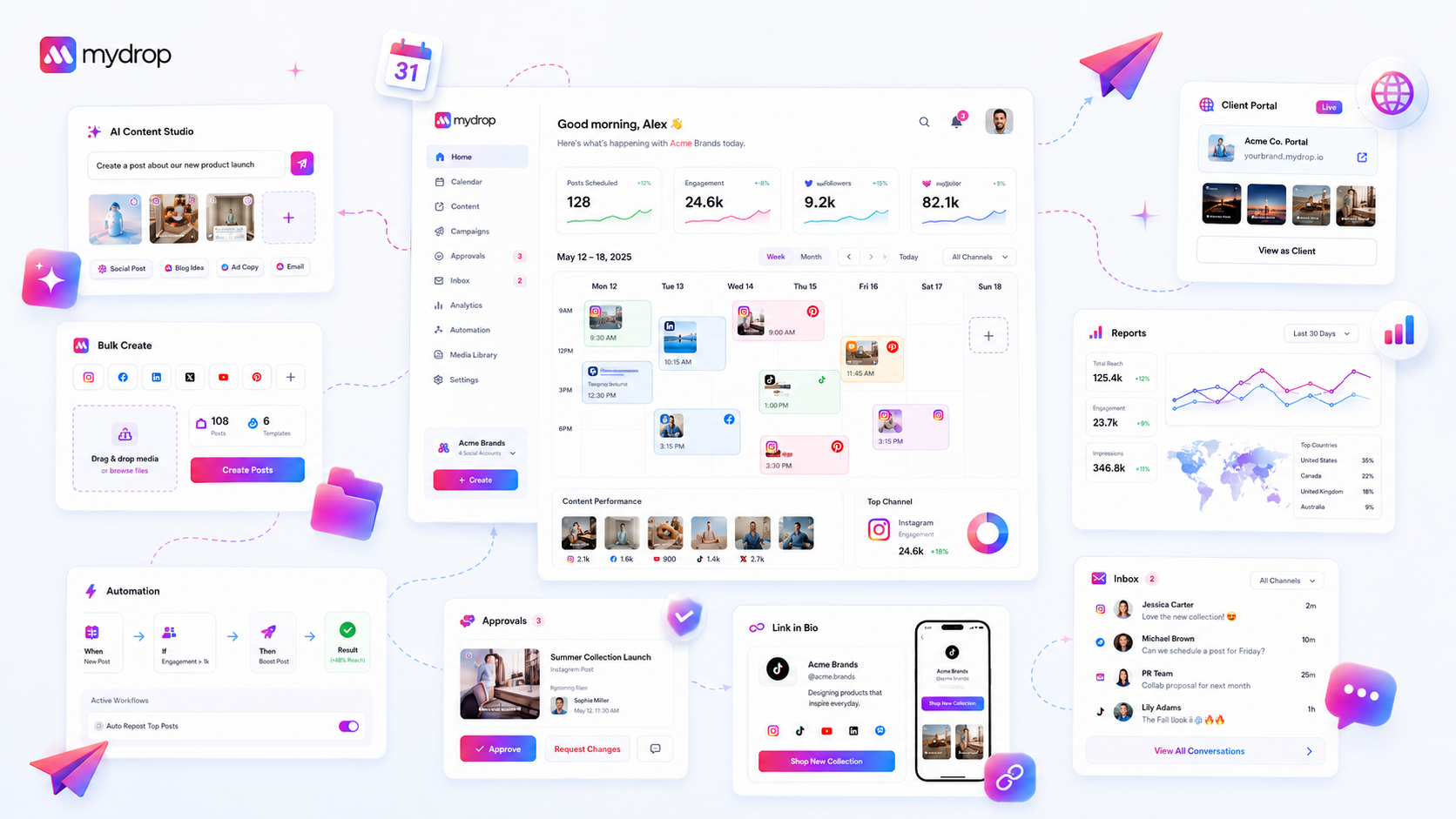
When we designed Mydrop, we treated onboarding as a core product feature rather than an afterthought. We don't just point users to a help link; we use a Quick Start Panel that validates milestones-like profile connections and asset uploads-in real-time. If a new manager has connected their accounts but hasn't tried our AI-assisted post generation, the workspace prompts them with the exact next step.
This approach ensures that "onboarding" is not a phase you survive, but a fast-track into the actual, productive work of your agency. Stop accepting "documentation-heavy" legacy platforms that force your team to solve their own software problems. Look for tools that act as a bridge, not a barrier.
Where basic tools start to break

Basic tools fall apart the moment your team grows past a handful of people because they treat onboarding like a static document repository. You get a "Getting Started" link, a five-page PDF, and a wish of good luck. This is the Help-Documentation Maze. Your new hire spends two hours reading, another hour hunting for the "Connect Account" button, and finally gives up to ask a senior teammate for a screen-share.
That screen-share is the moment your productivity dies. It is a one-time fix that doesn't scale, leaves no record, and pulls your most senior people away from strategy to play IT support. When software lacks interactive product tours or an in-app state tracker, it essentially assumes the user is a mind-reader. It doesn't know if the user is stuck, it just shows a dashboard and hopes for the best.
Common mistake: Relying on external wikis that are never updated. If the onboarding isn't inside the tool, it's just noise.
The buying criteria that matter
When auditing your current stack, stop looking for "comprehensive features" and start looking for contextual intelligence. A platform should know exactly where a user is in their setup journey. If your software can't tell the difference between a seasoned manager and a new hire who hasn't connected a single asset, it cannot offer the right help.
The Agency Onboarding Scorecard
Use this rubric to evaluate if your current platform is a bottleneck or a catalyst.
| Evaluation Criterion | The "Manual Debt" Way (Low Score) | The "Velocity" Way (High Score) |
|---|---|---|
| Setup Guidance | Static PDFs, external help docs. | Contextual, in-app tours (e.g., Intro.js). |
| Milestone Tracking | Manual check-ins, email status. | Live Quick Start state validation. |
| User History | Searching through folders/slack. | Home board with recent posts/chats. |
| Training Capture | Sending leads to an external form. | Embedded virtual-training lead capture. |
| Tool Intelligence | No visibility into user progress. | Deep product state awareness. |
The 10-Minute Rule: If a user cannot reach their first successful content execution (scheduling a post) within 10 minutes of account setup, your onboarding is failing.
At Mydrop, we see agencies waste hundreds of hours annually on basic setup friction. We built our Quick Start panel to eliminate this by validating live product data against a progress checklist. Instead of asking "Did you read the article?", Mydrop checks: "Are profiles connected? Is media uploaded? Has the user tried AI post generation?"
This is the shift from documentation-heavy workflows to data-driven enablement. If your team spends more time figuring out how to use the tool than actually producing content, you aren't paying for software. You are paying for a coordination tax.
How Mydrop supports this workflow
At Mydrop, we approach onboarding as a data-validation exercise, not a reading assignment. We assume that if your new hire is stuck, it is because they are missing a specific piece of state-a connected profile, an assigned brand, or a valid asset-not because they skipped a help article.
The Mydrop approach centers on the Quick Start Panel, which acts as a real-time progress mirror. Instead of guessing if a user understands the platform, the system tracks actual setup milestones like connected OAuth profiles, created brands, and successful AI post generations.
- Guided Setup Flows: We use interactive tours that trigger based on your live workspace state. If you haven't defined a brand asset yet, the system guides you to that specific screen. Once the data exists, the step marks itself as complete automatically.
- Persistent Context: When you return to the Home dashboard after a break, you aren't greeted by a generic welcome screen. You see your recent work history-the draft you were editing, the AI chat you just finished, and the specific reminders you set for tomorrow.
- Virtual Training Capture: For teams that need human-led instruction, we include direct paths to register for our virtual training programs, turning onboarding into an active bridge between software and human development.
Decision check: If a user can see their own progress toward "Done" in real-time, they do not need to email you for a status update.
A simple shortlist checklist
Use this checklist to audit any software you are considering for your agency. If a platform cannot check off these four boxes, your team will continue to pay the "ramp-up tax" every time you hire.
| Milestone | Why it matters | Pass/Fail |
|---|---|---|
| State-driven progress | Does the checklist update based on real data (e.g., connected profiles) or just clicks? | [ ] |
| Guided tour triggers | Can users force a "Show Me" tour for any major feature they struggle with? | [ ] |
| Workspace history | Does the homepage bring the user back to their exact previous state? | [ ] |
| Asset-first setup | Does the flow force brand/asset creation before allowing post scheduling? | [ ] |
If your current tool is essentially a "help desk in a box," you are not using a modern management platform; you are using a digital filing cabinet.
Conclusion
Scaling agency teams often mistake "learning curve" for "platform sophistication." The reality is simpler: a tool that requires your senior strategists to act as full-time trainers for every new hire is eating your margins.
The goal isn't to make software that is simple-social media management at scale is inherently complex-it is to make the path to productivity invisible. When your team spends their first hour in a new workspace actually shipping content rather than hunting for settings, you have finally stopped the bleed of coordination debt.
Most teams do not have a training problem. They have a configuration bottleneck. If you audit your stack today and find that onboarding relies on manuals, PDFs, or generic support pages, you know exactly why your new hires feel like they are starting from scratch every single time.