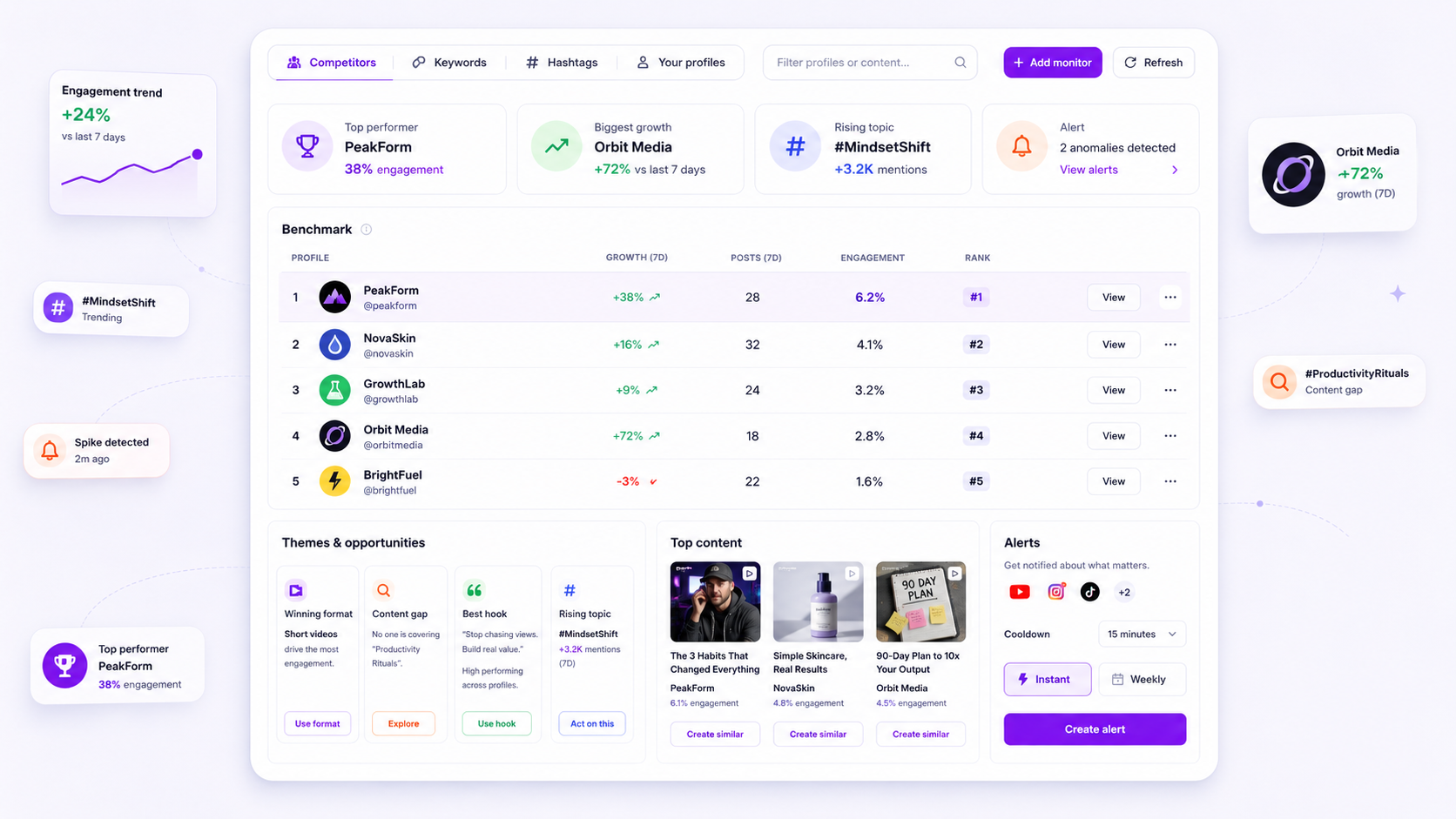
The best intelligence tool for your agency isn't just a data aggregator; it is an early-warning system that correlates your current performance against rising industry themes and competitor benchmarks. If you are still relying on reactive, manual monthly reports to figure out why a campaign flatlined, you are already two weeks behind the market. The goal is to move from simply tracking vanity metrics to identifying exactly where your creative strategy is drifting away from what your audience is actually consuming right now.
We get it. You are likely spending hours pulling reports, only to realize the campaign is flat. By the time you adjust, the trend has moved on. It is high-pressure, it feels like chasing a target that refuses to sit still, and frankly, no one enjoys trying to justify a creative pivot to a client when the data is already cold. You are not alone in this; most teams managing dozens of accounts feel this exact tension between needing to ship volume and wanting to maintain quality.
What the best tools need to handle

When you are managing multiple brands or large-scale social operations, you cannot afford to have your intelligence scattered across a dozen browser tabs. The best tools act as a central command, not just a bucket for data.
To move from "monitoring" to "active intelligence," your tool must handle these three operational non-negotiables:
- Automated Competitive Normalization: You need a single interface that normalizes data across YouTube, Instagram, and X. Comparing raw view counts between these platforms is useless. Your tool should automatically build benchmark rows and ranks so you can see which competitor is actually capturing the market share you’re losing, regardless of the platform.
- Theme-Based Content Gaps: Don't just track "Top Posts." You need to see content recipe clusters. Can your tool tell you that "Short-form interviews under 60 seconds" are currently the winning hook in your niche? If it only shows you likes and shares, it is failing you.
- Proactive Triggering: You need alerts that matter. A basic tool sends you an email when a competitor hits a follower milestone. A great tool alerts you when a topic cluster shifts, allowing you to spot an opportunity before the trend becomes saturated.
| Capability | Basic Monitoring | Agency Intelligence |
|---|---|---|
| Data Scope | Vanity metrics (likes/followers) | Content themes & format recipes |
| Context | Snapshot in time | 90-day trend history |
| Alerts | Milestone based (e.g., +1k fans) | Opportunity based (e.g., topic spike) |
| Workflow | Manual export to CSV | Automated dashboard + Email digests |
At Mydrop, we see agencies get stuck because they analyze their data in a vacuum. You might have a great engagement rate on a specific post, but if your competitor just pivoted to a new content theme that is capturing twice the watch time in your category, your "good" engagement is actually a missed market opportunity. The best intelligence tools don't just tell you what you did; they show you what you should be doing next.
Where basic tools start to break

Most teams start with what they already have: the native analytics suites of individual platforms. It works for a while, until you start managing more than a handful of accounts across different markets. Suddenly, you aren't managing social media; you are managing a coordination nightmare.
Basic monitoring tools fail because they are designed for vanity metrics-likes, follows, and reach-that tell you how loud you were, but not how well you resonated. They treat every platform as an island. You end up manually stitching together PDFs, trying to correlate a YouTube trend with an Instagram hashtag, and by the time the report is ready, the content strategy is already stale.
When you rely on basic dashboards, you aren't actually monitoring intelligence; you are just checking mirrors. You see where you have been, but you have no visibility into the lane next to you. If a competitor shifts their topic clusters or introduces a new visual hook, a basic tool will only show you the result weeks later when their growth has already outpaced yours.
Common mistake: Treating "Reach" as a proxy for "Market Intelligence." Reach tells you who saw your post; Intelligence tells you why your audience is moving toward a competitor's content theme instead of yours.
The intelligence monitoring scorecard
To help you audit your current diagnostic setup, we have put together a scorecard. If your current tool is consistently failing these checks, you are likely operating with a significant blind spot.
| Capability | Basic Monitoring Tool | Agency Intelligence (Mydrop-level) |
|---|---|---|
| Data Normalization | Platform-specific silos | Cross-platform (YT/IG/X) unified view |
| Trend Detection | Manual review of post lists | Automated topic cluster & theme alerts |
| Competitive Context | Limited to owned profiles | Full public profile & hashtag benchmarks |
| Historical Depth | 30 days or less | 90-day+ deep historical trend analysis |
| Actionability | Static PDF report | Triggered alerts & inspiration suggestions |
The buying criteria that matter
When selecting a tool for an enterprise team, do not get distracted by flashy UI or vanity features. The decision should hinge on whether the tool removes the manual friction that keeps your team from acting. In our experience, if a tool requires your team to spend more than 15 minutes a week "refreshing" data, you haven't bought a tool; you've bought a new chore.
Look for a platform that treats intelligence as a dynamic workflow, not a static report. Can the tool ingest a new competitor profile and immediately begin mapping their content recipes? Does it offer automated alerts when a competitor’s top-performing posts deviate from their historical norm?
At Mydrop, we see teams fail when they prioritize "number of features" over "speed to insight." Your ideal tool must handle the heavy lifting of data normalization so your team can focus on the creative pivot. You need an early-warning system, not just a graph. If the tool can't proactively suggest industry leaders based on your existing niche, it is forcing you to do the discovery work that AI should be handling.
Finally, demand transparency on how the tool handles refresh rates and platform API limits. You need to know if your "real-time" alert is actually running on a 24-hour batch cycle, or if you have the control to trigger a manual refresh when a campaign launch is imminent. A tool that hides its operational logic is one that will leave you stranded when you need the data most.
How Mydrop supports this workflow
At Mydrop, we designed the Intelligence Dashboard specifically to cut through the noise of raw analytics. Instead of forcing you to toggle between five different browser tabs for every platform, we normalize the data from your competitors and your own profiles into a single, cohesive view. You get to see the big picture without the manual cleanup.
When you use the Intelligence feature, you aren't just looking at charts; you are building an automated feedback loop. You define the profiles and topics you care about, and the system handles the heavy lifting of fetching daily trends and benchmarking.
- Benchmark Row Normalization: We map performance metrics across YouTube, Instagram, and X, so you can actually compare how a Reel stacks up against a YouTube Short or an X thread without guessing.
- Theme and Gap Detection: The system highlights rising content themes and identifies where you have a "content gap"-meaning your competitors are gaining traction with specific formats or topics that you have not touched yet.
- AI-Powered Inspiration: If you feel like your creative well is running dry, you can trigger a refresh of our AI-powered inspiration suggestions. It pulls in relevant industry leaders and lets you add them to your monitor list with one click, keeping your competitive radar current.
- Proactive Alerts: You set the parameters. Whether you want an instant ping when a competitor has a breakout post or a weekly digest summarizing industry topic clusters, the system ensures the information finds you-not the other way around.
Operator rule: Never manually refresh your intelligence data unless you need to investigate a live spike. Let the scheduled jobs do the work. If you find yourself clicking refresh every twenty minutes, you have a configuration problem, not a data problem.
A simple shortlist checklist
Before you commit to a new intelligence tool, run your current or prospective candidate through this "Agency Reality" check. If it fails on the first three items, it is a tool built for influencers, not your multi-brand enterprise environment.
| Criteria | The "Agency Ready" Standard |
|---|---|
| Normalization | Can it map performance across YouTube, Instagram, and X in one view? |
| Theme Detection | Does it identify rising topic clusters rather than just top-performing posts? |
| Historical Depth | Does it offer at least 90 days of trend history for benchmark comparisons? |
| Alert Customization | Can you route specific alerts (e.g., competitor spikes) to different team members? |
| Credential Hygiene | Does it require platform-native OAuth for data access, protecting your account security? |
Conclusion
The difference between an agency that pivots in time and one that keeps beating a dead creative horse usually comes down to visibility. If you have to wait for the end-of-month report to know why your campaign is underperforming, you are already three weeks behind the market.
Stop treating intelligence as an optional "nice-to-have" add-on. It is the core diagnostic layer that validates your creative strategy against reality. Most teams do not have a content problem; they have a decision bottleneck-and the right intelligence loop is the only way to break it.
Pick a tool that surfaces opportunities before they become yesterday's news, configure your alerts, and start focusing your team on the themes that are actually moving the needle. Your stakeholders will appreciate the clarity, and your team will appreciate not having to manually audit the competition every single Monday morning.