
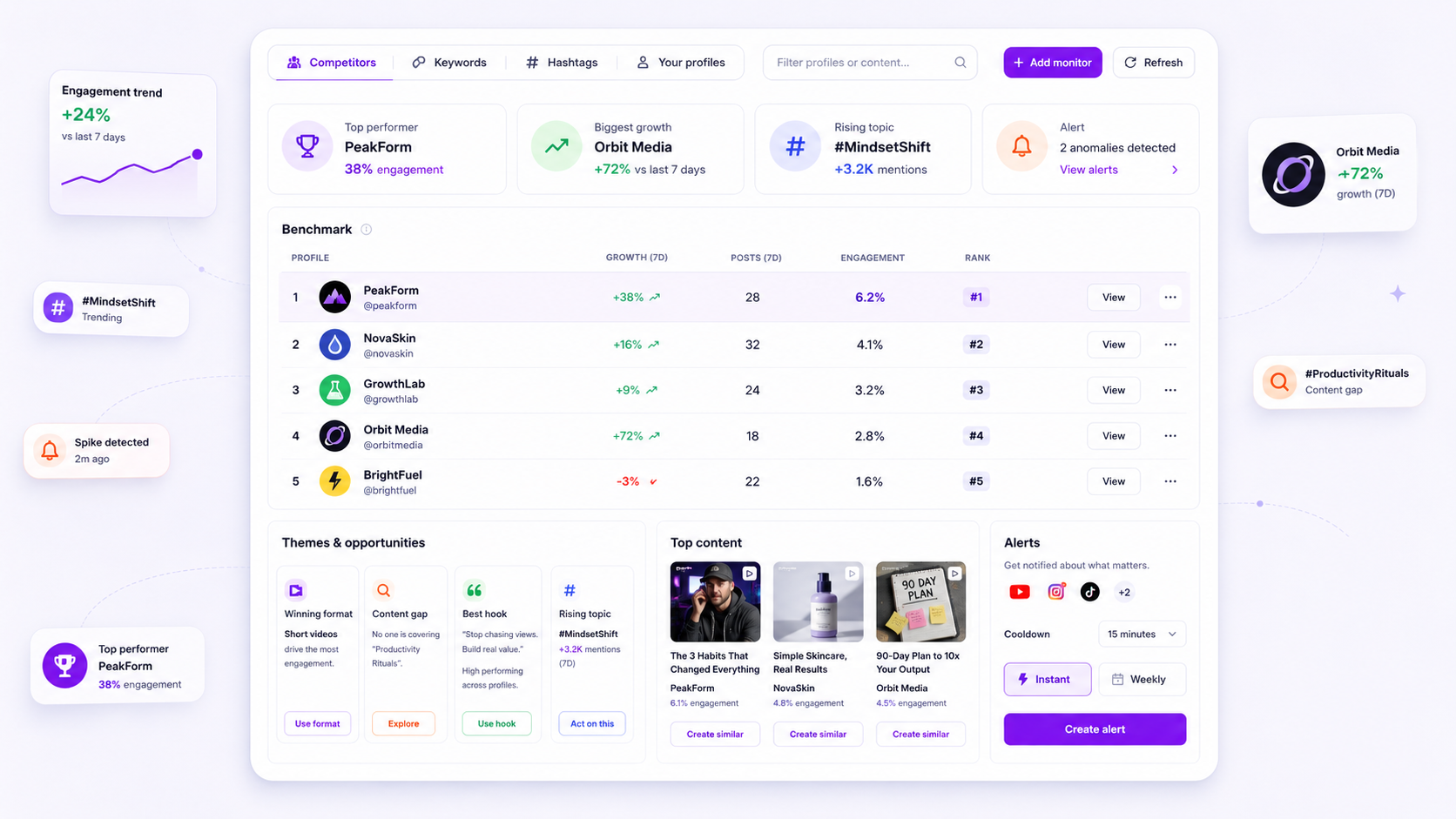
The best competitive intelligence software for your agency is one that transforms research from a manual, siloed chore into a shared team asset. If your team is still exporting CSVs from three different platforms to cobble together a weekly benchmark report, you aren't doing strategy. You are doing data entry.
We have all been there. Your inbox is flooded with automated alerts that tell you nothing about why a competitor's post went viral, and the most important insights get buried under a pile of daily vanity metrics. It is exhausting, reactive, and leaves you feeling like you are always chasing a trend that has already expired.
To fix this, you need a system that forces your team to stop thinking in terms of individual profiles and start thinking in terms of market-wide content themes. The goal is to move from "collecting links" to "sharing intelligence" so that when a competitor makes a move, the entire team has the context to react immediately.
What the best tools need to handle

Effective intelligence isn't just about watching a competitor's follower count grow. It is about understanding the content recipe they are using to get there. For enterprise teams, a tool must normalize data across platforms like Instagram, YouTube, and X so that you are comparing apples to apples, not just looking at a chaotic mix of different platform signals.
Here is how your current intelligence process likely breaks down when it lacks a unified workflow:
| Failure Mode | The Real Cost |
|---|---|
| Data Fragmentation | Teams spend 60% of their time stitching together reports rather than analyzing the "why" behind a successful post. |
| Notification Noise | Alerts hit individual inboxes, creating a "silo effect" where a winning content hook is missed by the rest of the strategy team. |
| Manual Refreshing | Relying on tools that require a manual button-click to fetch data is a recipe for missing the window on a fast-moving trend. |
| Vanity Metrics | Focusing on likes instead of Topic Clusters or Content Gaps means you are optimizing for the wrong signal. |
Operator rule: If you cannot explain the "winning recipe" of your top competitor in under two sentences, you do not have a strategy; you have a data collection habit.
Your software needs to act as a central hub, not just a reader. It must pull in public profiles, track specific hashtags or keywords, and store that history for at least 90 days. If the tool forces you to log into separate accounts to check a competitor's performance, it is failing the coordination test.
At Mydrop, we see that the most successful teams treat competitive monitoring as a living document. They use tools that automatically suggest industry leaders based on their specific niche and feed those insights directly into a dashboard that every strategist can access. When you can centralize alerts and automate the surfacing of rising topics, you stop being a reporter and start being a strategist.
The next step is evaluating whether your tools can handle the volume of your operations without breaking under the weight of manual configurations. True competitive intelligence is about high-signal, low-effort retrieval. If the setup takes longer than the analysis, you need to re-evaluate your stack.
Where basic tools start to break

Your current intelligence process is likely hitting a wall because it relies on the "download and pray" method. You log into platform native tools, pull a report, maybe paste it into a massive spreadsheet, and hope the data is still relevant by the time you share it. This isn't strategy-it is digital housekeeping.
Here is the awkward truth: if your intelligence setup requires a manual trigger to update, you are already behind. In a world where a content format can trend and die in 72 hours, waiting for a weekly manual sync means you are reacting to last week’s news.
Basic tools usually fail because they are platform-isolated silos. They don't normalize data across your YouTube, Instagram, and X channels. They don't know that your brand has specific "content themes" you care about, so they serve up generic follower growth metrics that are almost entirely useless for making a real creative decision.
Common mistake: Treating "follower growth" as an intelligence metric. It tells you what happened, not why, and certainly not what to do next.
When your tool treats every profile as an isolated entry, your team ends up with "data fragmentation." Marketing team A watches their competitors on Instagram, while team B is tracking different YouTube keywords. Without a shared dashboard that pulls this together, you lose the ability to spot the cross-platform "winning recipes" that actually move the needle.
The buying criteria that matter
Stop looking for more data and start looking for more coordination. You need a tool that functions less like a repository and more like a shared war room. If you are managing multiple brands or large social operations, the software you choose must bridge the gap between "monitoring" and "acting."
Use this scorecard to stress-test your current stack or any potential new investment.
| Feature | The "Agency-Scale" Standard | The "Vanity" Trap |
|---|---|---|
| Data Normalization | Aggregates YouTube, Instagram, and X into a unified benchmark view. | Requires separate tabs/spreadsheets per platform with no cross-view. |
| Refresh Logic | Auto-refreshes daily; intelligent cooldowns for real-time responsiveness. | Manual refresh only; requires someone to log in and click "update." |
| Alerting | Granular alerts sent via email or digest when content gaps appear. | Generic "new post" notifications that just add to your email noise. |
| Coordination | Shared dashboards with team-wide access to insights and trends. | Personal accounts or silos; insights stay trapped in one person's inbox. |
| Inspiration | AI-driven suggestions based on your own niche and audience. | Static list of "top profiles" that never changes. |
The Must-Have Checklist
Before you commit to a new platform, ensure it clears these three hurdles:
- OAuth/API Reliability: Does it require a proper business connection? If it doesn't, it is likely scraping data and will break the moment the platforms update their public access. At Mydrop, we prioritize stable integrations precisely because we have seen too many "scraped-data" tools fail right before a major campaign launch.
- Actionable Outputs: Look for systems that output content themes and hooks, not just engagement percentages. You want a system that identifies what your competitors are doing, not just how many likes they got for doing it.
- The 90-Day History Rule: Can the tool provide at least 90 days of historical trend data? Anything less, and you are staring at a snapshot, not a strategy. You cannot spot a long-term content gap if you don't have enough history to see the pattern.
Most teams do not have a data problem. They have a decision bottleneck caused by tools that weren't built for high-volume collaboration. Your intelligence software should be the engine that stops your team from guessing and starts them iterating.
How Mydrop supports this workflow
At Mydrop, we have seen this across thousands of profiles: the biggest risk to your strategy is not that you missed a competitor's post, but that your team is acting on outdated, siloed information. When you use Mydrop, we treat competitive intelligence as a living, shared dashboard rather than a static reporting chore.
We normalize platform data across YouTube, Instagram, and X, so your team spends zero time reconciling how different platforms track "success." Instead, you get a unified Intelligence Dashboard that maps your own performance against benchmarks automatically. Because the system includes your connected profiles in the mix, the comparative data is always relevant to your specific market position.
The real shift happens when you move from reactive monitoring to proactive alerts. Mydrop uses an intelligence-monitoring engine that tracks everything from content themes to rising hashtags, dispatching digests to your team based on the criteria you set. You aren't hunting for trends; the trends find you. And because we include AI-powered inspiration, when you are staring at a blank calendar, you can refresh the Inspiration row to surface relevant industry leaders and top-performing content clusters, giving your team an immediate head start on the next creative cycle.
Decision check: If your team has to open a second tab to see if a post is working, your intelligence tool is failing to provide context.
A simple shortlist checklist
Use this checklist to audit your current toolset before your next contract renewal. If you cannot check these boxes, you are likely paying for "data" when you should be paying for "coordination."
| Requirement | Why this matters for agency scale |
|---|---|
| OAuth Reliability | Direct API access ensures you aren't fighting rate limits or broken scraper connections. |
| Cross-Platform Normalization | Metrics are calculated the same way across YouTube, Instagram, and X. |
| Alert-to-Collaborator | Alerts arrive where the team already works (Email, Slack, or direct workspace notifications). |
| Automated Inspiration | AI-driven suggestions for new accounts to monitor, removing the manual research burden. |
| 90-Day History | Trends require context; you need to see if a spike is a one-off or a shift in market behavior. |
Quick audit task for this week:
- Identify who receives the competitor notification today.
- Ask them: "When you get that alert, do you have to move the data somewhere else to make a decision?"
- If the answer is "yes," you have a decision bottleneck, not a research problem.
Conclusion
The goal of competitive intelligence is to free your team from the grind of manual observation so they can get back to creative execution. When you stop treating research as an isolated task, you stop the leak of value that happens every time a teammate has to copy-paste a number from a native app into a spreadsheet.
Most teams do not have a research problem; they have a coordination debt.
The best tools act as a central nervous system for your social operations, surfacing the signal while filtering out the noise. When your software handles the monitoring, the data normalization, and the alert dispatch, your team is finally free to focus on what matters: out-executing the competition, not just out-monitoring them.
Choose a partner that prioritizes your team's velocity, ensures your data is reliable through direct API integration, and turns intelligence into a shared workflow. The difference is measurable-not just in reports, but in the time your team spends winning instead of watching.