
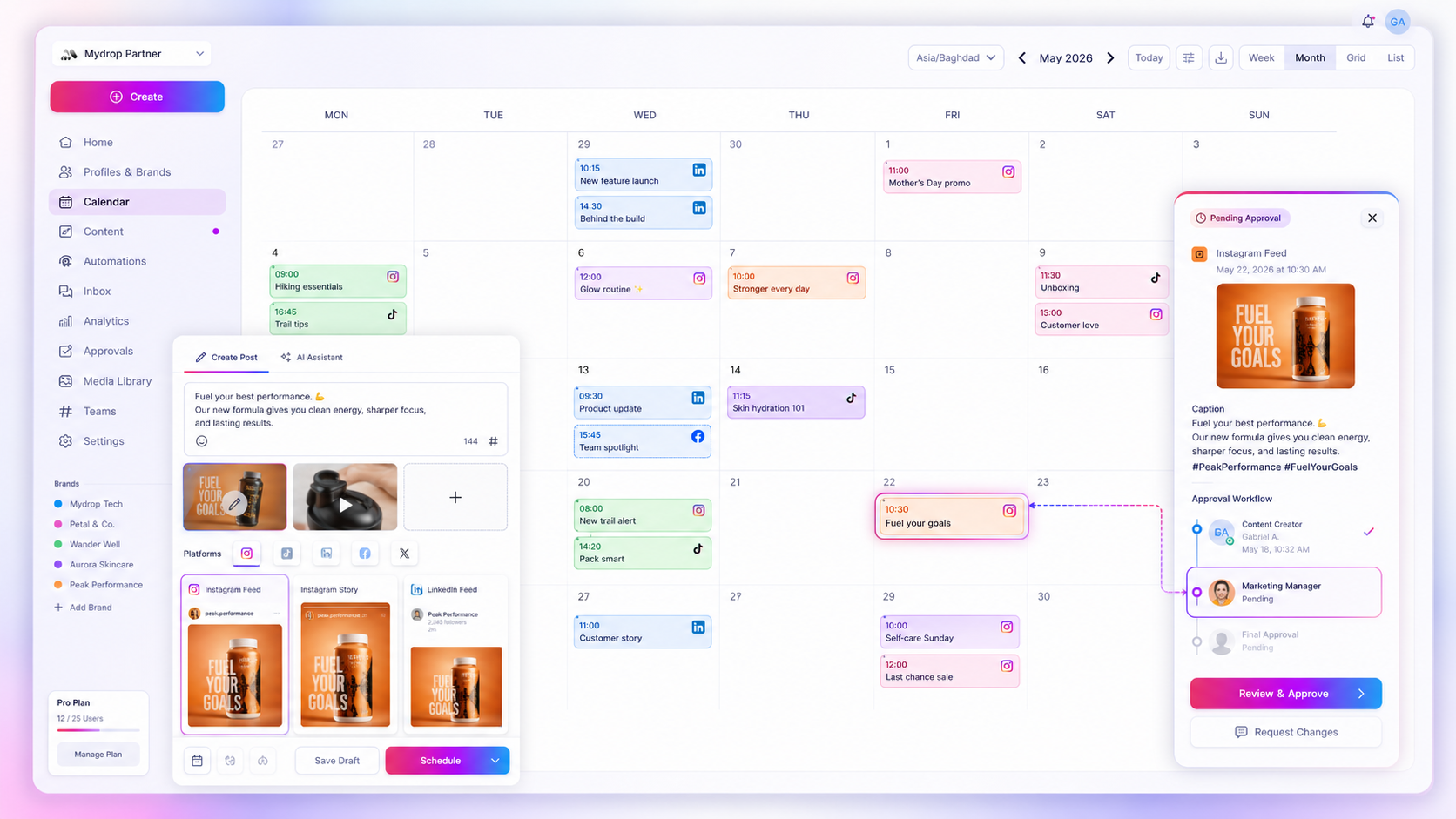
The best social media calendar for a multi-brand team isn't about scheduling posts-it's about eliminating coordination debt. If your current workflow requires you to toggle between five different tabs or manually cross-reference a spreadsheet to understand what is live across your brands, you are managing bottlenecks, not content.
We get it. You are spinning plates in a hurricane. Whether you are an agency balancing ten client identities or an enterprise team managing global market nuances, the "simple" calendar often becomes your biggest liability. It hides the complexity until it is too late, and the legal reviewer is already flagging a compliance issue at 6 p.m. on a Friday.
You do not need more features; you need a single, high-fidelity planning surface that turns scattered, disconnected streams into one coherent view. If you cannot filter your entire cross-brand workload by campaign, profile, and status in under three clicks, you are not managing brands-you are managing technical debt.
What the best tools need to handle

In a multi-brand setup, the calendar is the source of truth, not just a holding pen for dates. When you scale, your tool must stop treating profiles as silos and start treating them as data points in an aggregated ecosystem.
If your calendar tool cannot dynamically pivot across your entire portfolio, you are not gaining efficiency; you are just creating a more expensive version of a spreadsheet. The best tools handle this through granular, real-time filtering that allows you to zoom from a broad "Q4 Campaign" view down to the specific status of a single post in a single market.
Comparison: Filter Capabilities
| Feature | Generic Calendar | Multi-Brand Planning Surface |
|---|---|---|
| Cross-Profile Filter | Manual/Tab switching | Instant aggregate view |
| Campaign Attribution | Not supported/Tags | Core data dimension |
| Status Visibility | Limited (Draft/Live) | Granular (Pending Approval/Internal/Live) |
| Aggregation Logic | None (Siloed) | Unified (All-brand context) |
Operator rule: A calendar that does not let you filter by campaign is just a diary. If you cannot see how your efforts align with your overarching business goals, you are flying blind regardless of how pretty the interface looks.
True multi-brand maturity is about having the power to toggle visibility without losing context. When your team can instantly see that Brand A and Brand B are both running the same campaign in the same week, you can proactively resolve conflicts. That is not just scheduling-it is strategic coordination.
Where basic tools start to break

Most teams do not discover their calendar has failed until they launch the second brand. Suddenly, the simple, intuitive calendar that worked for one brand becomes an unmanageable wall of noise. This is where the spreadsheet usually becomes a crime scene, filled with color-coded cells, manual updates, and desperate attempts to track cross-brand status.
When you manage multiple brands, the biggest bottleneck is not scheduling; it is coordination debt. Basic tools fail here because they treat "profiles" as disconnected silos rather than aggregated data points. They lack the ability to slice the entire workload by campaign or status in real time. You end up tab-switching between five different brand views just to get a sense of who is posting what, when, and whether it has been approved.
We have all been there, chasing down a stakeholder at six p.m. because an approval request was buried in an email thread, lost because the calendar did not show a clear status indicator. The platform is not broken, but it is built for a single-brand, single-timeline workflow. When you need to scale, that single-thread design is exactly what causes the system to collapse.
The buying criteria that matter
Stop evaluating calendars based on their drag-and-drop UI or their ability to sync to a personal Google Calendar. For an enterprise team, the only thing that matters is how quickly you can achieve visibility across your entire portfolio. You need a tool that treats your data as a searchable, filterable resource.
If you cannot isolate content by campaign, profile, and approval status in under three clicks, you are not managing your brands, you are managing technical debt. Below is a decision matrix to help you evaluate whether a tool is built for your scale or if it is just a glorified sticky-note board.
| Feature | Basic Calendar | Enterprise-Ready (Mydrop) |
|---|---|---|
| Brand Aggregation | Siloed, single-view only | Native, cross-account view |
| Status Filtering | Manual or non-existent | Instant, multi-status toggle |
| Campaign Tracking | Not supported | First-class data dimension |
| Permissions | Basic user access | Granular, profile-level control |
Decision rule: If the tool requires you to open more than one view to see all scheduled posts across three brands, it does not support your workflow.
At Mydrop, we designed our Calendar view to treat every post as part of a larger ecosystem, allowing you to instantly toggle between broad campaign views and granular profile status. The goal is to provide a single, high-fidelity planning surface that turns your fragmented streams into a unified source of truth.
The right calendar should act as a conduit for your team, not a barrier. When you are responsible for dozens of profiles and constant stakeholder reviews, visibility is the only currency that matters. You need to be able to see the entire landscape in one glance, filter out the noise, and act on the content that requires immediate attention. A tool that fails to provide this level of oversight is not saving you time; it is costing you governance.
How Mydrop supports this workflow
At Mydrop, we built our Calendar view specifically to stop the plate-spinning chaos. When you are managing dozens of profiles across ten different brands, the last thing you need is another tool that forces you to switch context just to see what is going live tomorrow. We know the pain of having to jump between tabs to keep brand voices separate.
Our calendar acts as a unified data surface. It pulls your posts, reminders, and project notes into one single view. You can filter by anything-brand, campaign, profile, or even specific approval status. Need to see what the wellness brand has slated for the Q3 sustainability campaign? Two clicks. Everything else on the calendar instantly clears away, leaving you with only the relevant items.
This is not just about pretty pictures on a grid. Mydrop allows you to take action directly from that filtered view. You can preview a post, see if it is approved, edit the content, or duplicate it for another channel without ever opening a new browser tab. We have seen this save teams hours of manual verification time every single week. When you are responsible for cross-brand governance, the ability to zoom out to the campaign level and then zoom in to a single post status is how you maintain quality at scale.
A simple shortlist checklist
When evaluating your next tool, use this audit to see if it is built for the chaos of multi-brand management or if it will just add to your technical debt.
Multi-Brand Calendar Readiness Audit
- Unified filtering: Can you instantly filter by campaign across all profiles, or are you limited to one brand at a time?
- Contextual actions: Can you approve, edit, or delete a post directly from the calendar view, or does the tool force you to click through to a separate editor?
- Multi-type visibility: Does the calendar render reminders and internal notes alongside scheduled posts, keeping the entire team workflow on one timeline?
- Responsiveness: Does the UI stay snappy when you have hundreds of scheduled items, or does it hang every time you switch months?
- Granular permissioning: Can team members see only the campaigns or profiles they are responsible for, or is the calendar view all or nothing?
If a tool fails on more than two of these, it is not a planning surface-it is just a display board.
Conclusion
The truth about multi-brand social media is that your biggest threat is not a bad idea, but the coordination debt created by the tools you use to manage them.
Most teams do not actually have a content problem. They have a decision bottleneck. If your calendar makes you feel like you are chasing ghosts, it is time to move past the entry-level tools. Look for a system that treats your brand profiles, campaigns, and content status as core data dimensions rather than afterthoughts. Your goal should be a workflow so transparent that you can identify a compliance risk or a scheduling gap before the first coffee of the day.
Stop looking for the perfect calendar. Start looking for the one that removes the friction between your strategy and your execution. When you clear that bottleneck, you might finally have enough time to actually create the content your audience wants to see.