
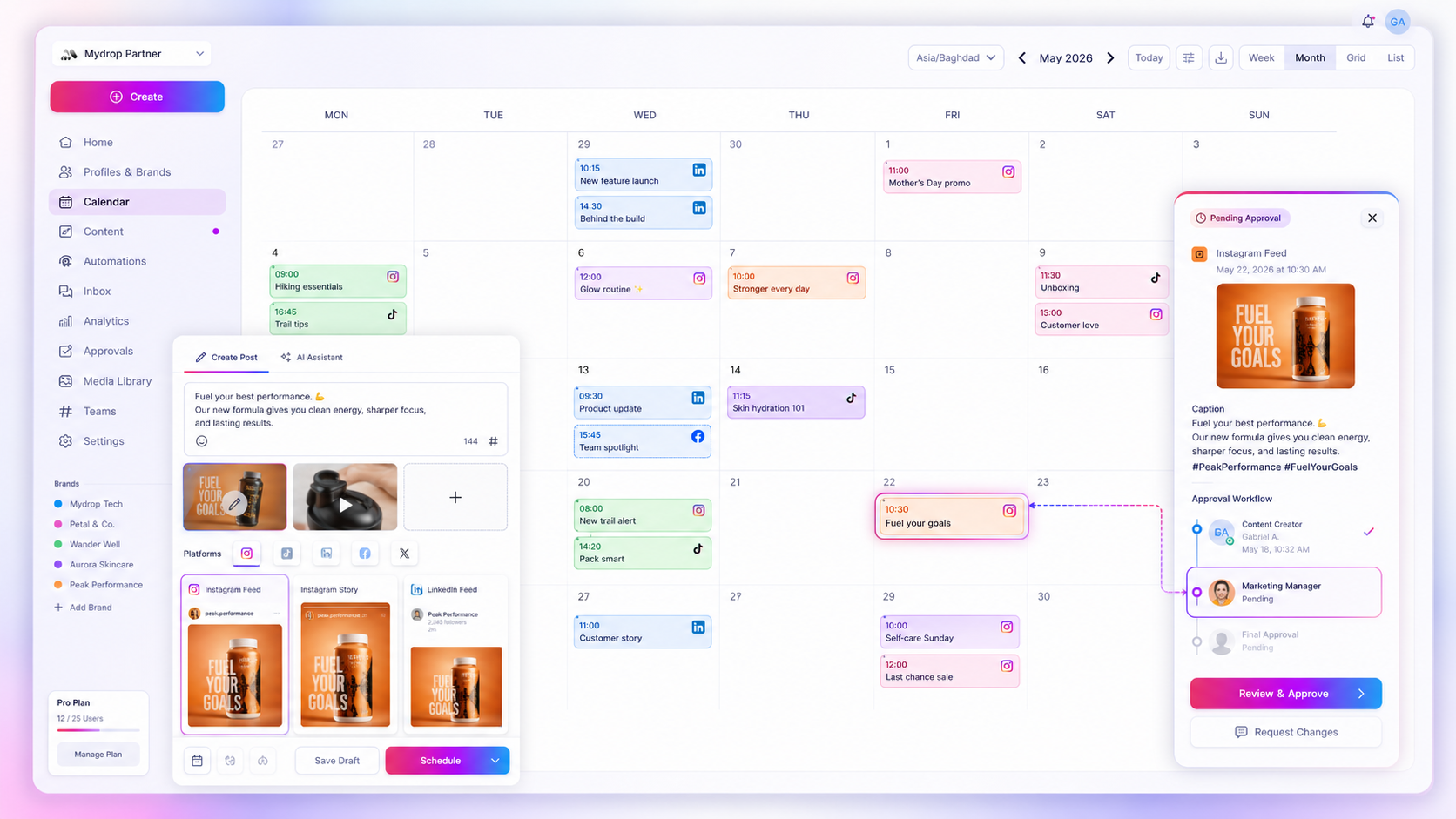
If your social media calendar is nothing more than a graveyard of past timestamps and random, unlinked reminders, you are managing a schedule, not a strategy. True enterprise-grade planning requires a bird-eye view that connects every single update to a specific business outcome. The most effective teams do not just fill time slots; they map content to campaign goals, ensuring that every post is a deliberate move rather than a routine chore.
We get it. Managing a high-velocity social operation for a sprawling enterprise team is inherently messy. You are balancing stakeholder approvals, fragmented brand guidelines, and platform-specific quirks, all while trying to keep your sanity in a sea of spreadsheets that have become crime scenes. You deserve a workspace that works as hard as your team, not one that forces you to constantly hunt for context.
This guide will help you audit your current planning tools for critical failure points and show you how to implement a campaign-first calendar workflow that actually delivers results. Most teams do not have a content problem. They have a decision bottleneck.
What the best tools need to handle

The primary job of a calendar in an enterprise environment is coordination, not just scheduling. When you move beyond a single brand or a handful of channels, the "Date View" becomes insufficient. You need a unified planning surface that acts as a single source of truth for your entire operation. If your tool cannot aggregate posts, reminders, and notes from across your entire Firestore architecture into a single coherent view, you are inevitably going to miss a critical dependency.
Operator rule: A calendar that does not support cross-brand filtering is a liability, not an asset.
The best tools on the market treat the calendar as a filterable database rather than a static wall calendar. Here is how you should evaluate the surface area of your planning tool:
| Capability | Why it matters for enterprise scale |
|---|---|
| Unified Surface | If notes and reminders live in a separate app from your posts, context is lost. You need them side-by-side to catch scheduling conflicts. |
| Granular Filtering | You must be able to view by campaign, profile group, or post state instantly. If it takes three clicks to find all pending posts for a specific campaign, your throughput will stall. |
| Actionable Previews | A calendar should be an operating hub. You should be able to trigger an approval, edit a draft, or duplicate a high-performing post without leaving the calendar view. |
| Status Transparency | You should see where a post is stuck. Is it awaiting legal review, or is it already live? If you can't distinguish between these at a glance, you are flying blind. |
When you manage hundreds of profiles and dozens of stakeholders, the gap between "scheduled" and "actually ready" is where most campaigns fail. You need a tool that lets you toggle between a high-level Monthly Campaign View and a Daily Task List effortlessly. At Mydrop, we see that the teams who succeed are the ones who treat their calendar as a live, interactive dashboard rather than a passive list of dates. If your current tool forces you to rely on external spreadsheets or Slack pings to track status, you are paying the cost of that coordination debt every single day.
Where basic tools start to break

Here is the awkward truth: most scheduling tools treat every post like an isolated event. They see a date, a time, and a platform. When you are managing ten brands and fifty channels, this "single-post" focus is exactly where your operation starts to bleed efficiency.
We have all been there. You have a massive product launch spanning three time zones. You log into your tool, and instead of seeing your campaign, you see a cluttered grid of individual boxes. You cannot tell which posts belong to the launch, which are brand-fillers, or which are still stuck in a legal review loop. To get that information, you have to export a spreadsheet, manually color-code it, and pray nothing changed in the last hour.
This is coordination debt. Every minute you spend hunting for status updates or cross-referencing a post against a campaign brief is a minute you are not actually strategizing. Basic tools fail because they treat the calendar as a storage bin rather than a planning surface. They lack the connective tissue to link an asset to a business outcome, leaving your team to hold the context in their heads or in a dozen different chat threads.
Common mistake: Relying on separate tools for "planning" (spreadsheets) and "execution" (scheduling). When these systems are decoupled, the moment a campaign pivot occurs, your data is already obsolete.
The buying criteria that matter
If you are auditing your current stack, stop asking if the tool can "post to X platform." That is table stakes. Start asking if the tool can act as a unified source of truth for your team's intent.
When evaluating enterprise-grade calendar planning, use the following scorecard to separate functional tools from glorified notification boards.
| Criteria | Why it matters | What to look for |
|---|---|---|
| Granular Filtering | You need to see the "Big Picture" or "Just the Launch." | Can you filter by Campaign, Brand, and Status in one click? |
| Unified Surface | Context switches kill productivity. | Does it show posts, reminders, and notes side-by-side? |
| State Visibility | Knowing a post is "scheduled## Where basic tools start to break |
Here is the awkward truth: your calendar tool is probably lying to you. Most standard scheduling apps are built for a single user managing a single feed. When you apply that same logic to an enterprise team-juggling multiple brands, local market nuances, and a revolving door of stakeholders-the cracks appear immediately.
The biggest failure mode is data fragmentation. When your team can only see content mapped to a single "main" calendar, they lose the ability to view reality through a campaign lens. You end up with "Calendar Blindness," where you are technically scheduled for the month, but you have no idea if that schedule actually satisfies the business requirements for your Q3 launch.
Basic tools also fall apart under the weight of approval latency. If a post is technically "scheduled" in your database but stuck in a pending review state, the calendar still treats it as a success. This creates a false sense of security. You think you are covered, but your feed is about to go dark because the regional manager has not clicked the approve button.
| Failure Mode | How It Sabotages Teams |
|---|---|
| Monolithic Views | Unable to filter by brand, campaign, or specific product lines across global markets. |
| Status Opacity | No distinction between "ready to publish," "needs legal approval," and "awaiting copy edit." |
| Data Silos | Posts, reminders, and strategy notes exist in separate tools, leading to massive context switching. |
| Aggregate Lag | The calendar view lags behind the actual platform status because of poor sync architecture. |
The buying criteria that matter
Stop shopping for a calendar and start shopping for a coordination engine. When you are evaluating potential tools, do not get distracted by flashy UI features or emoji support. Focus on whether the tool actually maps to the way enterprise work gets done.
We have found that teams managing at least 50+ posts per week across multiple channels need to prioritize three non-negotiable capabilities. If a tool cannot do these, it will become a liability within six months.
- Multi-Dimensional Filtering: Can you toggle the view to show only "Campaign A" across all profiles? Can you isolate all "Needs Approval" items across the entire agency portfolio? If you cannot slice your data by state, brand, and campaign simultaneously, you are still doing manual work.
- Unified Surface Coverage: Your calendar must render more than just post timestamps. To stop the endless app-hopping, you need to see all-day reminders, meeting notes, and content status updates in the same view as your scheduled updates.
- Permission-Aware Previewing: The ability to see exactly what is about to publish is critical. But for enterprise teams, the ability to take actions from that preview-like pushing a post back to drafting or flagging a compliance issue-is what separates a pro-level tool from a toy.
At Mydrop, we see teams struggle most when their calendar ignores the "work-in-progress" phase. Our Calendar Planning feature is built to solve this by treating a draft, a note, and a live post as equally important data points. When you can filter by campaign or automation status, you stop guessing if your coverage is sufficient and start seeing the gaps in your strategy.
Decision check: A calendar that does not let you filter by campaign status is just a digital to-do list. If your current tool forces you to keep a separate spreadsheet to track "what goes with what," it has already failed the enterprise audit.
The goal is to move your team from "did we post today?" to "are we on track for the campaign?" If you can't answer that second question in under ten seconds, your tooling is the bottleneck.
How Mydrop supports this workflow
At Mydrop, we approach the calendar not as a passive display of past events, but as the command center for your entire operation. We have seen thousands of workflows break because the tool could not reconcile the difference between "what we planned" and "what is actually happening."
When you open the Mydrop calendar, you are not just looking at a timeline. You are looking at a unified, interactive surface that pulls your posts, reminders, and notes into a single, filterable view.
If your legal team needs to approve a specific campaign, you do not have to hunt through separate emails or spreadsheet tabs. You simply toggle your filters to show only that campaign, verify the current post state, and act immediately from the preview panel. The goal is to collapse the distance between a status change and the actual publishing timeline. By allowing you to segment your view by brand, profile, or campaign, Mydrop keeps the noise down while keeping your strategic targets front and center.
Workflow check: A calendar that does not let you filter by campaign status is just a list of dates. If you cannot see which campaign is behind schedule in two clicks, you do not have a planning tool; you have a documentation problem.
A simple shortlist checklist
Before you commit to a tool or re-audit your current one, use this scorecard to see if your calendar can actually support enterprise-scale execution.
| Criteria | The "Enterprise" Test |
|---|---|
| Cross-Filter Depth | Can you filter by campaign, brand, and status simultaneously? |
| Object Variety | Does it render reminders and notes alongside social posts? |
| Action Density | Can you approve or edit a post directly from the calendar preview? |
| Data Integrity | Does the view reflect real-time status from your publishing pipeline? |
| Visibility Scope | Is the interface responsive when loading thousands of items? |
If you cannot check at least four of these boxes, your current setup is likely a massive source of coordination debt.
Conclusion
The transition from scheduling to planning is rarely about finding a better calendar app. It is about demanding a better view of your own complexity. When you stop obsessing over time slots and start focusing on campaign outcomes, you reclaim the bandwidth to actually lead your strategy rather than just feeding the content machine.
Take a hard look at your team's workflow this week. If you spend more than ten minutes finding a specific post or chasing down its approval status, that is your signal to stop managing the schedule and start managing the system. Your calendar is the most important dashboard you own; make sure it is actually working for you.