The best recurring task tool for multi-brand teams is not a standalone project management suite; it is a calendar-integrated system that attaches operational tasks directly to the specific posts, profiles, and media files you are already managing.
We have all lived the version of this nightmare where you are juggling three brand voices and a dozen platform schedules, only to have your "To-Do" list live in a browser tab three clicks away from your actual campaign calendar. It is a massive logistical drain. When your reminder to refresh seasonal assets has no link to the assets themselves, you are not managing a workflow; you are just playing an expensive game of hide-and-seek.
Most teams do not have a content problem. They have a coordination bottleneck.
What the best tools need to handle

The primary goal is moving from simple note-taking to active operational execution. When you manage content across multiple brands, a standalone task tool actually introduces new friction by creating a silo. You end up chasing information across platforms instead of steering your campaigns.
To break that cycle, any tool you choose must handle three fundamental shifts in your operation:
| Shift | From | To |
|---|---|---|
| Anchoring | Tasks in a generic list | Tasks linked to specific campaign objects |
| Cadence | Manual, repetitive entries | Recurring, calendar-native reminders |
| Visibility | Isolated tool notifications | Synchronized external calendar events |
Object-Centric Scheduling is the non-negotiable standard here. If a task is not anchored to a post, profile, or asset, it is just noise. If you have to copy and paste a linkThe best recurring task tool for multi-brand teams isn’t a separate project management suite; it’s a calendar-integrated system that attaches tasks directly to the specific posts, profiles, and media assets you are already managing.
If you are running social operations for more than one brand, you know the feeling: your actual content calendar lives in one tab, while your to-do list for client approvals, asset refreshes, or compliance checks lives in another. The result is a constant, low-level hum of anxiety-you are never quite sure if the task you are checking off actually connects to the campaign that needs it. We have seen this across hundreds of agencies and enterprise teams; the work isn’t just hard, it is disconnected.
The real cost here isn't just lost time. It is the coordination debt that accumulates when your reminders don't "live" where your content does.
What the best tools need to handle

When you are managing dozens of stakeholders across multiple markets, your recurring task tool needs to do more than just ding your phone at 9 a.m. It needs to bridge the gap between abstract planning and actual campaign execution.
Most teams get stuck because they rely on generic tools that treat "tasks" as isolated text strings. A truly operational tool, however, treats every reminder as an object attached to a workflow.
Here is what you should look for when auditing your current setup:
| Feature | Why it matters | The "Silo" Risk |
|---|---|---|
| Object Linking | Ties reminders directly to specific posts, profiles, or media files. | You spend 10 minutes searching for the file the reminder refers to. |
| Calendar Native | Lives in your content schedule, not a separate task view. | You plan in a vacuum, ignoring actual publishing bottlenecks. |
| Done-State Sync | Marks recurrence complete in your calendar without deleting the parent. | You lose history of whether a recurring task was actually performed. |
| Service Integration | Pushes tasks to external calendars (like Google Calendar). | Stakeholders outside your tool miss the deadline. |
At Mydrop, we often find that teams do not have a content problem. They have a coordination bottleneck. When your reminder to "Refresh client brand assets" is not linked to the assets themselves, you have created a new task, not solved a problem. The most effective operations rely on Object-Centric Scheduling-where every recurring action is anchored to the campaign objects you are already tracking. If a task isn't attached to an object, it is just noise.
Where basic tools start to break
Most teams start with what they already have: a shared calendar app or a lightweight project management tool. For a while, this works. Then you add a second brand, a third platform, and a few more stakeholders who need to sign off on copy. Suddenly, your "to-do" list is a separate window, disconnected from your actual content calendar.
The real breakdown happens when the task doesn't point to the work.
When a reminder says "Check Q3 campaign assets" but doesn't lead directly to the files, your team loses time. They have to hunt through folders, ask for links, or worse, guess which version is the final one. You end up with coordination debt-that invisible tax of chasing down context because your tools don't talk to each other.
In our experience, the failure modes are predictable:
- Fragmented Context: The task is in one tab, the creative is in another, and the approval status is in a spreadsheet.
- Sync Failure: Recurring tasks stay "pending" even when the work is done, or worse, the "Done" state doesn't update across recurring instances.
- External Disconnect: The team lives in Google Calendar, but the planning tool exists in a vacuum. If the task doesn't show up on their native calendar, it effectively does not exist.
Operator rule: If your team has to leave their primary workspace to confirm the status of a content asset, your tooling is creating bottlenecks, not solving them.
The buying criteria that matter
When evaluating a recurring task tool for multi-brand operations, stop looking for "task features" and start looking for object-centric connections. You need a system that treats your posts, profiles, and media as first-class citizens in your task flow.
Use the scorecard below to audit whether your current setup is built for scale or just adding to the noise.
| Capability | What to Look For | Why It Matters for Agencies |
|---|---|---|
| Object Linking | Does the task anchor to specific post IDs, profiles, or media files? | Prevents version confusion and "hide-and-seek" with assets. |
| Calendar Sync | Does it push/pull from Google Calendar natively? | Ensures the team actually sees the task where they work. |
| Recurring Logic | Does it support complex cadence (e.g., monthly report reviews) with exception handling? | Keeps operational overhead low without manual entry. |
| Done-State Sync | Do completed occurrences update across the board? | Provides a clear audit trail for compliance and status reporting. |
At Mydrop, we see teams struggle most when they try to force generic project software to handle social content. The best systems are those where the reminder layer is essentially a high-fidelity, calendar-integrated view of your campaign objects.
If you are currently managing more than five brand profiles across multiple markets, your goal isn't just to keep track of tasks; it is to ensure that every task is physically tethered to the campaign asset it governs. When a reminder to "review seasonal creative" pops up, clicking it should open the exact media file, the associated post draft, and the correct profile-all at once. Anything less is just another notification you will eventually learn to ignore.
How Mydrop supports this workflow
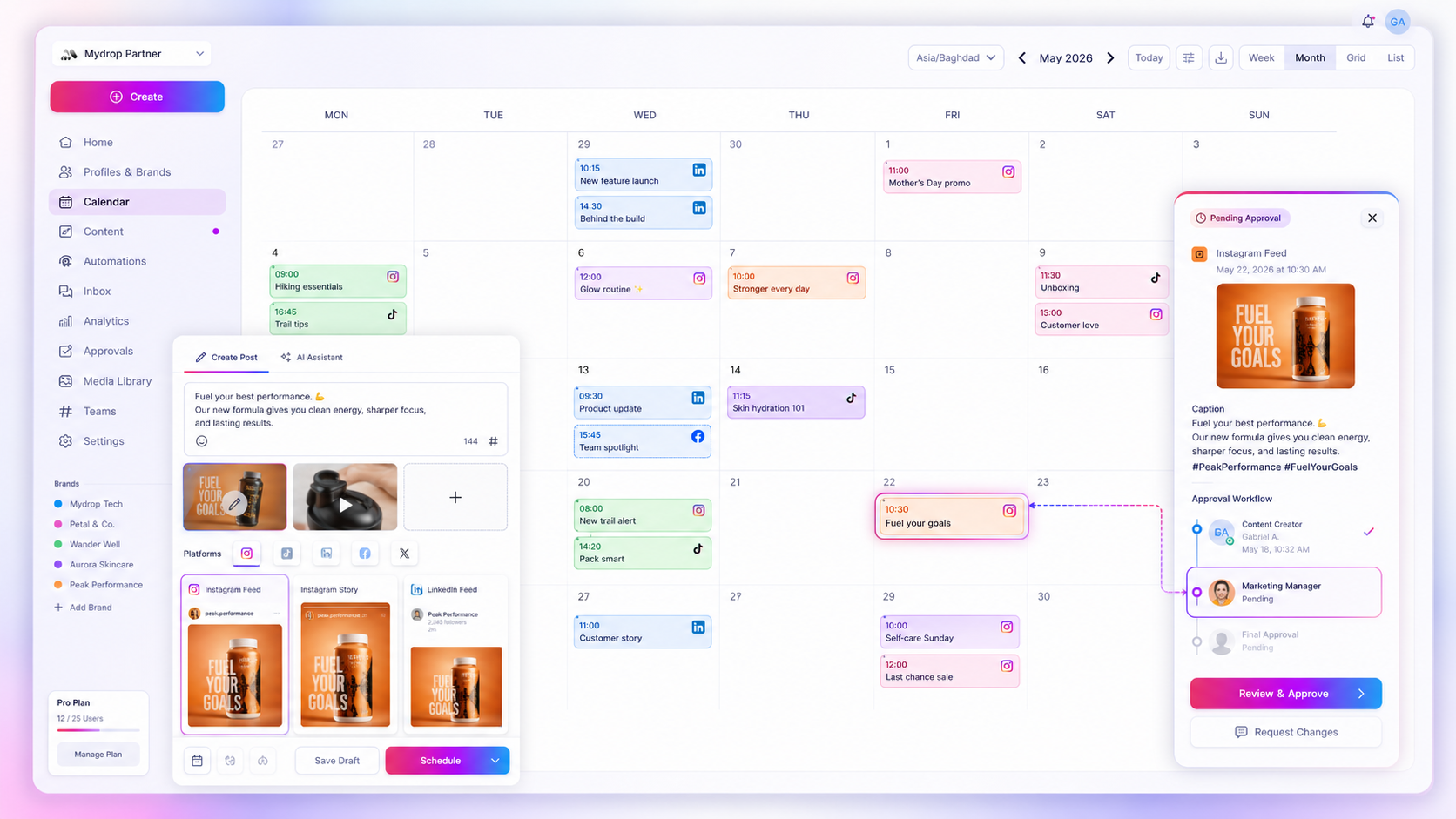
At Mydrop, we usually see that teams managing dozens of brand profiles don't actually need another "to-do" app. What they need is a way to stop hunting for the context behind a task. We built our Reminders feature as an operational layer that sits directly on top of your content calendar, rather than living in a separate, isolated tab.
When you create a reminder here, you aren't just writing a note. You are anchoring a piece of work to the actual ecosystem. You attach the specific post draft, the profile in question, or the raw media asset to the reminder. When the notification hits-or when you check your daily view-the "thing" you need to work on is already there, one click away.
Decision check: If a task isn't linked to a campaign object, it is just noise.
This approach solves the "context-switching tax" that drains hours from agency teams. Because Mydrop allows you to sync these reminders with Google Calendar, your team can see their editorial deadlines, approval touchpoints, and creative refreshes right alongside their regular meetings. When someone marks a recurring reminder as "done" for a specific week, it updates the status globally without breaking the underlying pattern. You stop chasing updates in Slack and start looking at a live, operational view of your brand output.
A simple shortlist checklist
If you are currently evaluating your tech stack, don't get distracted by UI flourishes. Use this 5-point checklist to determine if a tool can handle enterprise-scale coordination:
| Requirement | Why it matters |
|---|---|
| Object-Linking | Can you attach a specific post, media file, or profile to the task? |
| Calendar-Native | Does the task exist in the same view as your actual publish schedule? |
| External Sync | Does it push to your team's primary calendar (e.g., Google Calendar)? |
| Recurrence State | Can you mark one instance as "done" without nuking the recurring rule? |
| Team Visibility | Can others see the status of the task without asking you for a screenshot? |
If a tool fails more than two of these, it will eventually become a "coordination debt" liability. You might save five minutes today by using a basic checklist, but you will pay for it later in missed approvals and frantic, last-minute edits.
Conclusion
The reality of managing multi-brand content is that you will never have perfect predictability. Creative gets delayed, strategies shift, and stakeholders move slowly. The goal isn't to eliminate the chaos, but to stop it from becoming invisible.
Most teams do not have a content problem; they have a decision bottleneck. By moving your recurring tasks into a system that forces objects and actions to stay linked, you pull your operations out of the dark and into a format you can actually govern. Pick a tool that treats your tasks with as much respect as your content, and you will find that your team spends significantly less time "managing" and much more time shipping.