The best quick note tool for your team isn’t the one with the most bells and whistles; it’s the one that lives exactly where your work happens-next to your content calendar. If your team is constantly switching windows, hunting through Slack threads, or copy-pasting feedback from separate docs to manage brand voices, you are already losing the thread.
We get it. Agency work moves at a pace that makes most teams feel like they’re running on a treadmill turned up too high. One minute you’re on a client call, the next you’re juggling three different brand identities and a dozen platform deadlines. It’s messy and high-pressure, and those small, vital details-the actual client feedback-are often the first things to get lost in the shuffle.
We want to help you stop the "information leak" by centralizing those quick captures directly inside your workspace, ensuring every idea is ready for immediate action rather than buried in a disconnected app that nobody ever opens.
What the best tools need to handle

Most teams think they have a note-taking problem, but they really have a context problem. When your notes are trapped in a siloed app, they are just dead archives. To support a high-volume agency, a tool needs to do three specific things to keep you from drowning in coordination debt:
- Zero-friction capture: If it takes more than two clicks to start typing, your team won’t use it. You need a capture point that feels as fast as a sticky note but saves to the cloud instantly.
- Calendar proximity: Notes must live where the scheduling happens. If a strategist is looking at a Thursday content gap, they should see the note about the client's new messaging pivot without leaving the screen.
- Team-wide visibility: A note isn't an asset if it’s locked in someone’s private account. It needs to be accessible, shareable, and permission-gated so the right people see the right updates.
Operator rule: If your team has to "remind" each other about feedback via email or Slack instead of referencing an existing note, you don't have a communication problem-you have a visibility failure.
Here is how common setups typically stack up when you’re managing multiple brand profiles simultaneously.
| Capability | Isolated Tool (Notion/Evernote) | Integrated Workspace Notes |
|---|---|---|
| Proximity to Calendar | Low (Switching tabs) | High (Embedded/Sidebar) |
| Team Access | Manual (Sharing links) | Automatic (Workspace-wide) |
| Actionability | Low (Dead ends) | High (Directly linked to tasks) |
| Reliability | Variable (Version conflicts) | High (Optimistic sync) |
When you are supporting dozens of stakeholders, the friction of leaving your dashboard to check a note isn't just an annoyance; it’s a bottleneck that creates gaps in your publishing pipeline. The best tools don't just store data; they keep your team in the flow of execution.
Where basic tools start to break

Here is the awkward truth: generic note-taking apps are designed for linear thinking, while agency work is multi-dimensional.
When your team captures feedback in a tool that lives outside the calendar, you aren't just creating a "to-do"-you are creating a coordination tax. Every time someone has to copy, paste, or ping a teammate to move an idea from a personal notepad into the actual production workflow, you lose momentum.
At a certain scale-usually once you are managing more than five brands or juggling dozens of stakeholders-this friction stops being a minor nuisance and becomes a real danger to your delivery speed.
Consider the "digital dumping ground" effect. We see this all the time: teams start with good intentions, using a shared doc or a quick note tool to track campaign ideas. But because that tool isn't physically anchored to the daily scheduling view, it becomes an archive that nobody actually checks before they hit "publish."
Common mistake: Treating notes as an asynchronous graveyard instead of a live production asset. If your team has to leave the calendar to find the status of an idea, the idea has already lost its relevance.
The Visibility Scorecard: How your tools stack up
Use this simple audit to see if your current setup is actually working or just adding noise to your day.
| Feature | Isolated Quick Notes | Integrated Workspace Notes | Why it matters |
|---|---|---|---|
| Calendar Proximity | Requires tab-switching | Side-by-side view | Eliminates context-switching fatigue |
| Team Visibility | Requires manual sharing | Instant, role-based access | Prevents duplicate, conflicting work |
| Actionable State | Stagnant, passive text | Optimistic, editable state | Keeps ideas "live" for production |
| Governance | None (everyone has edit) | Permission-gated roles | Stops accidental deletion of assets |
The buying criteria that matter
If you are currently evaluating a shift in your tooling, do not just look at the interface. Look at the workflow architecture. The most common mistake we see is prioritizing "design" over "distribution."
You need a tool that treats a note as a living participant in your production process, not just a scratchpad. When assessing potential solutions, focus your criteria on these four non-negotiable points:
- Contextual Anchoring: Can you capture the note while looking at the content calendar? If you cannot see the date, the asset, and the note in one view, you are operating blind.
- Permissioned Collaboration: Does the tool allow for read-only access for some team members while keeping edit access for planners? You need to prevent "oops" moments where a junior team member accidentally wipes out a vital note from a client call.
- Optimistic Persistence: In an enterprise environment, latency is a killer. A great tool should handle local, optimistic updates so you never lose an idea when your internet connection hiccups-a frequent occurrence during high-stress, off-site brand workshops.
- Seamless Recall: Can you surface "Recent Notes" directly on your home dashboard? If you have to search for a specific noteId or browse a folder structure, you have already wasted time that could have been spent on the actual campaign.
The operational reality is simple: Your note tool should be an extension of your workspace, not a separate, disconnected room. If your team is constantly clicking back and forth, you aren't saving time-you are just moving the bottleneck. Focus on the tools that meet you in the middle of your workflow, keeping your ideas front and center, accessible, and ready for action.
How Mydrop supports this workflow
At Mydrop, we have seen thousands of teams struggle with exactly this problem. You have great ideas popping up while you are knee-deep in a calendar grid, but the moment you switch tabs to "capture" them, the momentum evaporates.
Our approach to notes is aggressively simple: if you cannot see it, you will not use it.
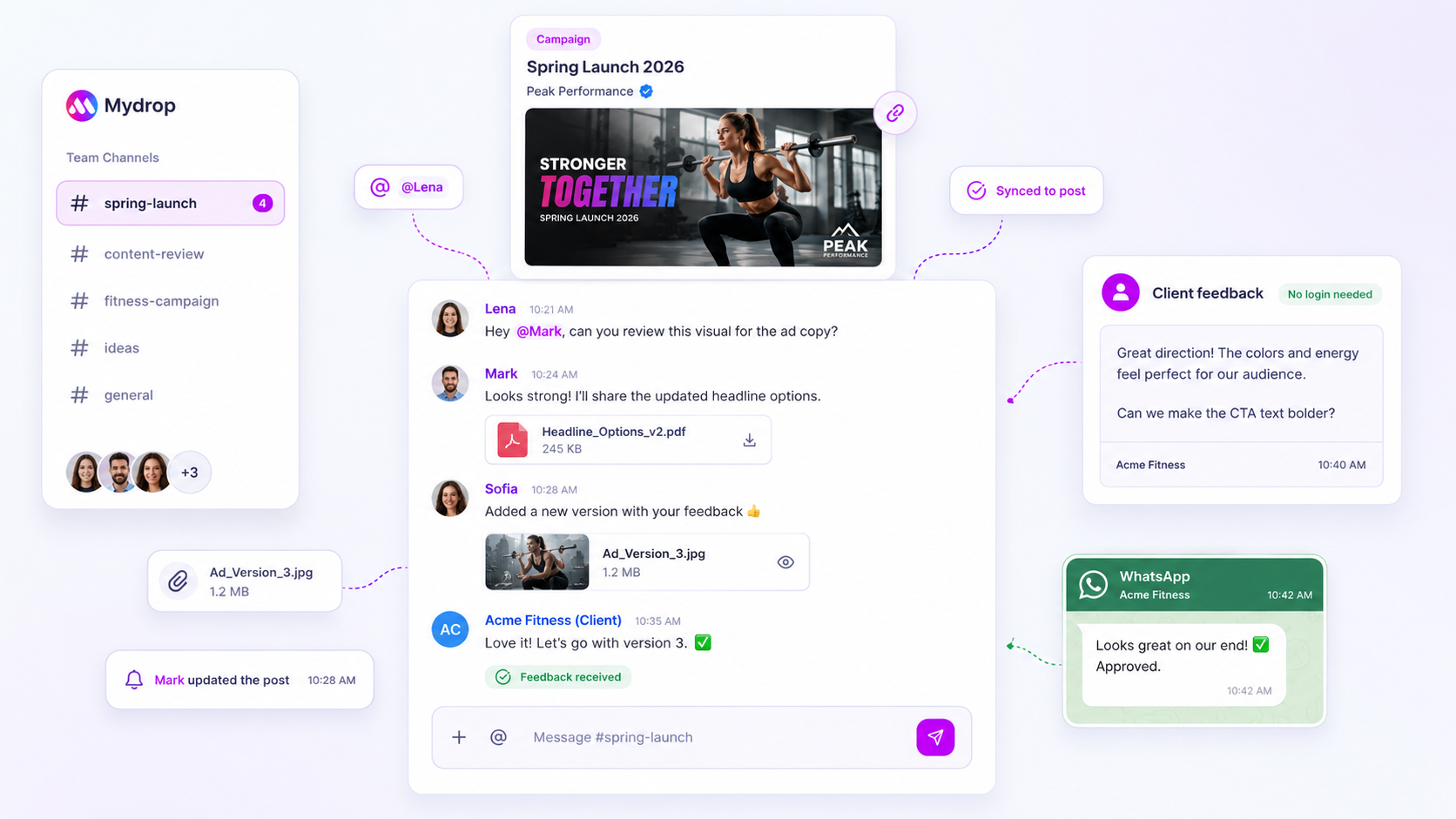
We designed our workspace notes to sit directly alongside your calendar and home dashboard. When you are looking at your weekly throughput or fine-tuning a content launch, you can pull up a quick note without losing your place. We handle the technical heavy lifting-like optimistic local updates and persistent themes-so you never have to wonder if your feedback actually saved or wait for a page refresh to continue working.
For agencies, we also built in permissioned visibility. You can capture sensitive brand directions or internal project pivots that remain clear and accessible to your core team, while our read-only states ensure that junior members or external collaborators can see the context they need without accidentally deleting the strategy.
Decision check: If a note takes more than three clicks to retrieve, it is not a working asset; it is just a digital grave for good ideas.
A simple shortlist checklist
Before you commit to a new tool-or decide to stick with your current messy setup-run this audit. If your current tool misses three or more of these, you are paying for a coordination bottleneck you do not need.
| Feature Check | Why it Matters | Essential? |
|---|---|---|
| Calendar Proximity | Can you read/edit notes without leaving your scheduling view? | Yes |
| Team Permissioning | Can you prevent accidental edits on high-stakes strategy notes? | Yes |
| Zero-Wait Save | Does the note save instantly without a "loading" spinner? | Yes |
| Searchability | Can you surface notes by keyword directly from your home board? | No |
| Theme Coding | Can you color-code notes by client or brand? | Optional |
If you find yourself manually copy-pasting notes from a sidebar back into your planning tools, the "tool" you are using is actually your biggest source of friction.
Conclusion
The goal isn't to be a better note-taker; it is to stop the information leaks that drain your team’s focus and slow down your approval loops. Whether you use Mydrop or another integrated system, prioritize proximity.
Stop treating your quick captures as a secondary task. When your notes live where the work happens, you stop fighting the tool and start focusing on the output. Agency work is chaotic enough-your workspace shouldn't add to the noise. Pick a home for your ideas, keep it visible, and reclaim those lost hours of context switching.