
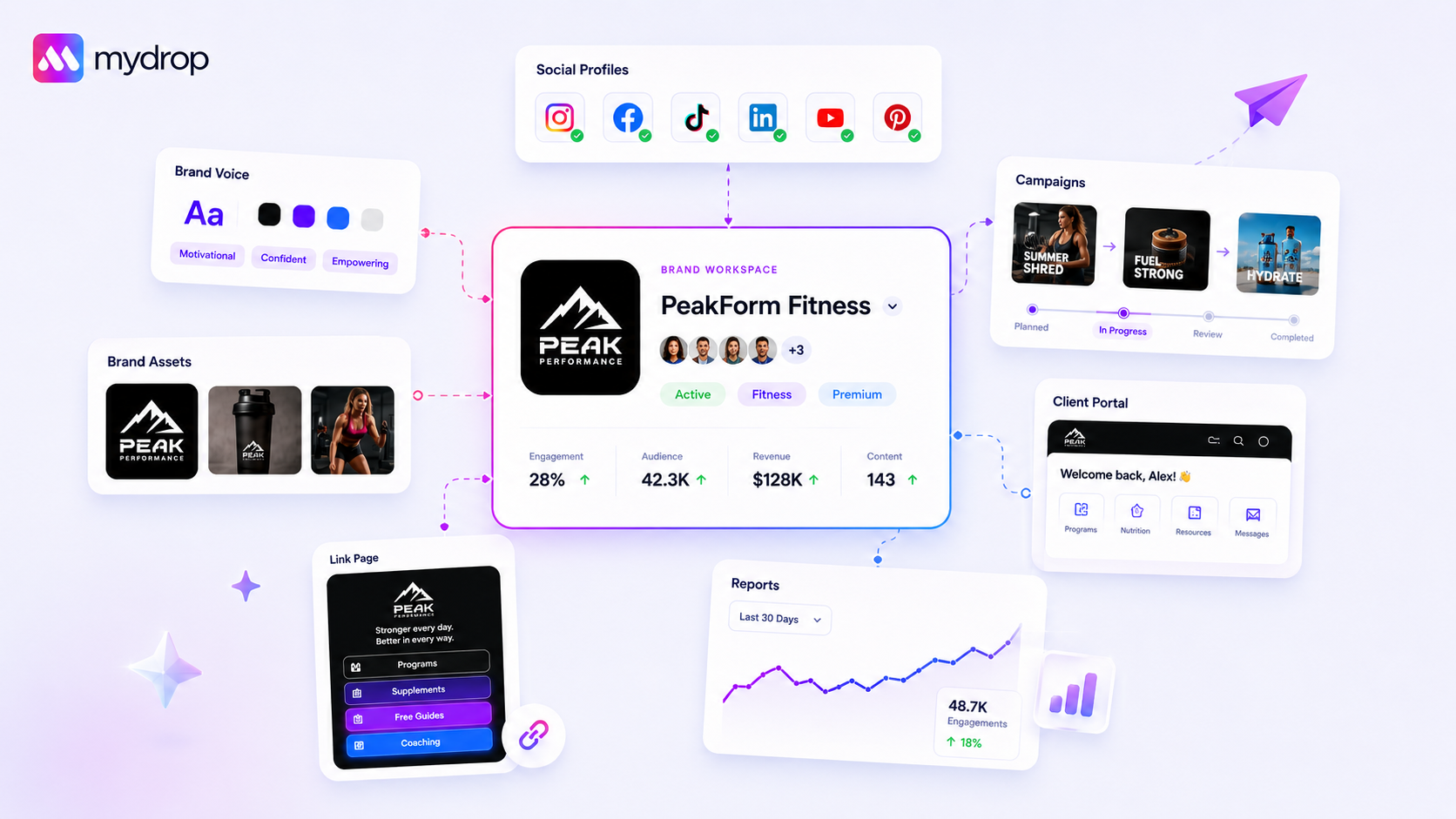
The best media library for an agency is not a storage bucket; it is a workflow bridge. You stop losing assets when your media management stops acting like a digital closet and starts acting like a live extension of your content composer and reporting tools. If your team is still digging through shared drives or Slack threads to find the latest version of a client logo, you are not managing a library-you are performing a recurring, high-stakes scavenger hunt.
We have all been there. It is 5:30 p.m., a client needs a post update, and the designer is offline. You open a folder, see five versions of a file named final_v2_updated_REAL.png, and experience that quiet, familiar panic. It is exhausting, inefficient, and entirely preventable. The secret is moving away from passive storage toward asset locality, where media is automatically indexed and reachable exactly where you use it.
What the best tools need to handle
True agency-grade media management requires more than just high-capacity uploads. You need to support the messy reality of agency life: multiple brands, shifting campaigns, and high-frequency content production. When we look at teams managing dozens of brand profiles and hundreds of active campaigns, the breakdown usually happens at the intersection of organization and execution.
Here is the decision matrix for evaluating whether your current tool can handle the scale:
| Criteria | Generic Cloud Storage | Enterprise-Grade Library |
|---|---|---|
| Workflow Coupling | Disconnected; requires manual download/upload. | Native; linked directly to composers & reports. |
| Brand Isolation | Folder-level permission hacks only. | Built-in brand-folder architecture. |
| Version Control | Filename-based (human error). | In-app edits with metadata tracking. |
| Asset Context | Lost; metadata is separate from storage. | Preserved; media knows its own history. |
Operator rule: If your team has to leave the application window to find an asset, your library has failed.
To get this right, you need to demand three specific capabilities from any tool on your shortlist:
- Nested Brand Logic: You must be able to group media into folders that map 1:1 to your client brands. If the tool forces you to keep everything in one giant "Workspace" bucket, your agency will reach its breaking point the moment you take on your second client.
- Direct-to-Context Embedding: The library modal should be available everywhere-in your post composer, your form builders, and your analytics reports. If you have to "download then upload" to get an image into a report, you are wasting 5 to 10 minutes per task.
- In-Browser Asset Utility: You should be able to crop, rotate, or mask an asset without opening external design software. At Mydrop, we see high-performing teams use this to make last-minute format adjustments right before publishing, saving countless back-and-forth cycles with designers.
Most teams underestimate the coordination debt created by basic storage tools. Every time a team member searches for a file or recreates a missing asset, that debt compounds. The goal is to make the library invisible by making it indispensable.
Where basic tools start to break

Basic cloud storage tools, while convenient for personal use, hit a wall when you scale to managing multiple brands. The failure is rarely about storage capacity; it is about context collapse. When your media lives in a silo separated from your social calendar and reporting tools, every asset becomes an unmoored file.
At Mydrop, we see this pattern repeat across thousands of campaigns. A team spends hours organizing files in a shared drive, but the moment a designer needs to find a version for the post composer, they have to abandon that workflow, switch tabs, search, download, and re-upload. The metadata-the "who, what, where" of that file-doesn't travel with it.
This is the hidden coordination debt that kills agency velocity. When you operate without asset locality, you aren't just wasting time; you are creating a versioning nightmare. You end up with multiple versions of the same file in different states of "finality," and no one is sure which one is actually approved for a specific market. Generic tools treat media as anonymous blobs; enterprise media needs to know which brand it belongs to and where it has already been used.
The buying criteria that matter
Stop looking for "unlimited storage" and start looking for workflow connectivity. If the media library isn't a native citizen within your composer, analytics, and brand-grouping tools, it will remain a destination, not a tool.
Use this scorecard to pressure test any platform before you commit your team's workflow to it.
Agency Media Capability Scorecard
| Capability | What to look for | Why it matters |
|---|---|---|
| Workflow Coupling | Can you select media directly inside the post composer or report builder? | Eliminates the download/re-upload dance. |
| Brand Scoping | Does the library support folder-level permissions tied to brand groups? | Prevents accidental cross-pollination of sensitive client assets. |
| In-App Editing | Can you crop, flip, or mask without external tools? | Saves 5-10 minutes per asset on simple layout adjustments. |
| Reference Tracking | Does the tool warn you if you're deleting an asset still in use? | Avoids broken posts and empty report widgets. |
Decision check: If you have to download a file from your library to use it, you are working with a storage bucket, not an agency-grade asset manager.
Beyond the checklist, prioritize platforms that treat media as metadata-rich documents rather than just files. Look for systems that track usage, allow for bulk actions like downloading folders as ZIPs, and offer easy filtering by brand. When your team can locate, edit, and deploy an asset without leaving their primary workspace, you have successfully moved from a file-storage model to a content-logistics model.
Most teams think they need more creative hours. In our experience, they usually just need a more reliable way to move existing assets from their library to their audience without friction.
How Mydrop supports this workflow
At Mydrop, we built our media library specifically to kill the "scavenger hunt" behavior that plagues growing agencies. We observed that when teams manage hundreds of social profiles across dozens of brands, a generic cloud folder isn't just inefficient; it is a liability.
The core idea here is asset locality. You should be able to touch your media without leaving your work. When you are inside our composer, an analytics report, or a brand configuration page, you should see your media right there. No tabs, no downloading, no re-uploading the same file to three different folders.
Our library supports this with a few specific mechanics:
- Brand-aware folder nesting: You create folders that are tied to specific brands. This forces order by default.
- In-browser editing: Why waste time downloading an image to crop it or add a text overlay? You can edit, mask, and filter right in the modal.
- Direct reference mapping: We don't just store the file; we track every post, report, and campaign that uses it. If you need to know which client is using a specific hero image, you don't need a spreadsheet. The data is already linked.
Common mistake: Many teams try to map their folder structure to their internal team hierarchy. That is a trap. Map your folders to your client-facing outputs.
A simple shortlist checklist
Before you commit to a new media tool, run this against your current process. If you can't check these off, you are likely burning hours on manual labor every single week.
- Modal access: Can I select, upload, and edit media directly inside my post composer without a new tab?
- Context awareness: Does the tool show me where a file is being used before I delete or move it?
- In-app transformation: Can I perform basic edits like cropping or resizing without an external tool?
- Brand isolation: Can I restrict media access by brand group so junior team members don't accidentally dump content into the wrong client folder?
- Batch utility: Can I export a full folder or a selection of assets as a single ZIP file for client hand-off?
Conclusion
The goal of a media library isn't storage; it is frictionless access. If your team is still spending 10 minutes navigating paths to find a single asset, you are not scaling-you are just repeating the same administrative work faster.
Stop treating your media like a digital storage unit. Treat it like a living part of your creative pipeline. The tools that win are the ones that disappear into your workflow, letting your team focus on the work that actually matters to your clients.