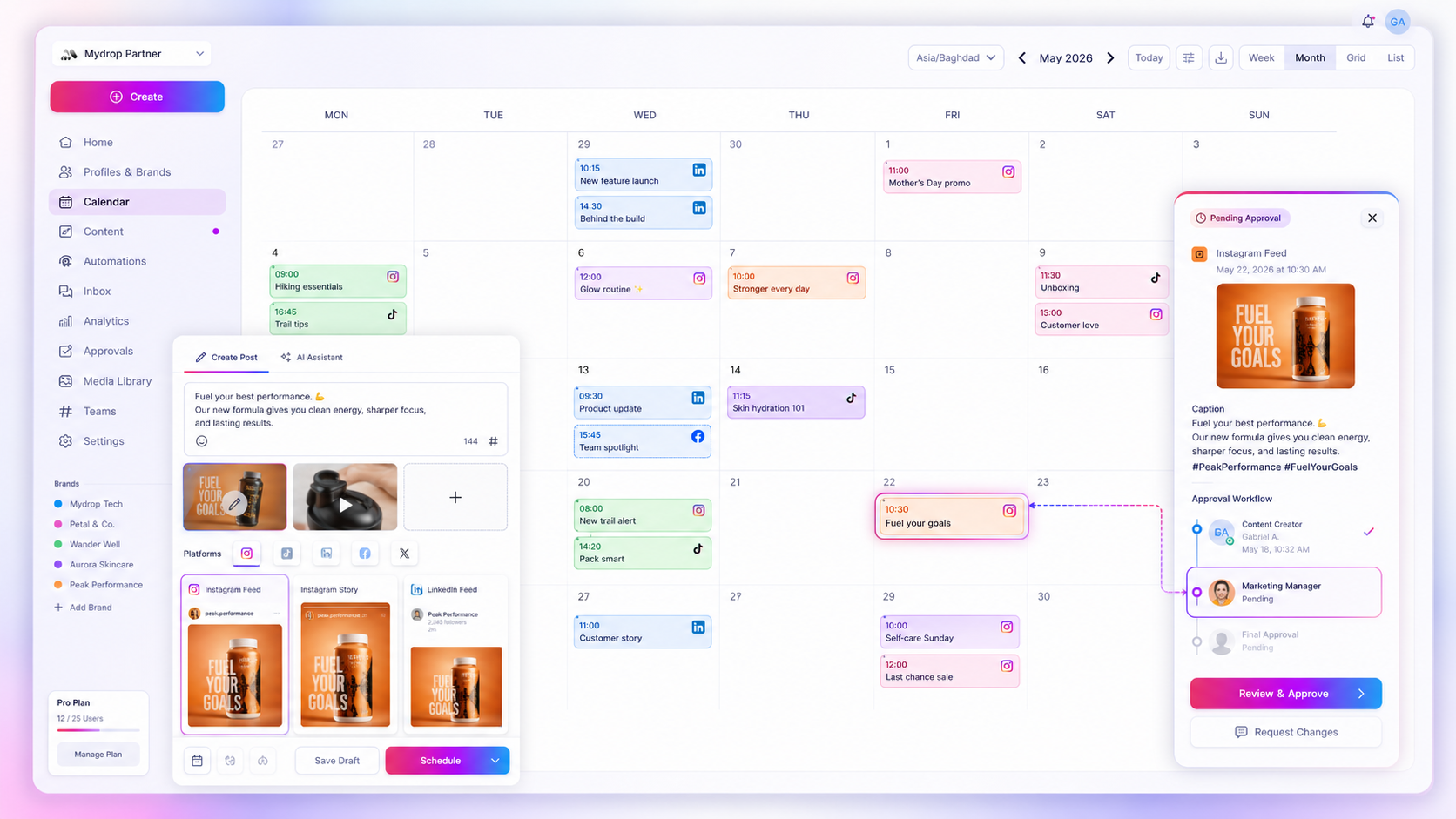
The best way to sync your social media calendar with Google is to stop treating it like a notification feed and start using it as an operational planning bridge. If your agency's content calendar exists only in your scheduling tool, you aren't running a workflow-you're running a silo. The right integration makes your content schedule the single source of truth for every stakeholder, turning your social strategy into a calendar-native event rather than a detached set of tasks.
We get it. Your team is juggling high-velocity edits, last-minute client requests, and the constant friction of "wait, where is this live?" The manual overhead of keeping spreadsheets, calendars, and dashboards in sync is exhausting. Worse, it’s where human error kills your credibility, leaving managers to act as glorified human sync-engines.
Operator rule: If a calendar sync tool doesn't let you choose specific profiles to display, it isn't an agency tool-it's a personal scheduler.
What the best tools need to handle

For agency-scale content, synchronization is a communication protocol, not just a data dump. When you are managing dozens of brands across hundreds of channels, a tool that pushes everything everywhere creates noise, not clarity. Your integration must distinguish between high-level team visibility and the granular reality of client-specific management.
To move from "dumb" notifications to a true planning bridge, look for these three core capabilities:
- Granular Profile Filtering: You should never be forced into an "all-or-nothing" sync. The ability to select specific profile IDs to map to client calendars prevents clutter and keeps stakeholders focused on relevant assets.
- Two-Way State Awareness: It isn't enough to push a post title to a calendar. The best integrations handle status updates, such as marking a recurring operational reminder as "done" or updating a post event when the schedule shifts, keeping your Google Calendar metadata fresh.
- Robust Webhook Watching: Manual "Force Sync" buttons are a fallback, not a strategy. An enterprise-grade tool uses webhook channels to automatically detect changes, ensuring your team isn't working off yesterday's spreadsheet.
Here is how agency tools typically stack up against this reality:
| Capability | Basic Notification Sync | Planning-Bridge Sync |
|---|---|---|
| Visibility Scope | Global (all posts) | Granular (selected profiles) |
| Task Alignment | None (posts only) | Full (reminders + post events) |
| Sync Mechanism | Static / Manual push | Webhook / Automatic watch |
| State Handling | Stale / Read-only | Live (done states, edits) |
Teams that ignore this distinction eventually hit a ceiling. When you lack granular sync modes, your account managers spend upwards of five hours a week just manually translating scheduling shifts into calendar updates. That is not just wasted time-that is coordination debt that slows down every approval loop.
A simple rule helps here: If the calendar cannot reflect your operational reality, it is a liability, not an asset. Before committing to a tool, check if it forces a one-size-fits-all approach or if it respects the complex structure of your agency's portfolio.
Where basic tools start to break
Here is the awkward truth: most calendar sync tools are built for personal life, not agency-scale operations. When you have ten team members juggling fifty brand profiles, a tool that simply pushes "every post from every account" to a single calendar turns into a digital dumping ground.
The "all-posts" noise problem is where teams usually hit a wall. When your creative lead tries to find a specific client launch window, they are met with a wall of noise from internal test posts, community manager replies, and minor account updates. The calendar stops being a planning tool and becomes a static list that no one trusts.
Even worse is the fragmented token trap. If your sync relies on a single, fragile service connection that expires silently, your calendar metadata goes stale instantly. You end up with "ghost events"-calendar entries for posts that were rescheduled or deleted in your source tool three days ago. When your team stops trusting the calendar, they stop using it. They revert to screenshots, spreadsheet trackers, and endless Slack pings to verify what is actually happening.
Common mistake: Relying on tools that lack granular filtering. If you cannot exclude specific profiles, you are essentially broadcast-spamming your own team.
The buying criteria that matter
If you are evaluating a tool, look past the "Google Calendar Sync" bullet point on their feature page. You need to verify if the tool is actually a planning bridge or just a notification pipe. Here is how to score your current setup against the reality of enterprise-grade content management.
Agency Sync Scorecard: Planning Bridge vs. Notification Pipe
| Capability | Notification Pipe (Basic) | Planning Bridge (Agency-Scale) |
|---|---|---|
| Visibility | All-or-nothing (everything synced) | Profile-specific filtering |
| Integrity | Pushes once, forgets forever | Webhook-driven auto-refresh |
| Tasks | Only syncs published posts | Syncs reminders & recurring tasks |
| State | Static event blocks | Syncs "Done" state & metadata |
Your decision threshold is simple: If you have to manually edit a calendar event because a post moved in your dashboard, the integration has failed.
The real buying criteria-the stuff that actually saves your team five hours a week-comes down to three non-negotiables:
- Granular Sync Modes: Can you map only high-priority brand profiles to a client's shared calendar? If not, the tool will never be clean enough for external stakeholder visibility.
- Webhook Reliability: Does the tool use real-time webhooks to watch for changes? You want a system that updates automatically when a post, reminder, or status changes in your dashboard.
- Task-Native Planning: Do your operational reminders and approval tasks show up alongside your published posts? A truly functional calendar combines content delivery with the work required to get there.
Most teams do not have a content problem. They have a coordination debt. If your calendar integration doesn't help you pay down that debt by centralizing both your delivery dates and your internal tasks, it is just adding to the overhead.
At Mydrop, we see teams that solve this by forcing every "selected profile" to have its own dedicated webhook channel. This ensures that when a manager marks a reminder as done or moves a launch window, the calendar reflects that reality in near real-time, keeping the entire team-and the client-aligned without a single extra email.
How Mydrop supports this workflow
At Mydrop, we built our calendar sync around a simple operating principle: your scheduling tool should be a mirror of your actual output, not an isolated island. We see teams managing hundreds of brand profiles who simply cannot afford the "all-or-nothing" approach most platforms force on them.
That is why we implemented granular selected-profile sync modes. You choose exactly which brand or region gets pushed to a specific Google Calendar, keeping the noise down for your cross-functional partners. When your legal team or client stakeholder opens their calendar, they see the precise content relevant to them, not every post you are managing globally.
We also treat your calendar as a two-way street. By using automatic webhook watch channels, we keep metadata fresh without manual intervention. If you update a post date or mark a reminder as done in Mydrop, the event on your Google Calendar updates near-instantaneously. You stop chasing account managers for status updates because the calendar is the status report.
Decision check: If your calendar sync doesn't support selective profile filtering, you aren't managing a schedule; you are managing a noise machine.
A simple shortlist checklist
If you are auditing your current stack this week, use this rubric to see if your calendar integration is an asset or a liability. If you hit more than two "No" answers, it might be time to look for a more robust planning bridge.
| Capability | Requirement | Why it matters |
|---|---|---|
| Selective Sync | Can you choose specific profiles to push to specific calendars? | Essential for multi-brand or multi-market sanity. |
| Two-Way Status | Do "Done" markers in the tool update the calendar event? | Keeps team members aligned on what is actually complete. |
| Webhook Health | Does the tool automatically re-establish lost sync connections? | Eliminates the "stale calendar" problem caused by expired tokens. |
| Visibility Control | Can stakeholders see post metadata without logging into the tool? | Reduces ad-hoc requests for schedule details. |
Conclusion
The difference between a frantic agency and a calm one is rarely about how many tools they use; it is about how well those tools talk to each other. When you treat your Google Calendar as a first-class citizen in your social operations, you stop managing coordination debt and start managing creative output.
Stop settling for sync tools that just dump data into a pile. You deserve a planning bridge that respects the complexity of your workflow. If your current calendar integration feels more like an extra chore than a silent partner, it is time to upgrade your protocol.