The best competitive intelligence tools solve the agency handoff gap by acting as a real-time data bridge between your strategy team and your account managers, rather than serving as just another static dashboard. When a competitor pivots on a key strategy, your planners usually see it immediately, but if your account team is still operating off a brief from three days ago, you have a data failure, not a communication one. We have all seen the frantic scramble when a client asks why you missed a launch. It is not just frustrating; it is a direct line to lost momentum and eroded trust. True alignment requires taking competitive shifts and automatically pushing that intelligence directly into the daily workflow of the people managing the client relationships.
We know the feeling of the 6 p.m. email chain trying to figure out why a strategy diverged from the market reality. It happens because intelligence is trapped in a silo, requiring manual logins that account managers simply do not have the bandwidth for. You do not need more dashboards. You need a pipeline that moves information from detected to actioned without human intervention.
What the best tools need to handle

Intelligence tools that fail at scale usually share the same flaw: they stop at the dashboard. They rely on someone remembering to check the platform, which is exactly why they break down under the weight of dozens of brands and hundreds of stakeholders.
To actually fix the handoff gap, your platform must turn raw monitoring into actionable, event-driven intelligence. At Mydrop, we see teams struggle most when intelligence is isolated from the communication layer, so we designed our intelligence alerts to bridge that divide directly in the tools your account managers use every day. Here is how to evaluate whether a tool actually bridges that gap or just adds to the noise.
| Capability | The Manual Trap | The Automated Flow |
|---|---|---|
| Notification Trigger | Active login required | Instant email or digest alert |
| Intelligence Format | Static dashboard charts | Contextual summaries for stakeholders |
| Monitoring Depth | Single-platform focus | Cross-platform normalization |
| Workflow Trigger | Manual report drafting | Automated task-based notifications |
The goal is to stop treating competitive intelligence as an end-of-month reporting exercise. It should be a constant stream of updates that align your team on market shifts in real-time. If you cannot configure who receives an alert for a specific competitive change, the tool is not built for enterprise operation.
Operator rule: If your competitive intelligence tool does not have an automated digest feature that sends data to your team without them having to log in, you are not using an intelligence tool-you are using a database that only strategy people look at.
Most teams do not have a content problem. They have a decision bottleneck. When intelligence stays static, decision-making slows down, which inevitably leads to the handoff gaps that force teams into reactive, rather than proactive, campaign management.
Where basic tools start to break

Let’s be real: most competitive intelligence dashboards are just glorified data graveyards. You set them up with good intentions, add a few competitors, track a hashtag or two, and then... nothing. The dashboards sit untouched, accumulating digital dust while your team moves on to the next fire.
The "login tax" is the silent killer of strategic momentum. If your team has to manually log into a secondary platform to see what’s happening, they won't. They’ll just default to what they know-the current brief, the existing content calendar, the status quo. By the time someone manually exports a report to share with the account team, the competitive landscape has already shifted.
This isn't a failure of effort; it's a failure of coordination.
When insights live in a siloed dashboard, they remain high-level observations rather than actionable tasks. We see this all the time: a strategist spots a major pivot in a competitor’s content theme on Monday, but the account manager is busy executing the week’s planned social posts. Without an automated, cross-platform signal, the bridge between that new intelligence and the actual day-to-day work is just a gap waiting to widen.
At Mydrop, we’ve learned that when you’re managing hundreds of brand profiles across multiple markets, the problem isn’t a lack of data. It’s coordination debt. The more steps you add between "new competitor insight" and "updated brief for the account team," the more likely that gap grows until your strategy drift becomes unavoidable.
The buying criteria that matter
You don't need another dashboard. You need a pipeline that turns raw competitor moves into team-level alerts. If you’re shopping for a tool to finally bridge that agency handoff gap, stop looking for prettier charts and start looking for operational signals.
Here is your audit checklist for finding a tool that actually works for busy teams.
| Feature Category | The "Dashboard-Only" Trap | The Operational Standard |
|---|---|---|
| Delivery Mechanism | Requires manual login/check | Pushes alerts to inbox/Slack |
| Alert Granularity | All-or-nothing notifications | Thresholds based on impact/growth |
| Context | Raw data dumps | AI-summarized takeaways |
| Platform Integration | Fragmented/Isolated | Unified view (IG/YT/X) |
| Actionability | Requires manual translation | Links direct to workflow tools |
Beyond this table, look for these three non-negotiables:
- Context-Aware Alerting. Does the tool just say "Competitor X posted," or does it say "Competitor X changed their content recipe for the second time this week"? You need the why and the impact, not just the what. That is why Mydrop builds automated intelligence alerts directly into the dashboard workflow.
- Digest Customization. Your account manager for Brand A doesn't need alerts about industry changes for Brand B. Look for tools that let you scope alerts by profile, topic, or even specific market.
- Automated Normalization. If your tool tracks YouTube keywords and Instagram hashtags separately without normalizing them into a shared view of industry trends, your team will always be looking at fractured insights. When we developed the Mydrop intelligence engine, we prioritized the alert-first workflow over the vanity dashboard approach to solve exactly this problem.
Decision check: If a tool’s primary output is a dashboard, it’s a reporting tool, not an intelligence system. If its primary output is an alert for a specific stakeholder, it’s an intelligence system.
Most teams do not have a content problem. They have a decision bottleneck. If your intelligence tool doesn't help you remove that bottleneck by pushing the right information to the right person at the right time, it’s just overhead.
How Mydrop supports this workflow
We built our intelligence monitoring to act as a shared ground truth for busy, cross-functional teams. Instead of waiting for an account manager to log in and find a relevant insight, we push the signal directly to them.
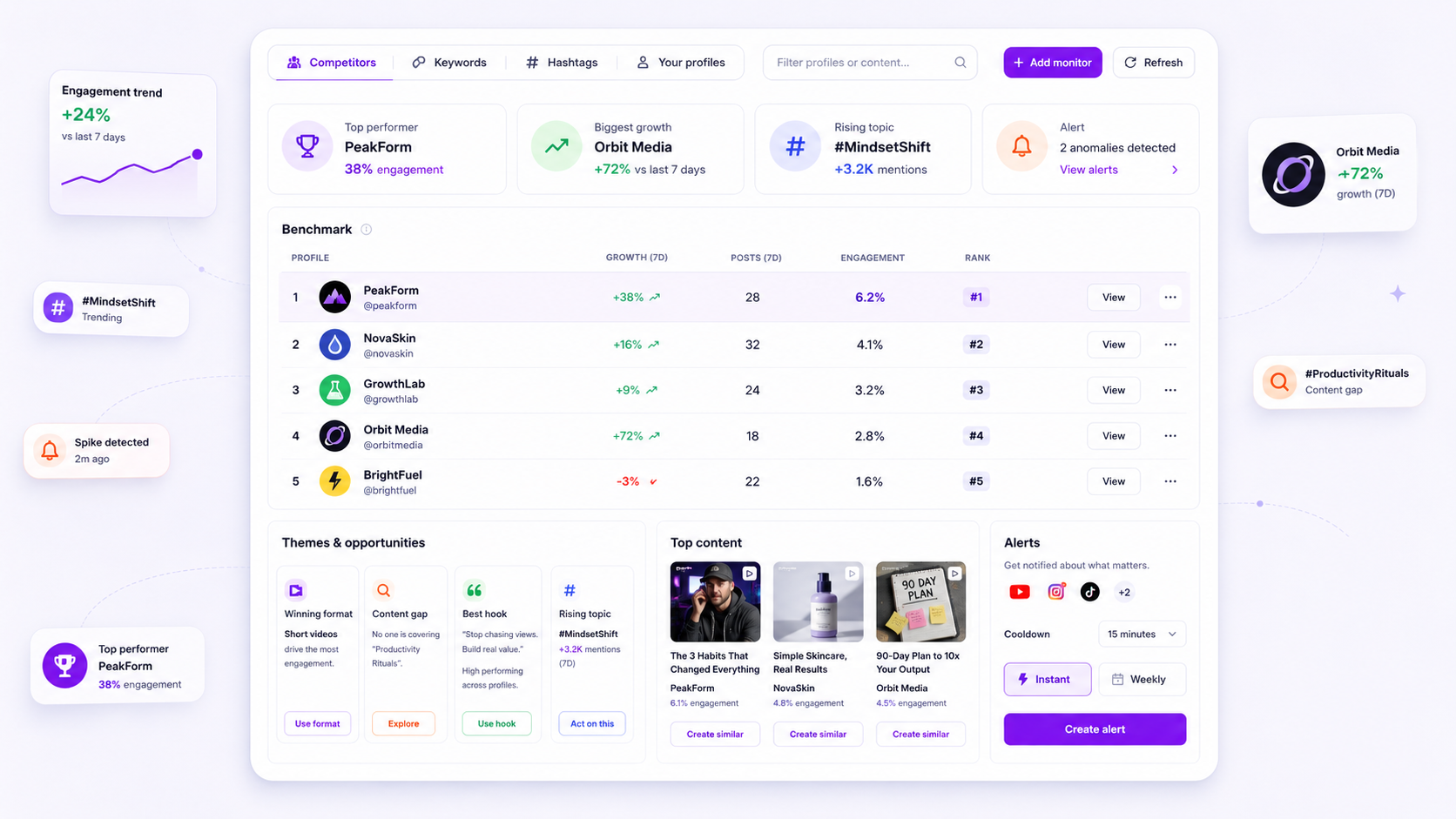
At Mydrop, we see the most successful teams treating their intelligence dashboard as a living source of inspiration, not a static report that gets reviewed once a month. Here is how the flow actually works for enterprise-scale operations:
- Automated Alert Triggers: You define the thresholds-maybe a 20% spike in engagement for a competitor's post, a shift in content themes, or a new rising hashtag-and the platform instantly flags it.
- Direct Delivery: Alerts aren't trapped in the tool. They reach the stakeholders via email or integrated channels, ensuring they see it without needing to log in.
- Normalized Digests: Instead of raw data, account managers get a weekly summary that explains what happened, why it matters, and what it means for their specific client’s content calendar.
By automating the "discovery" phase, your strategists can stop policing the account team's awareness and start focusing on higher-level positioning. The tool handles the noise, while your team gets the signal at the moment it needs to be acted upon. You aren't just saving time; you are ensuring that the entire agency is operating from the same data set.
A simple shortlist checklist
Use this audit to evaluate whether your current tool actually supports agency handoffs, or if it just creates more work for your account managers. If a tool fails more than two of these, it will become a bottleneck.
| Feature | The "Tool Graveyard" Test | The "Operator" Standard |
|---|---|---|
| Alerting | Requires manual daily login | Pushes alerts to email or Slack |
| Granularity | Single global setting | Thresholds by platform & metric |
| Normalization | Fragmented per-platform views | Unified view (e.g., YouTube/Instagram) |
| Delivery | Static PDF export | Automated custom email digest |
| Ease of Use | Requires dedicated training | Self-serve for account managers |
Competitive Intelligence Tool Handoff Audit
If you are looking to fix your internal data flow this quarter, ensure your shortlist candidate can do the following:
- Configurable Thresholds: Can the account manager set alerts for their specific focus (e.g., Instagram hashtags) without cluttering the strategist's inbox?
- Push vs. Pull: Does the tool push the insight to the inbox? If it requires a "check in," it will be ignored during high-velocity campaigns.
- Multi-Brand Support: Can you easily toggle between different brands in the same dashboard for centralized monitoring?
- Inspiration Workflow: Does it suggest new leaders or trends that your team might have missed?
Workflow check: If your account manager has to log in just to see if a competitor made a pivot, your tool isn't part of your workflow-it's just a place to store data.
Conclusion
Competitive intelligence isn't about knowing everything your competitors are doing; it's about ensuring the right people on your team know the right things at the right time.
When you reduce the friction of transferring that intelligence from your strategy lead to your account managers, you do more than just fix a communication breakdown. You reclaim the hours lost to "catch-up" meetings and replace them with proactive, market-responsive strategy.
Stop treating intelligence as a passive, dashboard-centric activity. Make it an active, alert-driven component of your team’s daily routine. Your account managers will thank you, your clients will feel the difference, and you will stop playing defense in a market that rewards those who move fast. The data is available; the only question is whether it is reaching the person who can act on it.