The best way to fix your competitive intelligence workflow is to stop treating it as a research project for individuals and start treating it as shared infrastructure. If your team is still manually scraping profiles into spreadsheets before every client meeting, you are not managing intelligence. You are managing a bottleneck.
We have seen this across dozens of agencies: the account manager needs data to justify a pivot, the strategist is buried in tabs trying to synthesize what competitors did last week, and the content creator is waiting on a Slack thread that may never come. The real cost here is not the time spent collecting data. It is the translation tax. Every time an insight changes hands from a research-focused analyst to a brand-focused creator, it loses fidelity. You end up with report bloat, expensive slide decks that die the moment they are presented because they lack the specific, actionable hook needed to actually change a content plan.
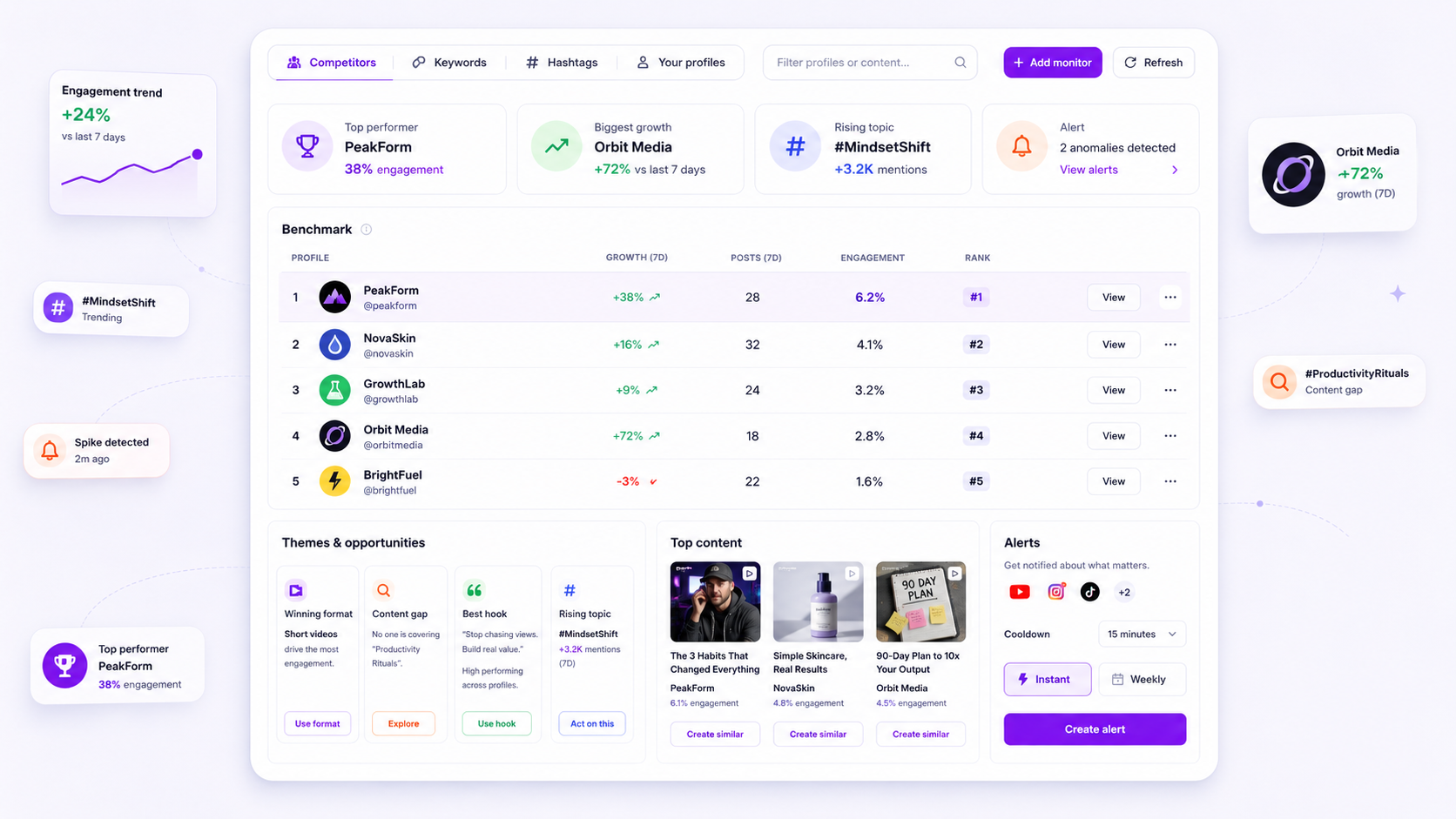
The solution is moving from chaotic, siloed research to a standardized, team-wide dashboard where insights flow in, get tagged, and are accessible the second a team member needs them. At Mydrop, we built the Intelligence Dashboard precisely for this: to ensure that when a competitor shifts their format or a new topic starts trending, the entire team sees the same signal simultaneously. You stop chasing data and start managing the strategy. It is the difference between being reactive and actually leading the conversation.
What the best tools need to handle

To move past the chaos, you need more than just a place to track numbers. A serious intelligence tool must integrate into your daily workflow rather than existing as a separate tab you visit only when forced to write a report.
Your infrastructure needs to do three things exceptionally well:
- Centralize the signal: All competitor profiles, hashtags, and keywords must live in one spot. If you are checking YouTube in one tool and Instagram in another, you are wasting time.
- Standardize the output: A good tool translates raw data into actionable insights, like identifying content gaps or top performers, instead of just dumping raw follower counts on you.
- Automate the delivery: If you have to remember to check for an alert, the alert is already late.
Here is how to distinguish between a static reporting tool and a true operational asset.
| Feature | Manual Spreadsheet Flow | Standardized Intelligence Tool |
|---|---|---|
| Data Freshness | Stale (Weekly/Monthly) | Live (Instant refresh/alerts) |
| Insight Format | Subjective commentary | Data-backed recipes & trends |
| Accessibility | Siloed (Individual owner) | Shared (Workspace-wide) |
| Actionability | Low (Requires translation) | High (Direct content application) |
Common mistake: Buying a tool just for the dashboard view. Look for how the tool notifies you when a competitor's strategy shifts materially, rather than just showing you charts you have to interpret manually.
Most teams do not have a content problem. They have a decision bottleneck. If your tool does not make it faster to decide what to build, it is just adding to the noise.
Where basic tools start to break

The moment competitive intelligence stops being a living stream and starts being a static document, your agency has already lost. We have all seen the spreadsheet that was meant to track competitor activity, only to become a forgotten graveyard of last month's trends. When you rely on manual tracking or fragmented tools, you are essentially asking your team to pay a translation tax on every single insight.
The analyst spends three hours scrubbing data into a slide deck. By the time they present it, the content creator is already onto the next project. They either ignore the deck entirely, or they try to act on outdated information that missed the peak. This is not a data problem. It is coordination debt.
When an account manager needs to justify a pivot to a client on a Monday morning, and they have to Slack the strategist to send over the latest competitor numbers, you have failed. The data is locked in a private note, a buried email, or a team member's head. If the data is not accessible, the strategy is not actionable.
Watch out: Treating competitive research as a periodic reporting chore instead of a continuous infrastructure layer.
The real pain is the repetition. You are manually monitoring the same platforms, using different tracking methods across accounts, and hoping someone actually captures the why behind a competitor's winning post. Basic tools leave you staring at the what, but they leave you guessing on the how.
The buying criteria that matter
Stop looking for the prettiest dashboard and start looking for the tool that forces a shared workflow. If your intelligence tool does not change how you work, it is just adding to your noise. You need a platform that turns raw monitoring into a shared team asset.
Here is the rubric we use to decide if a tool actually supports an agency-scale operation or just provides another tab to ignore.
Agency Intelligence Capability Audit
| Capability | Basic Tool (Manual/Fragmented) | Elite Infrastructure (Integrated) |
|---|---|---|
| Monitoring | Periodic manual checks | Automated, persistent tracking |
| Intelligence | Raw data dumps | Pattern recognition and thematic clusters |
| Actionability | Requires manual synthesis | Alerts based on specific conditions |
| Handoffs | Email/Slide attachments | Shared, persistent workspace |
| Scaling | Limited to few accounts | Unlimited brand and competitor profiles |
Look for tools that prioritize the alerting logic and shared knowledge. You do not need more data. You need fewer, higher-quality notifications when a competitor changes their strategy materially.
At Mydrop, we often talk about the difference between passive listening and active intelligence. If you are just collecting posts, you are still doing the work. You want a system that does the heavy lifting: identifying content gaps, flagging rising topics, and suggesting inspiration that is actually relevant to your niche.
When auditing a tool for your agency, run through this simple checklist before committing to a contract:
- Direct Integration: Does it link directly to your connected social profiles for instant benchmarking?
- Multi-Platform Normalization: Can it handle the distinct formats of YouTube, Instagram, and X in one unified dashboard?
- Action-Oriented Alerts: Can you set specific thresholds for notifications, or is it just another "everything is important" flood?
- Shared History: Can team members browse 90 days of trends without needing a new manual pull?
- Collaborative Context: Can you add team notes, tags, or status updates to monitored profiles?
If a tool cannot pass this audit, it will only create more work. Elite agencies do not just track competitors; they operationalize the findings so the team knows exactly what to do next.
How Mydrop supports this workflow
When you move from individual research to a shared workspace, the dynamic changes instantly. The goal isn't just to track what competitors are doing, but to build a living, breathing repository of "winning recipes" that your entire team can access without asking for permission.
At Mydrop, we built the Intelligence Dashboard specifically to break that bottleneck. It treats competitor and topic tracking as shared infrastructure, normalizing data from YouTube, Instagram, and X so that your account managers and content creators are looking at the exact same benchmark metrics. Instead of waiting for a weekly report that is already outdated by the time it lands, your team can check the dashboard for live trends, content gaps, or competitor alerts.
The real shift happens with the inspiration and opportunity features. Because the system automatically suggests industry leaders based on your workspace profile and brand focus, you spend less time hunting for new handles and more time analyzing why a specific hook or format is working. When a teammate needs to justify a creative pivot for a client, they don't have to scramble to find you. They can pull the data directly from the dashboard, look at the AI-powered summary of rising topics, and build their argument with real-time benchmarks already in front of them.
A simple shortlist checklist
Before you commit to a tool or re-engineer your current setup, run your candidates through this audit. If a tool fails more than two of these, it will eventually become just another silo where insights go to die.
- Platform Normalization: Does the tool treat YouTube, Instagram, and X as a unified stream, or will your analyst have to manually stitch together metrics to get a clear picture?
- Alert Fidelity: Do alerts trigger based on material changes, or do they just flood your inbox with noise for every minor update?
- Collaboration Layer: Can teammates add comments, tags, or assign action items directly on a competitor’s top post, or is that data stuck in an isolated view?
- Inspiration Resolution: Does the tool suggest relevant industry leaders and resolve those profiles, or are you stuck manually finding and adding handles to your tracking list?
- Reporting vs. Strategy: Does the dashboard prioritize a "winning recipe" or content gap analysis, or does it just output raw data that requires another hour of manual interpretation?
Conclusion
Competitive intelligence is only as valuable as the team that can act on it. If your current workflow relies on a few people manually gathering data, you aren't actually tracking intelligence-you are managing a research bottleneck. The best agency teams stop treating intelligence as a personal project and start treating it as a shared infrastructure asset.
Shifting your process means giving everyone on your team-from the strategist setting the direction to the creator producing the assets-access to the same source of truth. When the research is standardized, the translation tax disappears, and your team can finally move as fast as the trends they are tracking. Whether you are using Mydrop or building your own internal version of this, the objective is the same: stop creating documents and start building a feed. The speed of your agency depends on it.