Centralized brand management isn't just about secure asset storage; it's the structural foundation for ensuring consistent output across disparate client workflows. If your tool doesn’t group profiles with their brand identity, you aren't managing brands-you're just organizing files. Agencies and multi-brand companies are constantly drowning in context fragmentation. Every time a team member switches between a fashion client and a tech client, they shouldn't have to manually swap brand assets, re-verify tone, or search for the right profile group. This is the part people underestimate: the real hidden cost isn't the file retrieval; it’s the fragmentation of context that kills your team’s efficiency.
We get it-this work is messy. Managing multiple clients feels like constantly switching hats, and one wrong file or off-brand post can jeopardize weeks of relationship building. You're exhausted by the administrative overhead of making sure the right content hits the right brand profile. A simple rule helps keep the chaos at bay: One Brand = One Source of Truth (Profiles + Assets + Identity). If a profile group doesn't automatically pull its associated color palette, font family, tone guidance, and AI-ready brand context, the tool is failing you.
What the best tools need to handle

The best brand management tools stop treating profiles as isolated entities. Instead, they lock profiles, assets, and identity into a single, cohesive unit. When you’re managing hundreds of brand profiles, the administrative debt of manual configuration isn't just annoying-it’s a major compliance and brand risk.
Here is where most basic tools start to break. They function as a "generic workspace" where assets are stored centrally but aren't context-aware. If you have to manually map a color palette or re-select a tone guide every time you open a composer, you are paying for storage, not management.
Operator rule: If your tool doesn't know that the "fashion client" profiles always use this specific font, this color set, and this AI-prompt tone, you are essentially manually building your own brand compliance software from scratch.
You need tools that handle dynamic context, not just static files. Look for these four pillars:
- Dynamic Profile Grouping: The ability to add or remove profiles from a brand without having to reconnect or re-authenticate them.
- AI-Context Awareness: The system should automatically read the brand's target audience, marketing goals, and tone when you hit "generate" in the composer.
- Automated Asset Application: If you import a website, the tool should extract colors and assets automatically to accelerate onboarding.
- Centralized Identity Record: One source of truth for the brand's description, contact details, and core messaging that carries across reports, portals, and link-in-bio pages.
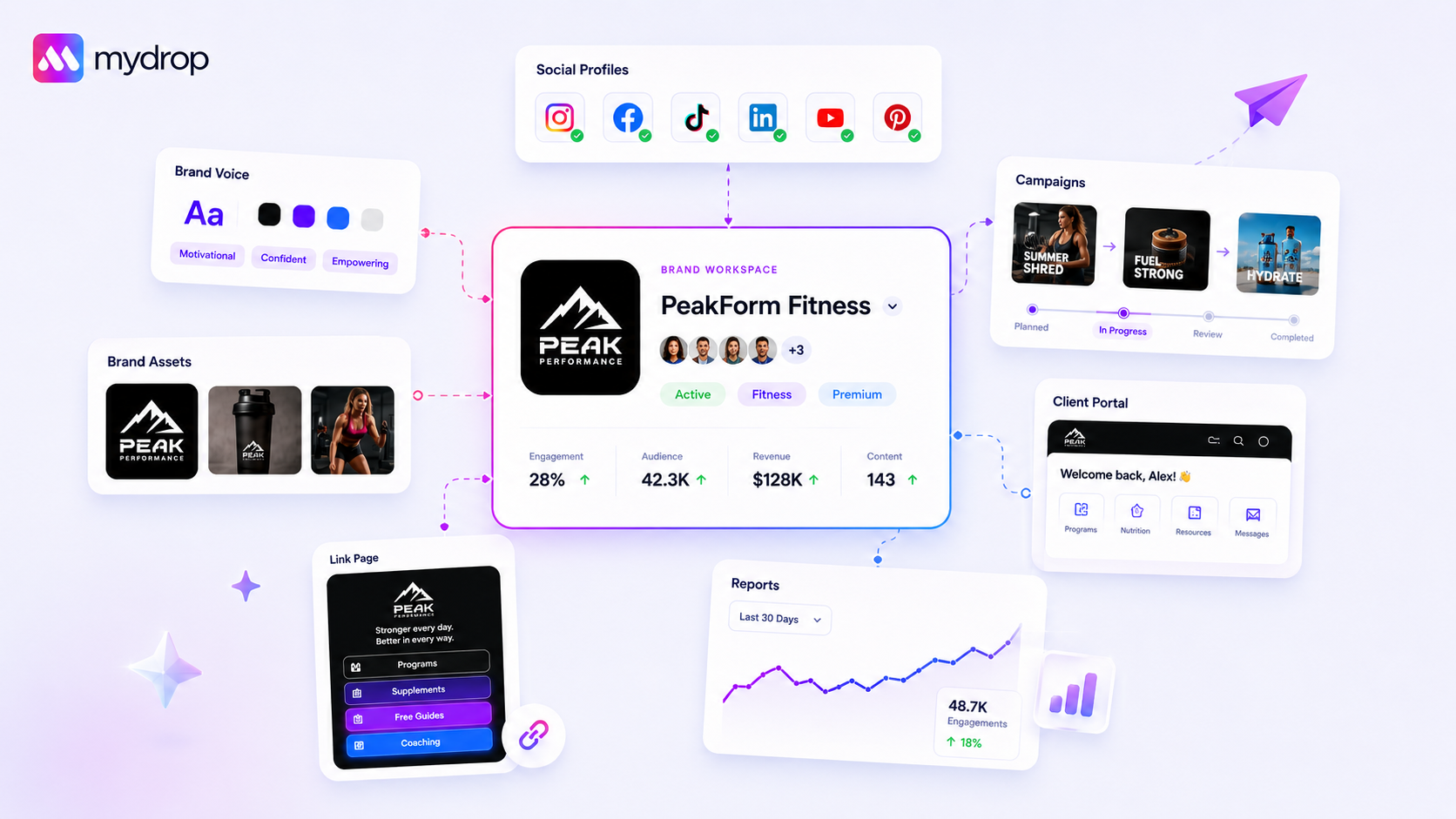
At Mydrop, we approach this by locking profiles into Brand Groups. A brand isn't just a container; it's the operational hub where we house the structured context-like tone and marketing goals-that drives our AI generation and publishing workflows. When you change an asset in the brand group, it updates everywhere, instantly, across that profile group. If your current tool forces your team to manually chase down the "latest" version of a logo or double-check the hex codes before a post, you are working harder than you need to.
Where basic tools start to break

You know that moment when a team member accidentally posts an old logo or uses a stale color palette for a client campaign? That is not just a minor mistake; it is a clear system failure. Many standard tools treat social profiles as isolated, blank slates in a workspace. They are great for scheduling a single post to a single account, but they collapse the moment you need to manage the actual DNA of a brand across multiple channels.
If your current tool forces you to dig through sub-folders to find a brand color, or if you have to manually copy-paste the "brand voice" into an AI generator every time you create content, your setup is actively hindering your team. You are spending more time managing the logistics of being "on brand" than actually building the brand itself.
At Mydrop, we see this coordination debt build up quickly. When profiles are not locked to their specific brand identity-meaning their font families, color palettes, and marketing goals are not automatically surfaced-every post becomes a potential compliance risk. It is a slow, quiet erosion of quality that eventually leads to a messy brand reputation.
The "generic workspace" trap is where most teams get stuck. They treat every profile as an independent entity rather than a component of a larger, branded machine. When onboarding a new client, this means manually adding every asset to every profile, which is not only slow but error-prone. You end up with versions of your brand living in five different places, and no one is quite sure which one is the "official" version.
The buying criteria that matter
Stop looking for "more storage" and start looking for "orchestration." A tool is only as good as its ability to bridge the gap between asset management and content distribution. When you manage dozens of clients across hundreds of profiles, you need to evaluate your tech stack based on how well it keeps the context aligned.
Here is the breakdown of what separates a generic tool from one that actually scales for agencies and multi-brand teams.
| Capability | Generic Asset Storage | Centralized Brand Orchestration |
|---|---|---|
| Profile-to-Brand Mapping | Manual (Post-by-post) | Automatic (Group-based) |
| Asset Auto-Application | User-managed (Copy/Paste) | System-applied (Dynamic) |
| AI-Context Awareness | Zero (Requires prompt input) | Native (Reads brand goals/tone) |
| Profile Re-grouping | Time-intensive (Reconnect) | Flexible (Drag-and-drop) |
Evaluation Threshold: If your current tool cannot handle at least 3 of the 4 items in the right-hand column, your workflow is highly vulnerable to scaling bottlenecks.
When you audit your next tool, look for these three operational realities:
- Flexible Grouping: Can you add or remove profiles from a brand without re-authenticating the whole brand group? This is a massive hidden time-sink for agencies that often have to rotate clients in and out of active campaigns.
- Native AI Context: Does the AI generating your captions know the specific brand voice and target audience without you having to re-educate it every time? At Mydrop, we approach this by locking profiles into Brand Groups, which act as the central record for that client. It means when you open the composer, the brand's colors and voice are already there. You aren't "finding" them; they are just part of the workflow.
- Scalable Asset Folders: Are assets automatically available to anyone working within that brand group, or does someone need to share a file link each time? If a team member can’t access the right files from within the publishing interface, they will inevitably use whatever is easiest, not what is right.
Most teams do not have a content problem; they have a decision bottleneck. If your tool doesn't automate the boring parts of brand compliance, your team will continue to pay the price in missed deadlines and inconsistency.
How Mydrop supports this workflow
At Mydrop, we approach this by locking profiles into distinct Brand Groups. Think of this as a logical container that sits above your individual social accounts. Instead of managing assets in a shared drive and then manually applying them to profiles, you define the brand identity once-colors, fonts, logos, and even AI tone guidance-and that context automatically follows your profiles across the platform.
When you create a brand, the system generates a dedicated media folder and extracts your brand colors directly from your website. You stop hunting for the "latest" version of a logo because the Brand Detail view becomes the single source of truth. If you need to add a new LinkedIn page or remove an Instagram handle, you just update the Brand Group. You never have to reconnect profiles or re-upload files.
This centralized approach pays off most when your team starts using AI. Because Mydrop stores structured brand intelligence-like your specific target audience, marketing goals, and tone-the AI tools inherently understand who they are writing for. You don't have to reprompt the AI with brand guidelines every time you open the composer. The context is already there, baked into the Brand Group, ensuring that every post feels intentional and aligned, even when your team is managing dozens of clients simultaneously.
A simple shortlist checklist
Before you commit to a brand management tool, run your current workflow through this audit. If you answer "No" to any of these, you are carrying unnecessary coordination debt.
| Capability | Requirement | Why it matters |
|---|---|---|
| Profile-to-Brand Mapping | Can you group multiple profiles under one brand? | Eliminates switching silos. |
| Asset Auto-Application | Do brand colors/logos populate automatically? | Prevents version control drift. |
| AI-Context Awareness | Does the tool know your brand tone/goals? | Removes repetitive AI prompting. |
| Dynamic Grouping | Can you add/remove profiles instantly? | Handles client onboarding/offboarding. |
| Website Integration | Can it import assets directly from a URL? | Accelerates initial brand setup. |
Decision check: If your team spends more than an hour per week just organizing files or verifying asset usage, your tool is acting as a storage unit, not a brand management solution.
Conclusion
Most teams do not have a content creation problem. They have a coordination bottleneck. When you scale from managing three brands to thirty, the traditional approach of folder-based organization breaks down immediately. Every manual step-every re-upload, every color check, every profile re-auth-is a small tax on your team’s focus, and these taxes compound until your brand consistency starts to slip.
True brand orchestration is about making the right choice the easiest one for your team. When you centralize identity-linking profiles directly to their assets, tone, and goals-you stop managing assets and start managing the brand itself. You give your team the guardrails they need to stay fast and consistent without constant supervision.
Stop treating your social media management tool like a digital filing cabinet. The goal isn't just to keep your files organized; it is to create a frictionless environment where your team can move from strategy to publication without tripping over the infrastructure. When the platform handles the coordination, you finally have the bandwidth to worry about what actually matters: the quality of the content and the strength of the client relationships.