
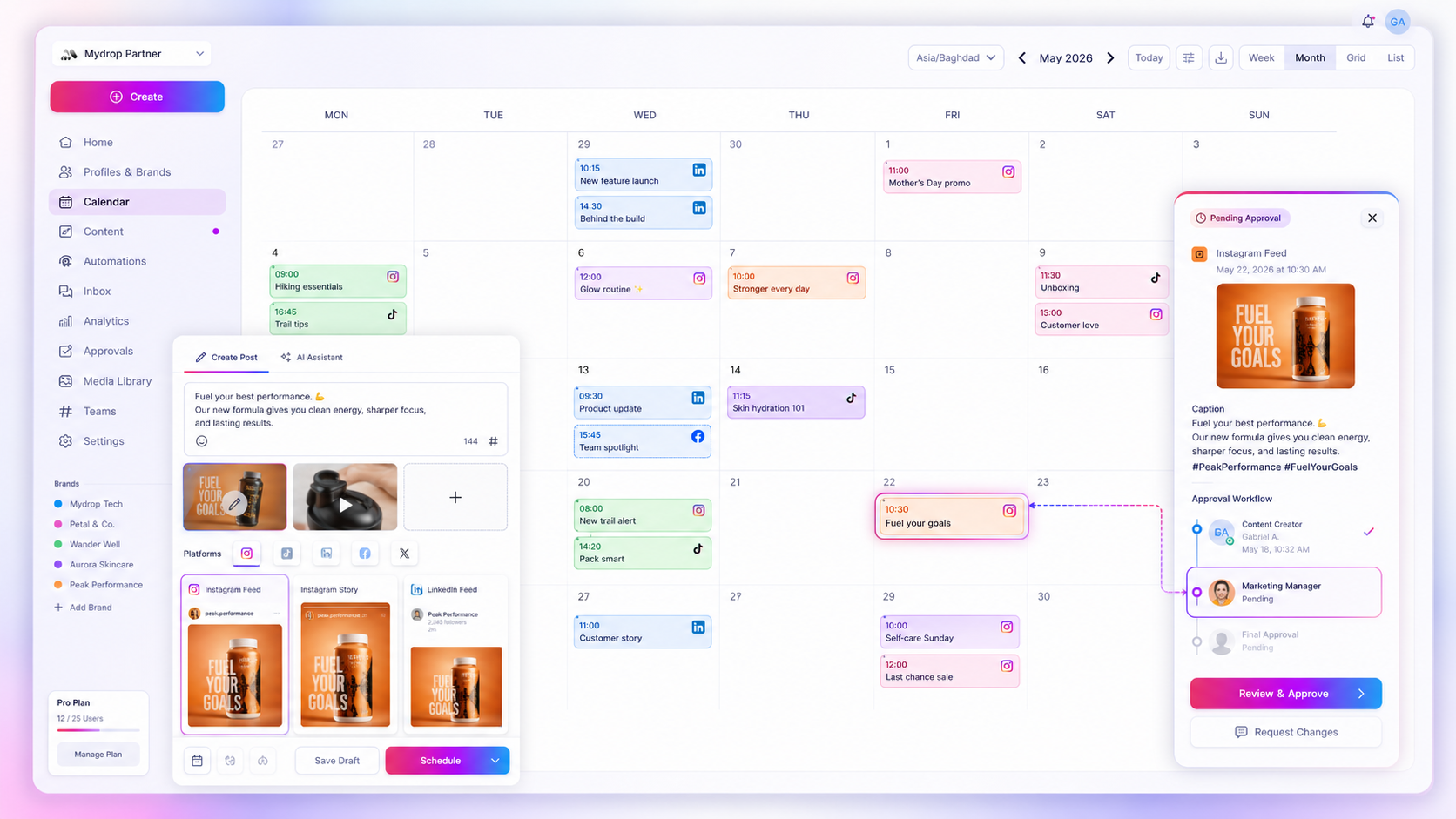
When your multi-brand launch fails to hit benchmarks, you don’t need more creative assets-you need a unified campaign architecture. Most performance drops are not caused by the content, but by the coordination debt incurred when every post, platform, and sub-brand operates in a vacuum without shared tracking or visual intent.
We get it. Managing a multi-brand presence feels like trying to conduct an orchestra while each musician is reading from a different sheet of music. It is messy, noisy, and exhausting to keep your reporting clean. The awkward truth is that you are likely cannibalizing your own results. Without centralized campaign periods and identity settings, you aren’t launching one cohesive campaign-you are launching fifty disconnected social experiments.
What changed before the numbers moved

In our experience with teams managing hundreds of brand profiles, the shift from mediocre to high-performing launches almost always starts with campaign-period thinking.
Before the numbers move, most teams operate on "single-post" logic. A manager creates a post, attaches a link, and hopes for the best. When you scale this across five markets and three internal sub-brands, you inevitably lose the plot. UTM parameters are mistyped by junior team members, campaign assets are inconsistent, and your analytics dashboard becomes a graveyard of "Direct" or "Other" traffic that tells you absolutely nothing about which launch actually converted.
When you move to a campaign-period model, the discipline changes. You stop asking "What are we posting today?" and start asking "What is the active intent of this campaign window?"
At Mydrop, we see the highest-performing teams anchor their work in defined campaign objects that handle the heavy lifting of governance. When you assign a post to an active campaign, the system stops relying on human memory for tracking. It automatically appends the correct UTM strings and aligns the visual assets to the brand intent. You stop guessing if your attribution data is correct because the "campaign container" forces consistency before the publish button is even clicked.
Here is how the transition usually looks in the wild:
| Workflow Stage | Fragmented (The Debt) | Centralized (The Conduit) |
|---|---|---|
| Link Tracking | Manual UTM entry per post | Auto-appended via campaign period |
| Brand Identity | Ad-hoc, variable across teams | Campaign-locked assets & colors |
| Attribution | Orphaned data, mismatched tags | Consolidated by campaignId |
| Governance | Loose, silos across profiles | Period-bound active windows |
If you are currently struggling to see a clear "signal" in your conversion data, you are likely suffering from coordination lag. Your team is firing in different directions because they lack a shared operating habit.
Operator rule: If a post is part of a launch, it must be assigned to an active campaign container. If it isn't, it is not a launch post-it is an orphan.
Fixing this isn't about working harder; it is about forcing the system to do the work for you. By enforcing a campaign-first workflow, you move from auditing mistakes to observing actual audience signals.
The failure patterns to check first

When you are deep in the weeds of a multi-brand launch, it is easy to assume that missing numbers are a creative issue. You start questioning the hooks or the visuals, asking your designers for new variations while the launch clock is already ticking.
The reality is usually much more boring-and much more fixable. Most performance drops aren't a creative failure; they are a coordination failure. When your team operates in a vacuum, you lose the ability to see how your different brand activities overlap or conflict.
Here is the audit we run when we see a launch underperforming:
| Failure Mode | The Symptom | The Real Cost |
|---|---|---|
| Manual UTM Chaos | Every team member defines their own tracking parameters. | Broken data feedback loops; impossible to credit the campaign. |
| Identity Drift | Different brands in the same launch use mismatched campaign colors or logos. | Weak audience recall; the "sum" of your brands feels like noise. |
| Orphaned Assets | Posts are published without a campaign association. | Hidden engagement; your biggest winners don't show up in the report. |
| Period Fragmentation | Team A starts the campaign on Monday; Team B waits until Wednesday. | A weak, disjointed market signal instead of a cohesive wave. |
If you are seeing these patterns, stop optimizing the creative and start fixing the coordination debt. The goal is to move your team from "single-post" thinking to "campaign-period" thinking, where every asset is tethered to a shared, high-level goal.
The proof that separates signal from noise
You cannot manage what you cannot see, yet we see teams constantly firing in the dark. To gain clarity, you need a way to map your actual output against your intended campaign coverage. This is where a simple visibility scorecard turns a chaotic, fragmented week into a clear operational picture.
Below is a Campaign Visibility & Tracking Scorecard. Use it to audit your last launch and identify where your results are leaking.
Campaign Visibility & Tracking Scorecard
| Metric | Threshold | Why it matters |
|---|---|---|
| Campaign Coverage | >95% of launch posts linked to a campaign | Orphaned posts mean you are blind to part of your conversion funnel. |
| UTM Consistency | 100% of links carry standardized tracking | Manual entry is where data dies; automated appending is the only safeguard. |
| Visual Intent | All posts show the active campaign brand asset | Without visual tethering, your launch fails to build brand equity. |
| Active Period Adherence | 0% of posts scheduled outside the launch window | Posting after the "buy" window ends is effectively throwing budget away. |
When you run this audit, you will likely find "Orphan Posts" that are performing well but contributing nothing to your tracked ROI because they weren't assigned to the campaign. Or worse, you will find active UTMs that don't match the campaign configuration, making your analytics dashboard look like a crime scene.
At Mydrop, we have seen that teams who succeed at scale do not rely on their memory or a shared spreadsheet. They treat campaigns as first-class infrastructure. They define the brand, the active dates, and the UTM logic once, and then use the campaign selector to ensure every post-whether created manually or pushed by an automation-inherits that structure by default.
When you remove the manual tax of tagging and grouping, your team finally stops playing data detective and starts focusing on the campaign itself. If the tracking is automatic and the visual identity is locked, the only thing left for your team to worry about is whether the work is actually good. And really, that is the only place you should be spending your energy anyway.
What to fix this week
If you are currently staring down a dashboard that looks like a statistical crime scene, stop adding more content. The impulse is always to out-publish the silence, but more noise only buries the signal.
Start your cleanup by identifying every "Orphan Post"-those pieces of content living in your queue without a home. In our experience, teams often find that 30% of their output is unassigned, meaning it bypasses your attribution tracking entirely.
Actionable steps for the next five days:
- Tagging Audit: Identify all posts currently in the hopper for the next 14 days. If a post is part of a launch but doesn't have a linked campaign, pause it.
- Centralize the Identity: Ensure your active brand profiles have a defined Campaign container. Instead of manually applying UTMs to every link in the composer, set your parameters at the campaign level. This ensures that every link, regardless of who writes it, carries the exact same tracking configuration.
- Active Window Lockdown: Verify that your campaign start and end dates are actually set. If your tracking is set to "always on," you are likely polluting your clean data with evergreen content.
Decision check: If you cannot map a post to a specific business goal or campaign period, it shouldn't be live. A post without a campaign is just a vanity metric waiting to happen.
When to stop diagnosing and change the workflow
There is a point where the spreadsheet becomes a monument to your own frustration. If you find your team spending more than 20 minutes per post checking if the UTMs are correct, or if you are still manually copy-pasting tracking parameters into a shared document, you have already lost the efficiency war.
At Mydrop, we see teams reach this wall when they hit a certain scale-usually once they start juggling more than three active markets or a dozen brand profiles. You stop diagnosing when you realize the problem isn't "human error," it’s "human-dependent architecture."
When the system itself demands perfection from the user every single time, the system is the failure point. You need to shift to a model where assignment equals execution. When a content planner assigns a post to a campaign, the UTMs, the visual assets, and the tracking period should automatically follow. If your current tools don't do that, you are just performing manual labor disguised as strategy.
Conclusion
Campaign performance isn't a mystery. It is a mirror reflecting the structural integrity of your team’s coordination. When you stop treating social media as a collection of isolated posts and start treating it as a governed, period-based launch, the "underperformance" usually disappears on its own.
Clear the debt, consolidate the tracking, and align your team on a single source of truth. You don't need a more expensive agency or a different creative agency-you just need to stop the bleed caused by fragmented setup. Get your house in order, and the engagement will follow.