
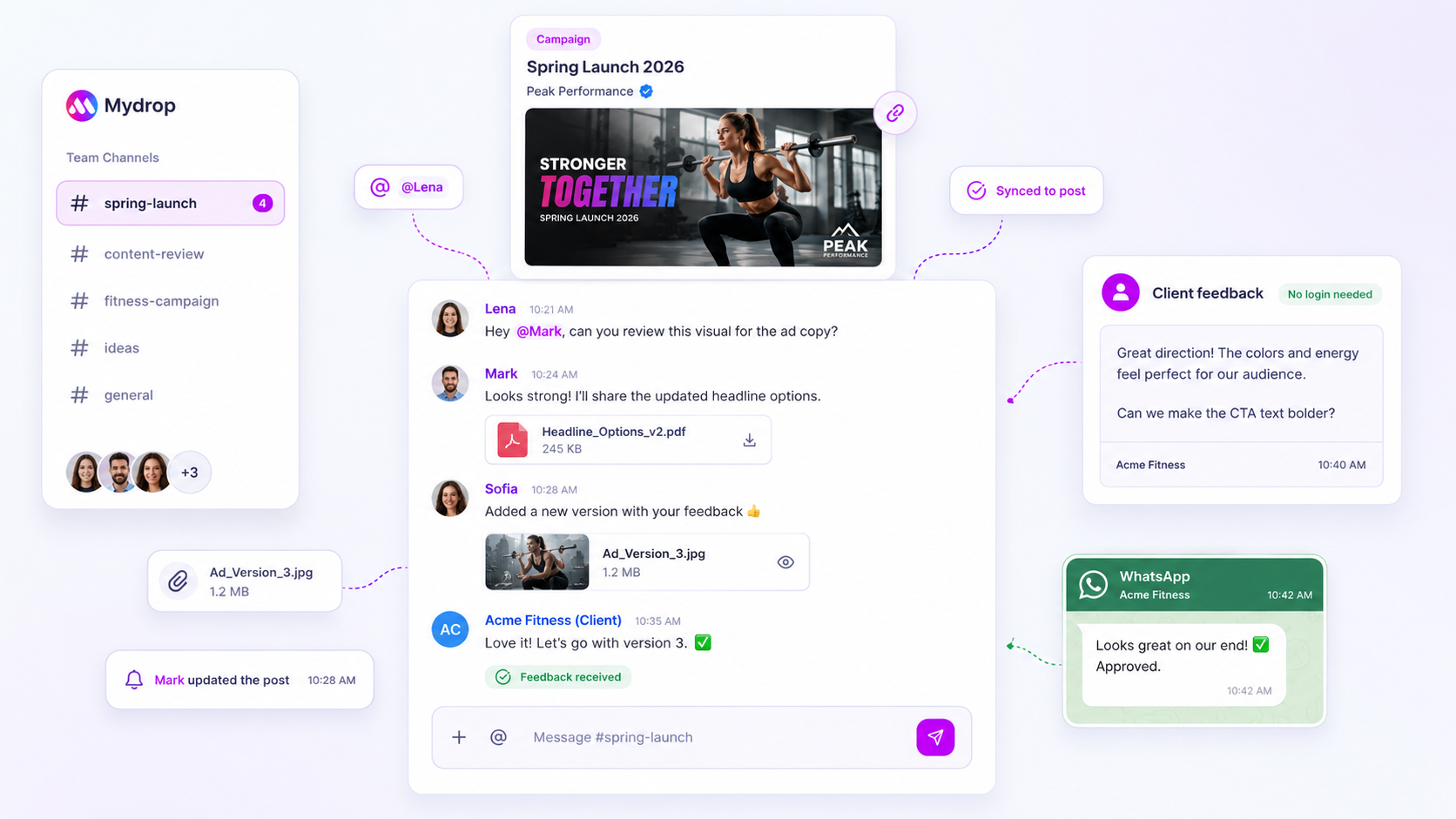
The fastest way to kill a winning content idea is to leave it in a group chat. The moment a brilliant spark moves from a quick message to a bottomless thread of status updates, it stops being a concept and starts being noise. To keep your team’s best insights alive, you have to move the work out of your communication tools and into the same environment where your strategy actually breathes.
We have all been there: you feel a genuine rush of inspiration while away from your desk, fire it off to your colleagues, and watch as it slowly dissolves under the weight of incoming notifications. It is exhausting to feel like the best parts of your brand strategy are slipping through the cracks of your own digital workspace. When your planning tool and your idea capture tool live in different worlds, you are constantly forcing your team to bridge the gap-which, as we see across thousands of social media operations, rarely ends well.
Where the handoff is actually breaking

The core issue isn't a lack of creativity; it's a structural separation between where you talk and where you build. When ideas exist only in email threads or chat apps, they are effectively invisible to the person responsible for your calendar. They require a secondary, manual step of translation-copying, pasting, and re-contextualizing-before they can ever become a draft.
Most teams underestimate how much friction this creates. Every time a creator has to pause their workflow to search through a chat history for a vague mention of an idea, you lose momentum. More importantly, you lose the context.
To audit your current situation, look for the following patterns of fragmented planning:
| Symptom | The Hidden Cost | Operational Reality |
|---|---|---|
| Search Lag | High | Ideas require manual retrieval, leading to "search debt" |
| Fragmented Context | Medium | Original intent gets stripped during transfer between tools |
| Visibility Gap | Critical | Strategic planners cannot see the backlog of raw concepts |
| Duplicate Work | Low | Different team members "re-discover" the same insight |
Common mistake: Treating a communication channel as a long-term database for your editorial strategy.
At Mydrop, we see teams struggle because they view the "capture" phase as separate from the "execution" phase. Instead of treating ideation as a standalone event that requires a new tool or a new meeting, it should be a background habit that lives inside your workspace. When you can drop a note directly into your dashboard-anchoring it to a specific date or a future campaign objective-you remove the need for that costly, manual handoff.
If you aren't capturing your ideas where your calendar lives, you are essentially asking your team to do twice the work for half the visibility. A simple rule helps: if a concept isn't stored in your central planning environment, it is not an idea-it is just chatter waiting to be forgotten.
The coordination debt checklist

Most of us have a "search and rescue" mission built into our daily routine. We know the feeling: you remember a great idea from last Tuesday, but you are not sure if it lived in a Slack channel, an email thread, or a passing comment during a Zoom sync. That scavenger hunt is the telltale sign that your ideation system has drifted away from your planning surface.
Audit your team against this checklist to see where your best concepts are going dark. If you check more than three boxes, your planning rhythm is likely being hijacked by your communication tools.
| Audit Marker | Frequency | Impact on Workflow |
|---|---|---|
| Search Time | > 10 min/day | High friction; team stops looking for old ideas. |
| Approval Lag | > 24 hours | Stagnation; ideas lose their relevance to current trends. |
| Context Switching | Constant | Mental fatigue; creative sparks die while navigating tabs. |
| Visibility Gap | Low | Leadership has no pulse on the upcoming creative pipeline. |
| Duplicate Work | Frequent | Waste; two people build the same post for different brands. |
How to score it: If you spend more than a few minutes searching for a concept, you are already paying a heavy tax on your team's creative output. The goal is to move the capture point so far upstream that searching becomes obsolete.
How to move decisions closer to the work
The secret to stopping these leaks is proximity. An idea needs to be captured in the exact same environment where you manage your calendar and production schedule. If you use a tool like Mydrop, you do not need to hunt through threads because your workspace acts as the system of record, not just the delivery vehicle.
We see successful teams embrace a simple, high-visibility rule: if it is not a note, it is not a plan. By using a lightweight feature like Mydrop Notes, you can jot down a creative spark directly from your Home dashboard or your active Calendar view. Because these notes are visually anchored to your workflow, they do not get buried. They sit right next to the posts you are actively building.
This proximity creates a natural loop for your team:
- Intake: Capture the raw idea immediately in a workspace note while context is fresh.
- Anchor: Use the note as a placeholder or a briefing doc that stays attached to the day you intend to publish.
- Refinement: At the end of the week, open your Recent Notes view. Drag the ones that still hold heat into the production queue.
- Disposal: If a note sits in your workspace for thirty days without becoming a post, delete it. A clean workspace is an active workspace, and clearing out old noise is just as important as capturing new signals.
Operator rule: Treat your workspace notes like a kitchen counter during a dinner rush. Keep the immediate workspace clear of old, cold ingredients so you have room to prep the next course.
By embedding capture into your daily interface, you stop forcing your team to choose between "doing the work" and "documenting the idea." When the tool handles the heavy lifting of keeping ideas visible, your team can focus on the actual craft of social media. The best ideas do not need a dedicated database; they just need a place where they cannot be ignored.
The roles and rules that reduce rework
The best way to stop ideas from evaporating is to define clear boundaries for where your team creates, not just where they talk. When everyone treats a chat channel as an inbox for strategy, you have effectively guaranteed that your best concepts will get lost.
To break this cycle, you need to establish a simple, non-negotiable protocol. We recommend the "Workspace-First" rule: if it is not logged in your planning system, it does not exist for the calendar.
Decision check: If an idea is worth executing, it must live as a Note in your workspace. Treat Slack or email as a place for discovery, but treat your planning dashboard as the only place of truth.
By moving the capture step into a tool like Mydrop, you anchor those sparks to the same place where you manage your calendar. When a team member has a fresh angle, they open their Create menu or jump into their Home dashboard to drop a quick note. Because these notes are visible alongside the upcoming editorial flow, they stop being isolated text and start being potential posts. This shifts the team from a defensive "search and rescue" posture to a proactive "review and approve" flow.
The weekly habit that keeps the system honest
Without a recurring review, even the most disciplined capture system becomes a digital graveyard. You need a short, tactical session-we call it the "Strategy Sync"-to bridge the gap between inspiration and production.
Spend 15 minutes every Friday morning clearing your board. Look at your recent notes, pull the winners into the calendar, and delete the noise. This habit does two things: it cleans your workspace and it reinforces the belief that if an idea is captured, it will actually be seen.
| Phase | Action | Goal |
|---|---|---|
| Review | Scan your Recent Notes cards | Identify high-potential themes |
| Commit | Drag or map notes to calendar dates | Turn loose ideas into planned slots |
| Clean | Delete stale or duplicate entries | Keep the interface signal-focused |
| Archive | Archive assets for future reference | Maintain a searchable library |
When you do this consistently, you stop chasing phantom concepts. You create a rhythm where the team feels confident that their input is tracked. Over time, this transparency transforms your team from a group of disconnected creators into a coordinated engine.
Conclusion
Content operations at scale fail not because your team lacks talent, but because your infrastructure hides it. You are likely losing dozens of hours every month simply trying to remember what was discussed in a side-conversation or a buried DM.
The fix is not more software, but more proximity. By forcing the capture process to happen inside the same environment where your strategy lives, you remove the friction that kills your best ideas before they reach the light of day. Take the leap this week: kill the "I'll ping you later" habit, move the discussion into a persistent workspace note, and watch how much more visibility you gain. It is the single most effective way to start operating like a top-tier brand, and the most reliable path to getting your best work out of the chat and onto the feed where it belongs.