
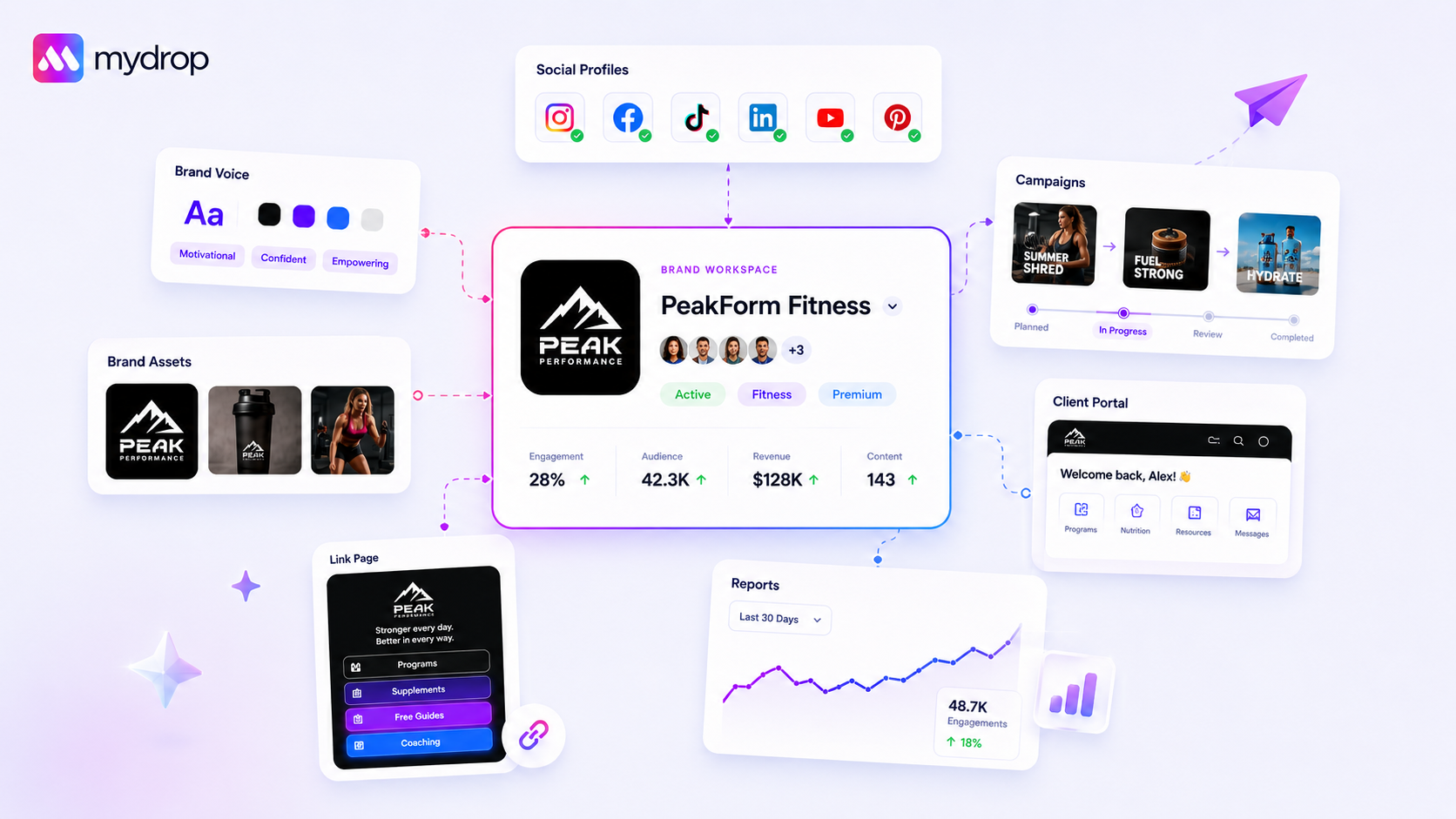
The "wrong brand" post isn't a human error-it is an environment error. When your team navigates a shared workspace containing dozens of profiles, the cognitive load of constantly switching context creates a mathematical certainty of failure. The solution is not to tell your team to be more careful; it is to implement architectural guardrails that enforce focus at the workspace level.
We get it. You are managing high-stakes content across a sprawling portfolio, and one errant click can lead to a client fire that burns your entire afternoon. It is exhausting work, and we have seen thousands of teams hit this same wall. Training your team to "double-check" every dropdown menu is a failing strategy because it relies on willpower where you need a system.
What changed before the numbers moved
In the early days, managing your social footprint was simple enough that a shared spreadsheet and a prayer were sufficient. But as your team scaled, the complexity didn't just grow-it compounded. You went from managing three brand profiles to thirty, then sixty, then adding multiple regions and product lines.
The trouble is that most legacy social media workspaces are built like an open-plan office: everyone can see everything, and everyone is expected to be everywhere at once. This creates coordination debt. When an agency member toggles from a tech client to a retail client but leaves the tech profile active while drafting a post, they are fighting the UI, not just their own focus.
Here is why your current setup likely struggles as you scale:
| Diagnostic Layer | How Complexity Breaks Your Workflow |
|---|---|
| Global Selection | Every search and report includes every profile in the workspace, forcing manual filtering every single time. |
| Cognitive Friction | The "wrong account" isn't a mistake; it is a UI trap where profiles are visually indistinguishable. |
| Governance Gap | Permissions might stop a junior team member from deleting an account, but they rarely prevent them from accidentally posting a drafted campaign to the wrong audience. |
| Approval Fatigue | Stakeholders are forced to hunt for their specific brand's content among a sea of irrelevant activity. |
Most teams do not have a "carelessness" problem; they have a decision bottleneck caused by too much noise. When your team has to manually verify the selected profile for every action-posting, reporting, or scheduling-they are not operating at speed; they are performing a safety drill.
The awkward truth is that if your software allows your team to see the wrong account, they will eventually select it. You need a way to carve out a permanent, distinct environment for each brand so that "wrong brand" posting becomes a technical impossibility rather than a recurring audit item.
The failure patterns to check first

When you peel back the layers of a "wrong brand" post, you rarely find a clumsy employee. You usually find a workspace that forces them to sprint through a minefield.
We see this across teams managing dozens of brand profiles: the environment itself is designed for friction. If your team has to constantly filter, hunt, and double-check their target account for every single action, they aren't just working-they're performing a constant, low-grade diagnostic test on their own workflow. That is cognitive load, and it is a tax you pay on every post.
Here are the patterns that signal your workspace is ready for an audit:
- The "Shared Selector" Trap: Your global account selector shows every profile, every time. A team member managing three different luxury brands has to scroll past 40 other accounts just to find the one they need.
- The "Left-Behind" Filter: Someone switches from a tech client to a retail client but forgets to clear the previous filter. They start drafting a campaign, and because the UI didn't enforce a hard break, they accidentally push a retail update to the tech client's audience.
- The "Dashboard Mirage": Your analytics report shows high engagement, but your team can't tell if that data belongs to your client or their direct competitor because the workspace doesn't enforce a rigid, brand-specific view.
- Approval Fatigue: When the legal or brand manager has to look at a raw list of pending posts from five different clients, they stop looking closely. They just click "Approve" to clear the queue, and that is where the errors go unnoticed.
The proof that separates signal from noise
Most managers try to fix these errors by doubling down on "carefulness." They issue memos, demand triple-checks, or hold status meetings. But if your software allows the user to see the wrong account, they will eventually select it. That is a mathematical certainty, not a training gap.
You need to know if your team is operating in a safe environment or if you are one tired afternoon away from a client fire. Use this scorecard to audit your current risk profile.
| Risk Indicator | What to look for | Risk Score (1-5) |
|---|---|---|
| Profile Overload | More than 10 active profiles in the global selector. | 5 (High) |
| Lack of Boundaries | No visual separation between different brand client profiles. | 4 (High) |
| Manual Filtering | Team must manually re-select profiles for every new task. | 5 (High) |
| Shared Dashboards | Analytics and reporting include non-brand-related data. | 3 (Med) |
| Approval Blending | Pending posts for all clients appear in one master list. | 4 (High) |
How to score your team:
- Score 16-20: Your workspace is an accident waiting to happen. You have massive coordination debt and are relying entirely on individual human vigilance.
- Score 11-15: You are experiencing frequent near-misses. Your team is likely exhausted from the constant context-switching.
- Score 5-10: You have decent hygiene, but you are likely wasting hours every week on manual work just to stay safe.
Operator rule: If your team spends more time verifying "where" they are posting than "what" they are posting, your workspace architecture has already failed.
The goal isn't to get your team to work harder. The goal is to build an environment where the "wrong" account is physically impossible to select. Once you have established these clear, hard visual boundaries, the error rate drops, not because people got smarter, but because the system finally stopped tempting them to click the wrong button.
What to fix this week
If your team is still relying on a simple "double-check" instruction to keep brands separate, you are essentially asking them to be perfect machines while operating in a high-stress, high-volume environment. That is not a strategy; it is a ticking clock.
To fix this, you need to move from behavioral vigilance-hoping people don't make mistakes-to architectural containment.
Here is your 3-step triage to stop the bleeding this week:
- Audit your current visibility: Review your team’s workspace. Does everyone see every account? If your junior designer sees the corporate account and your PR lead sees the retail handle, you are inviting cross-pollination.
- Implement Brand Lock: If your platform allows it, stop the "global view" madness. Use a Brand Lock feature to restrict a user's workspace to only the specific brands or profiles they are responsible for. When a team member clicks that selector, the noise disappears. They stop seeing the wrong accounts because those accounts literally cease to exist for that session.
- Institutionalize the "Focus State": Make it a standard operating procedure that members don't just "log in" to the tool; they "select their scope." If someone is working on a high-stakes campaign, their workspace should be locked to that client’s brand group until the work is shipped.
Decision check: If your team can accidentally select a profile, eventually they will. Your software should not present the option to err.
When to stop diagnosing and change the workflow
Teams often get stuck in a "diagnosis loop," constantly meeting to discuss why a mistake happened. You review logs, you issue new warnings, and you tighten the approval chain. But the mistakes persist because you are treating the symptom, not the structural environment.
Stop diagnosing when the manual cost of error-prevention exceeds the cost of a platform update. If your team is spending more than an hour a week manually filtering, double-checking, or apologizing for wrong-account posts, you have crossed the threshold. You are no longer managing social media; you are managing a platform that is actively working against your team's focus.
In our experience, the transition from "we need to be more careful" to "we need a better system" is the moment a small agency begins to scale. It is the shift from fighting fires to building a pipeline.
Conclusion
The "wrong brand" post is rarely the result of a bad hire. It is the predictable outcome of a workspace designed for chaos rather than focus. When you strip away the noise and enforce boundaries at the tool level, you give your team the only thing that actually prevents errors: the ability to see only what matters.
Stop asking your team to be perfect. Build an environment where they can't be anything else.