The line between a helpful assistant and a dangerous liability is context. If your AI isn't grounded in your specific media plan, brand voice, and recent performance analytics, you aren't saving time-you are creating a "copy-paste" debt that your team will have to spend hours editing away. Most marketing teams don't have a content problem; they have a coordination bottleneck that generic LLMs only make worse by generating high volumes of mediocre, unverified text.
We get it: the content calendar is never-ending, and the pressure to stay "always on" turns every manager into a bottleneck. You are drowning in creative requests while your best brand work from last month sits locked in a folder, invisible to the very tools trying to help you. The goal is to move from "generic generation" to "executable intent," and that requires a tool that understands your actual workspace.
Where the handoff is actually breaking

The "Generic AI Trap" is the hidden cost of using tools that sound smart but don't know your business. When you prompt a standard chatbot, you are essentially starting from zero every time. It has no visibility into your previous campaigns, your specific design assets, or the approved tone you spent weeks refining. As a result, you end up doing the work twice: first to generate the draft, and then to manually police it for brand compliance.
Across teams managing dozens of brand profiles and hundreds of assets, we see the same three failure modes:
- The Content Gap: The AI lacks access to your brand repository, leading to generic hooks that don't convert.
- The Structural Mismatch: The AI produces a flat string of text instead of an object the system can use, like a campaign-ready post or a media plan.
- The Validation Vacuum: There is no integrated check to see if the draft adheres to platform-specific limits or current media plans before the user touches it.
Operator rule: Never request content from a tool that does not have "eyes" on your current brand artifacts, media plans, and past campaign performance.
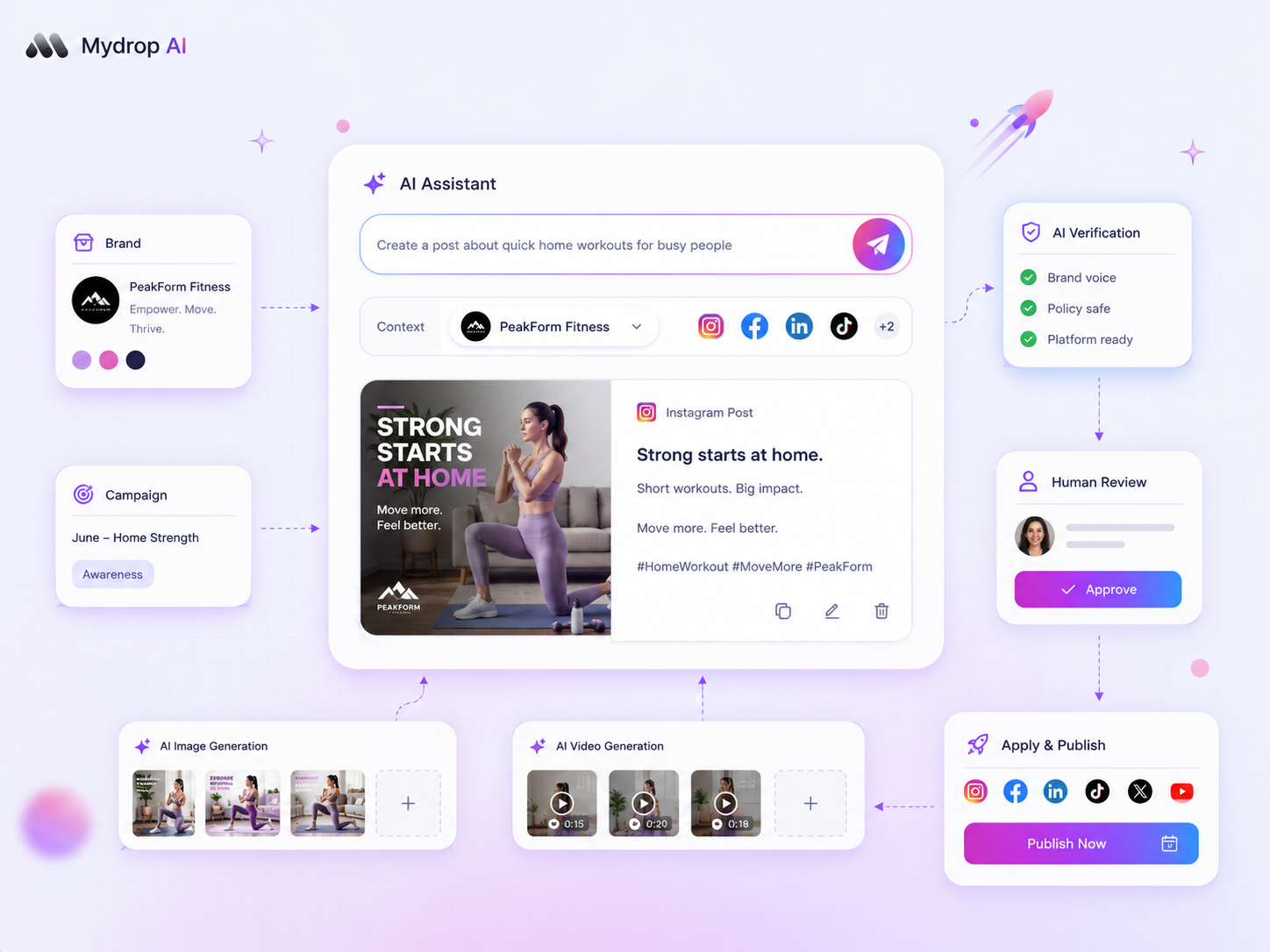
When you use a workspace-aware agent like the Mydrop AI Assistant Agent, the workflow shifts from "prompting" to "curation." Instead of waiting for a draft that needs a total rewrite, you are reviewing a structured artifact-a post or a campaign plan-that was built using your actual historical data. You move from the chaos of manual re-prompting to a verified, repeatable operating habit.
| Feature | Generic LLM Chatbot | Workspace-Aware Agent |
|---|---|---|
| Input Source | Public web data / Blank slate | Your brands, media, & history |
| Output Type | Plain text (copy-paste) | Executable structured artifacts |
| Brand Safety | Manual policing required | Knowledge-guided & verified |
| Validation | None (blind trust) | Integrated draft verification |
| Workflow State | Disconnected | Ready for review & application |
The shift is simple: stop asking for advice and start generating objects. When your AI can see your media library and your past engagement wins, it stops being a chat companion and starts acting as an extension of your operations team.
The coordination debt checklist

When you move from a lone creator using a chatbot to a team managing dozens of brand profiles across multiple markets, "generic speed" becomes a massive liability. You are likely accumulating coordination debt the moment your AI starts generating content that doesn't understand your current campaigns, active media plan, or specific compliance rules.
Before you copy that next draft into your live scheduler, run it through this filter. If you answer "no" to any of these, your "AI efficiency" is actually just moving the work from the generative phase to the cleanup phase.
| Question | Why it matters |
|---|---|
| Is it grounded in a current campaign? | If the AI is writing in a vacuum, you will spend your afternoon manually updating links, tags, and calls-to-action. |
| Does it respect our brand asset registry? | Generic text often ignores your actual media library, leading to "placeholder" visuals that your creative team never actually approved. |
| Are the platform constraints validated? | An AI that suggests a 3,000-character LinkedIn post is helpful for drafting; a tool that catches the character limit violation before you open the composer is an operator. |
| Is the tone consistent with our recent high-performers? | If you don't feed your agent your own historical winning hooks, you are just training your team to post mediocre, generic copy. |
| Can we turn this output into a workspace object? | A draft that requires a manual rewrite is a chore. A draft that lives as an artifact you can directly apply or schedule is an asset. |
How to move decisions closer to the work
The most successful teams we see aren't using AI to write more; they are using AI agents to govern more. They treat their agent as a senior analyst that sits between the idea and the execution, ensuring every output meets the standards of their media plan and historical performance.
At Mydrop, we see this transition happen when teams stop asking, "Can you write a post?" and start asking, "Can you verify this draft against our active campaign and brand voice?" This simple shift moves your AI from a content machine to an operating copilot.
Decision check: Never treat an AI draft as a final deliverable. Treat it as a "draft artifact" that must be verified against your actual workspace context before it touches a live channel.
When you use an AI Assistant Agent that is workspace-aware, the workflow changes from "generate and pray" to "plan, verify, and apply." You aren't just saving minutes on typing; you are removing the friction of brand-alignment check-ins. If the agent can see your media plan, it can flag if your post draft is promoting the wrong link or missing the required assets for a multi-channel launch.
Ultimately, you want your tools to close the gap between your strategy and your execution. If your AI is still living in a browser tab separate from your media plan and your historical data, it isn't part of your team yet. It is just another spreadsheet you have to manage.
The roles and rules that reduce rework
The reason most AI-assisted content calendars turn into a chaotic mess by Thursday is a lack of defined boundaries. When anyone can feed a prompt into a chatbot and call the result "strategy," you have essentially replaced professional brand judgment with a random number generator that happens to sound confident.
To fix this, we have found that high-performing teams treat AI as a junior staffer who needs a specific brief, not a magic box that spits out finished work. You need to formalize who gets to "touch" the AI and what rules the output must survive before it hits the production queue.
Workflow check: If your AI agent cannot reference your approved media plan or brand style document, it is not helping-it is just generating noise.
The Content Hand-off Protocol
| Role | Responsibility | Rule |
|---|---|---|
| Strategist | Inputs the goal, theme, and relevant source material. | No "make something cool" prompts. Use specific source docs only. |
| AI Agent | Drafts the artifact (post, campaign, link-in-bio page). | Output must be a structured object, never just raw text. |
| Reviewer | Validates against brand guidelines and platform mechanics. | Reject any output that violates core tone or fails verification checks. |
By forcing the output into a structured artifact rather than a flat document, you create a tangible object that can be audited. At Mydrop, we see teams that lean on these structured objects spend 70% less time on back-and-forth edits because the "AI Assistant Agent" has been forced to respect the guardrails of the specific campaign blueprint from the start.
The weekly habit that keeps the system honest
You cannot "set and forget" an AI workflow. If you want to avoid the slow creep of generic, repetitive content, you need a recurring audit that separates the high-value output from the automated filler.
Try this simple Monday Morning Reset to keep your team's output sharp:
- Spot Check: Select three posts generated by the AI from the previous week.
- Compare: Do these posts match your actual performance analytics? (e.g., Are we still leaning on the hooks that drove conversion last month?)
- Refine: Update your agent's "knowledge documents" with the winning patterns identified from the last seven days.
- Verify: Run a quick verification check on your next week's batch of post drafts to ensure all platform-specific formatting is still aligned with the latest updates.
This habit transforms the agent from a static tool into an evolving part of your marketing stack. You are not just using AI to write; you are using it to institutionalize what you have already learned.
Conclusion
The goal of integrating AI into a serious social media operation is not to produce more content-it is to produce more effective content with less coordination debt. When you choose to deploy a workspace-aware agent, you are opting out of the "generic generation" race and into a more disciplined, artifact-driven workflow.
Stop asking your tools to guess what you want. Start giving them the context to execute what you have already planned. Your brand voice is too valuable to leave to a hallucination.