The decision to use AI-generated media shouldn't be based on "can it look good," but on the opportunity cost of manual design versus the risk of brand dilution. If the asset serves as ephemeral, high-volume support for a campaign, leverage AI generation; if the asset is the campaign's anchor or identity, manual design is non-negotiable.
We get it. Your content calendar is a beast that never sleeps, and the pressure to churn out high-quality visuals for a dozen channels is relentless. It is messy, it is exhausting, and the temptation to press "generate" on everything is real. But there is a hidden cost here: the silent erosion of your brand’s visual vocabulary. When every campaign looks like a generic prompt, your audience stops looking at you.
We have spent years observing teams managing hundreds of brand profiles across thousands of posts. The best operators treat AI-generated media as an operational lever for speed, not a replacement for brand equity. They gate AI usage behind a fidelity-vs-velocity threshold.
The decision teams usually frame too broadly

Most teams fall into the trap of treating all media requests as equal. They route everything through the same congested pipe: the creative director’s desk. This is where coordination debt kills your output. You end up waiting three days for a custom illustration that is destined for a post that will be buried in your audience's feed after four hours.
To break this, you need to stop asking "How long will this take?" and start asking "What does this asset need to achieve?"
| Campaign Objective | Asset Type | Recommended Workflow |
|---|---|---|
| Core Brand Narrative | Hero Images, Brand Films | Manual Design (High Fidelity) |
| Trend-Jacking | Rapid Social Proof, Memes | AI Generation (High Speed) |
| Performance Ads | Iterative A/B Test Variations | AI Generation (Rapid Scaling) |
| Community Engagement | Seasonal/Event Spotlights | Hybrid (AI Base + Human Edit) |
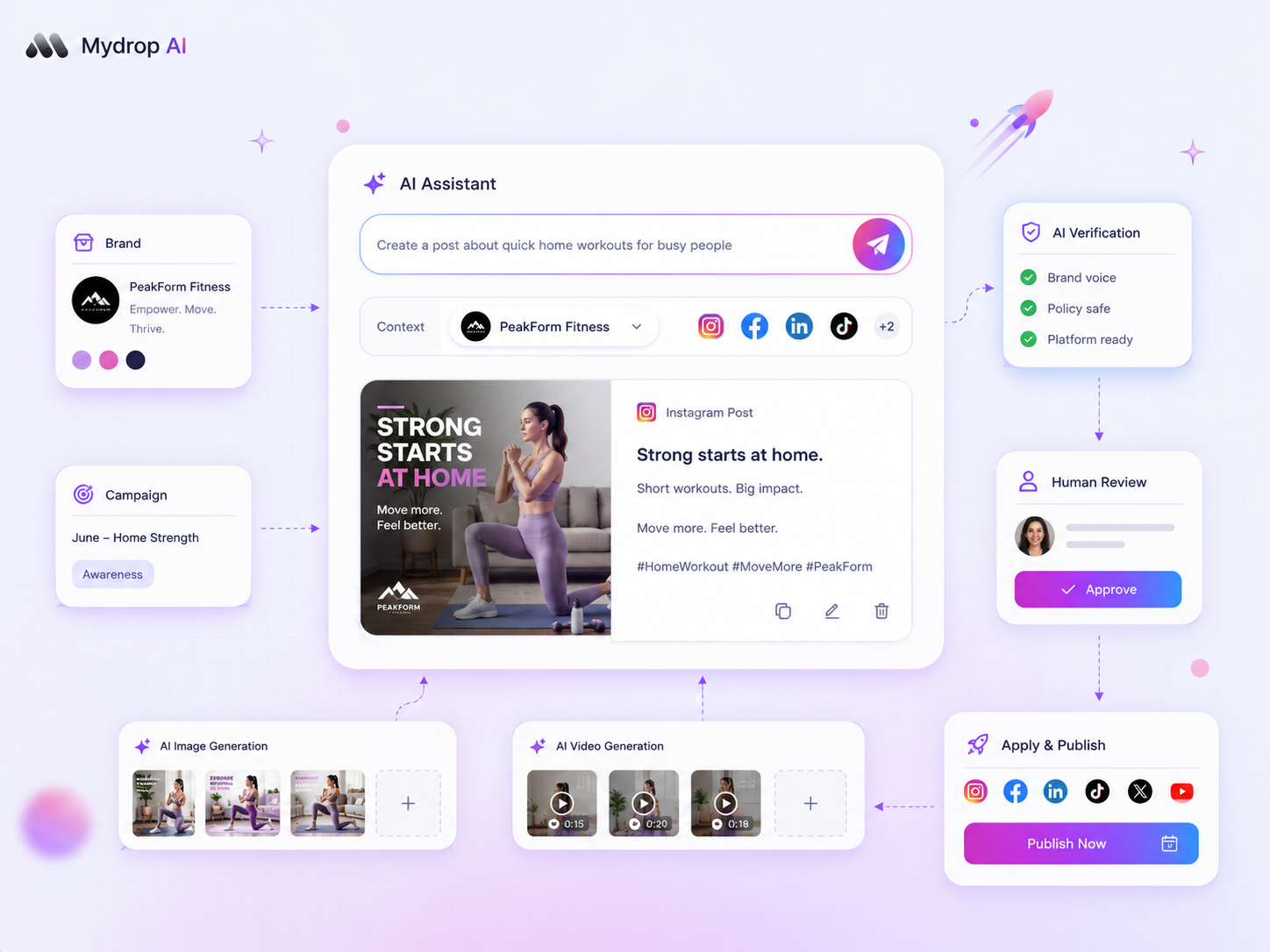
When you treat AI-generated media as a fire-and-forget solution, you lose control over your output. At Mydrop, we see the most successful teams using the AI Media Panel to generate and poll status for high-volume assets while keeping the media plan itself verified by an agent. This ensures that even when your speed increases, your governance doesn't slip.
Operator rule: If the asset is the face of your campaign, your creative team must own it. If the asset is the skeleton that holds your campaign together, let the machine build it.
What should stay manual and what can move faster
The dividing line between a job for your creative team and a job for your AI tool isn't about complexity; it is about brand equity preservation. If you are building the visual foundation of a new campaign, you need the human touch. When you are scaling the supporting noise-the localized versions, the performance test variants, or the reactive trend content-that is where you should lean on automated generation.
The trap most enterprise teams fall into is treating every asset as a custom work of art. This creates a bottleneck where your designers are buried in resizing and minor adjustments, while your high-impact brand narratives get delayed by the sheer volume of "urgent" requests.
At Mydrop, we see teams managing hundreds of profiles struggle because they lack this distinction. When your designers are spending their time on temporary social proof assets, they aren't working on the brand identity that keeps your customers around.
Decision check: If an error in an asset could lead to a legal review, a PR headache, or a fundamental misunderstanding of your product value, it belongs in manual design. Everything else is a candidate for AI.
Before you push a task to an AI media panel, run it through a quick reality check. Are you looking for a specific, non-negotiable brand color? Do you need a layout that matches an existing set of brand guidelines precisely? If the answer is yes, do not waste your quota on generation. The time you save in the generator will be lost twice over when you have to manually "fix" the output to align with the brand.
The tradeoff matrix
To make this concrete, we use a simple decision framework to categorize assets. This stops the "should we automate this" debate before it drains your Slack channels or your team’s morale.
| Campaign Objective | Asset Type | Primary Risk | Recommended Workflow |
|---|---|---|---|
| Core Brand Narrative | Hero Images, Brand Films | Brand Dilution | Manual Design |
| Community Engagement | Seasonal Spotlights | Generic/Low Relevance | Hybrid (AI base + Human Edit) |
| Performance Ads | A/B Test Variations | Lack of Iteration Speed | AI Generation |
| Trend-Jacking | Rapid Social Proof/Memes | Stale Content/Timing | AI Generation |
Note: For Hybrid workflows, use AI to generate the base composition or background textures, then finalize with your team to overlay precise brand marks or approved typography.
When you are scaling, keep an eye on your asynchronous dependencies. AI media jobs are not instant. If you are launching a massive, multi-regional event, don't trigger 50 generation tasks at 5 PM on a Friday. The polling delays and provider task queues can leave you with nothing to post at 9 AM Monday.
If you use a tool like Mydrop, verify your media plan in the dashboard before triggering the full generation queue. This simple habit keeps your workspace quotas in check and ensures your team isn't manually refreshing status indicators when they should be focused on higher-level strategy.
Most teams do not have a content problem. They have a coordination bottleneck that turns simple creative tasks into full-blown operational crises. Once you clear that pipe, you can stop fighting about the process and start deciding which assets actually deserve your designers' limited time.
How to pilot the workflow safely
You do not want your first experiment with AI media to be a panicked, last-minute pivot during a high-stakes campaign launch. Instead, use a sandbox phase to calibrate your internal expectations. Start by choosing a single recurring, low-risk content series-like weekly community shoutouts or event calendar reminders-to run through your new AI-assisted pipeline.
This is where you build the "muscle memory" for your team. You need to know how long it takes for a request to poll and complete, how often you need to regenerate to hit the right aesthetic, and where your specific brand guidelines break under AI interpretation. If you use Mydrop, you can leverage the AI Media Panel within the composer to test these waters. It allows you to generate and attach assets without committing them to a final, public-facing project until you have verified the result against your brand standards.
Here is a simple checklist to run before you sign off on any AI-generated asset:
- Color Integrity Check: Does the output match your core brand palette, or will it look jarring next to your manually designed hero assets?
- Contextual Accuracy: Does the AI hallucinate details that contradict your brand values or the specific regional event you are promoting?
- Quota Status: Have you verified your workspace AI image usage quota to ensure your campaign won't stall out mid-launch?
- Human Oversight: Has a designer reviewed the generation to ensure it serves the audience rather than just filling a slot in the calendar?
Workflow check: Never treat AI generation as a "set and forget" button for any asset that carries your brand logo or primary campaign message. If you do not have time for a human-in-the-loop review, you do not have time to use AI.
The operating rule to keep
The most dangerous assumption in modern social media operations is that faster creation leads to better performance. It rarely does. Instead, it usually leads to a messy, diluted feed that confuses your audience. To keep your sanity, you need a hard policy that treats AI-generated media as an operational utility rather than a creative strategy.
Use your creative team for the anchors-the stuff that defines who you are-and reserve AI generation for the connective tissue-the stuff that keeps your presence consistent and active. When you are managing dozens of channels, this distinction is the only thing that prevents coordination debt from spiraling. If your team is spending more time chasing prompt variations than they are planning the core brand narrative, you have lost the plot.
At Mydrop, we see the most successful teams using the Media Plan Review feature to enforce this boundary. They require that any planned media item be verified by an agent or a senior manager before it ever reaches the production phase. It is a small piece of friction that saves you from a massive cleanup effort later.
Conclusion
The goal of your social media operation is not to churn out the highest volume of content possible, but to maintain a standard of excellence that keeps your audience paying attention. AI is a powerful lever for that goal, provided you have the discipline to hold it back when it matters most.
Stop looking for the tool that does the work for you, and start looking for the process that lets your best people do their best work. When you stop treating every post like a bespoke piece of art and start treating your content calendar like a professionalized operation, you will find that the stress of "keeping up" begins to fade. You have the skills; now you just need the constraints.