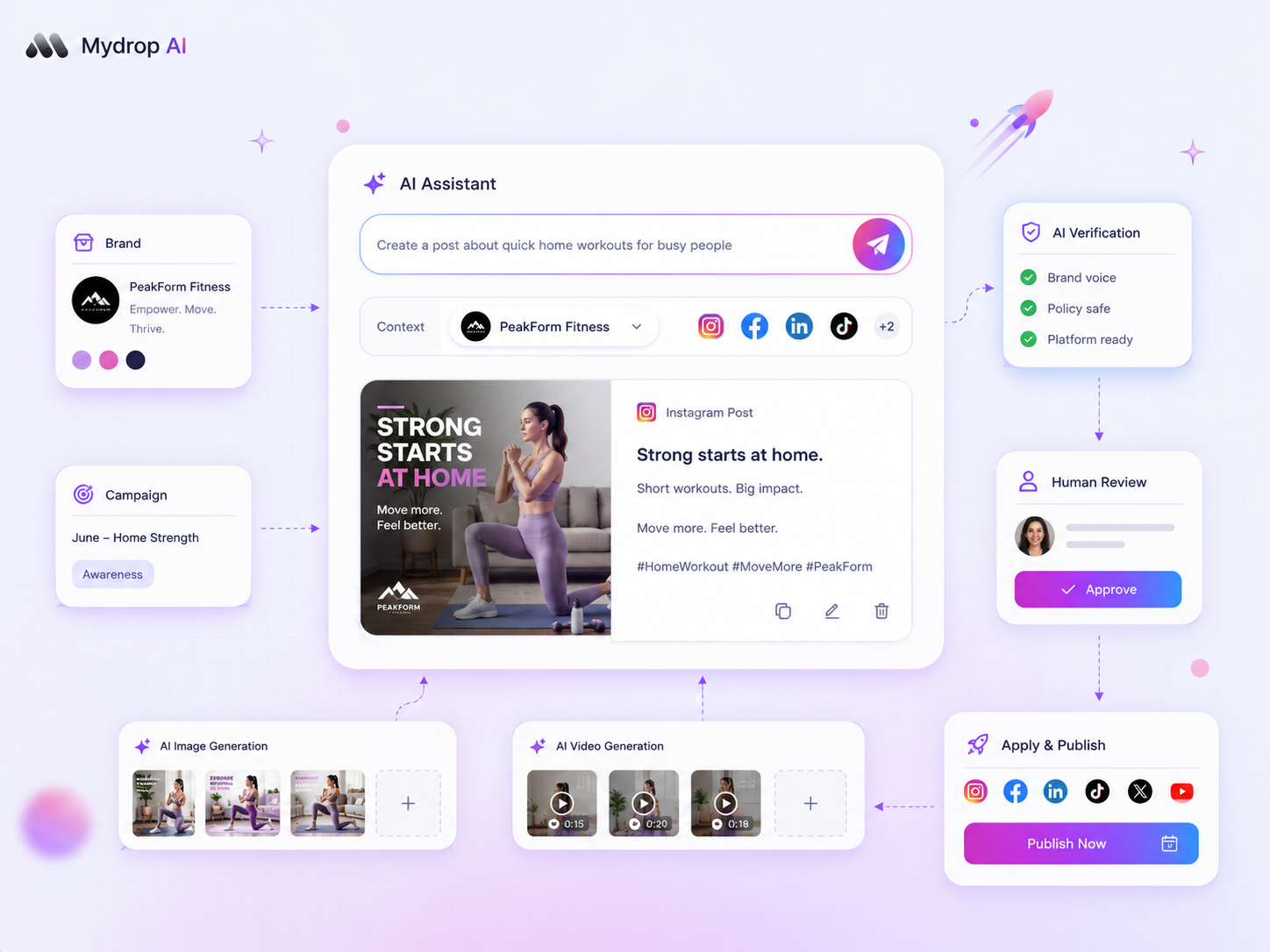
Stop automating your social voice the moment your virality score trends upward while your conversion rate flatlines. You are currently trading long-term brand authority for short-term reach, and that is a ceiling you will eventually hit. When every post sounds technically perfect but emotionally hollow, you have entered a state of homogenization drift where the machine has effectively sidelined your brand identity.
We get it. The volume of content required to stay relevant across dozens of channels is exhausting, and the temptation to let AI handle the heavy lifting is immense. You are trying to keep the lights on without burning out your team. But when your AI-generated output is indistinguishable from every other brand in your category, you aren't saving time-you are spending your brand equity to pay for efficiency.
Here is the hard truth: Most teams don't have a content problem. They have a decision bottleneck. Using AI to generate bulk captions is a force multiplier for scale, but it becomes a liability the second it bypasses your brand standards. You need a way to determine exactly when the AI turn should end and human intervention must begin.
The decision each metric should trigger

If your primary goal is Top-of-Funnel Reach, lean into automation. If the post's primary goal is Community Trust or Conversion, the AI is merely your drafter, and human curation is the mandatory final step. You need to map these goals to specific metrics to avoid the drift.
Teams often get stuck because they measure the "what" (post volume) rather than the "why" (audience sentiment). When you track these three metrics, the decision to pause AI becomes data-driven rather than an emotional reaction to a bad post.
| Metric | Goal | Trigger for Human Intervention |
|---|---|---|
| Sentiment Shift | Trust | Dip of 5% or more in positive brand sentiment over a 14-day rolling window. |
| Conversion Rate | Sales | When click-through rates on high-intent campaigns drop below the 6-month average. |
| Engagement Depth | Community | When comment sentiment shifts from conversational to transactional or generic emoji-only. |
A simple rule helps: If a metric flags, the "generate all" button gets disabled.
At Mydrop, we see many enterprise teams rely on bulk automation to hit their publishing cadence. When the metrics start to drift, it is almost always because the model is optimizing for platform-agnostic virality rather than segment-specific needs.
Before you trigger an intervention, check your workflow: Are you grounding your model? If you are using AI Attachments to provide specific campaign media context, your output quality often stabilizes. If you are just using raw prompts without brand-aware context, the AI is simply guessing your voice.
Ultimately, if the metrics don't move, the content is just noise. Do not wait for a full-blown PR crisis to realize your automation is working against your brand. If the scorecard says you are drifting, stop the machine, reset your prompts, and bring the humans back into the loop.
The scorecard that keeps reporting useful

Stop letting vanity metrics hide your quality rot. You need a simple way to look at your last ten posts across different channels and honestly grade the AI versus the human input. If your virality score is high but your sentiment consistency is trending down, you have an AI-tuning problem, not a content-creation problem.
Use this scorecard to audit your recent output. For each metric, assign a 1 (AI was clearly superior or did the heavy lifting) to 5 (Human intervention was absolutely mandatory for brand safety).
| Post Metric | Goal | When to Trust AI | When to Intervene |
|---|---|---|---|
| Brand Sentiment | Trust/Loyalty | Routine updates, factual posts | Crisis response, sensitive topics |
| Engagement Depth | Relationship | Polls, short-form questions | High-stakes community management |
| Conversion Rate | Sales/Lead Gen | Top-of-funnel reach, awareness | High-touch campaigns, partnership deals |
Operator Rule: If your aggregate score for a campaign exceeds 15, you have lost your brand voice to the machine. You are no longer managing social media; you are just outputting noise.
At Mydrop, we see teams use this in their weekly reviews to identify which categories of posts are safe to automate and which ones need to stay in the hands of the copywriters. If you find your conversion-heavy posts are consistently scoring 4 or 5, it is time to build a saved prompt that locks in your brand guardrails or force a manual review step in your workflow before anything goes live.
What to stop measuring by default
You need to stop obsessing over every engagement uptick and start tracking the delta between AI-drafted content and human-edited content. Most teams treat every metric as equally important, which is a recipe for analysis paralysis.
- Stop tracking raw impression growth as a proxy for brand health. AI is excellent at finding broad audiences, but it is often terrible at keeping them.
- Stop ignoring the "Approval Delay." If your team is spending more time fixing bad AI captions than it would take to write them from scratch, the
ai-content-generationfeature has become a distribution bottleneck, not a productivity accelerator. - Stop measuring "Virality Score" in isolation. It is a useful signal for draft optimization, but when you prioritize virality over brand identity, you are essentially optimizing your company's voice for an algorithm that does not care if you exist next year.
The real goal is finding the balance where your team spends 80 percent of their time on the 20 percent of posts that actually move the needle. Let the AI handle the heavy lifting of the routine, informative updates, but keep the human hand on the wheel for anything that requires trust. Your brand is not a data point; it is a promise. Don't let a chatbot break it just because it found a clever way to increase reach.
How to connect metrics to next actions
The data in your dashboard is useless if it does not force a decision. Most teams fall into the trap of observing a dip in engagement and simply "trying harder" by pushing more AI-generated volume. This is how you drown in coordination debt. Instead, tie your metrics to specific operational gates that trigger a shift from AI-first to human-first workflows.
When a post category or campaign segment hits the following thresholds, you must bypass your automated generation pipelines.
| Metric | Threshold Trigger | Required Action |
|---|---|---|
| Brand Sentiment | Drops > 5% MoM | Shift to 100% human-written captions for 30 days. |
| Conversion Rate | Stagnant for 2 cycles | Audit "AI voice" against top-converting historical posts. |
| Community Replies | Depth (word count) drops | Move to human-led community management; pause AI drafts. |
| Approval Lag | > 24 hours per post | Simplify the prompt library; reduce AI drafting for complex topics. |
At Mydrop, we see teams that treat these triggers like a circuit breaker. When the system detects high approval lag or declining sentiment, the team stops the automation and manually audits their saved prompts. You are not failing by turning off the AI; you are optimizing for the health of your brand.
The review cadence that makes the model stick
A scorecard is only as good as the time you spend looking at it. Do not wait for quarterly business reviews to realize your social voice has become robotic. If you manage hundreds of brand profiles across multiple markets, you need a high-frequency, low-friction check-in.
We recommend a 30-minute "Voice Alignment" sprint every two weeks:
- The Random Five: Pick five posts from each primary brand-three generated by AI and two written by human leads.
- The "Blind" Test: Have a team member who did not write the posts read them aloud. If they cannot tell which is AI, your prompt library needs a serious injection of brand-specific context.
- The Attachment Audit: Review the media used in the AI-generated posts. Are you utilizing
AI Attachmentsto ground your models in actual campaign creative, or are you letting the AI guess the context from thin air? - The Prompt Refinement: Update your saved prompts based on the "Winners." If a specific structure resonated, bake that tone into your Mydrop prompt library for the next cycle.
Decision check: If your team spends more time editing AI output than they would have spent drafting the post from scratch, the automation has become a tax, not a tool.
Conclusion
The goal of using AI in your social stack should not be to replace your voice, but to amplify the parts of your operation that are already working. Enterprise scale is built on repeatability, but it only survives when you know exactly when to let a human take the wheel.
If your "virality score" is rising but your community is silent, stop looking for better prompts and start looking for your brand identity. AI can handle the volume, but only your team can handle the trust. Use the tools to clear the backlog, then step in to close the deal.