You stop needing a ledger when you start needing an engine. If your team is still managing social planning inside a spreadsheet, you aren't just tracking content; you are actively paying a hidden tax on every post you schedule. The spreadsheet has become a static graveyard for dynamic decisions. You are likely burning hours every week just to keep those cells in sync with the actual, shifting reality of your publishing pipeline.
We get it. That color-coded fortress of tabs and formulas feels safe, familiar, and perfectly tailored to your team's specific quirks. But there is a quiet exhaustion that comes from manually updating, cross-referencing, and emailing status updates that should be automated by a shared view. You are trying to run a modern, high-velocity social operation using a tool designed for accounting, and that mismatch is exactly where your coordination debt is hiding.
The decision teams usually frame too broadly

Most marketing leaders tell us they need "better software" when they really mean they need to stop the bleeding caused by decoupled workflows. They assume the jump to a new tool is just about getting a prettier UI, but that is a dangerous framing. You don't choose a centralized calendar because it looks better; you choose it to eliminate the "context switching overhead" that eats up 20% of your team's week.
At Mydrop, we see teams across every scale-from boutique agencies to massive multi-brand enterprises-repeatedly hit the same wall. When your planning is trapped in rows, it is disconnected from your publishing, your approval loops, and your real-time analytics.
Here is how you can measure that friction right now:
| Friction Point | Spreadsheet Reality | Calendar-Driven Reality |
|---|---|---|
| Status Updates | Manual check-ins and emails | Real-time state (e.g., Pending, Approved) |
| Asset Preview | Link-hopping to folders | Instant visual content preview |
| Multi-Brand View | Creating a new tab per brand | Filtered view by brand or campaign |
| Feed Syncing | Static text, prone to "ghost edits" | Direct hook to publishing pipeline |
Operator rule: If a post status isn't visible in the same place as the post itself, it effectively doesn't exist for the rest of the team.
When you keep your planning in a spreadsheet, you force your stakeholders to live in a state of "version blindness." They are constantly asking "Is this the latest version?" because the document is a snapshot, not a stream. The transition isn't just about moving data; it is about moving your team from a passive ledger to an active planning engine where approvals, edits, and scheduling are unified.
What should stay manual and what can move faster

The biggest mistake teams make is trying to move everything at once. If you try to force every brainstormed idea and rough note into a structured scheduling tool, you end up with a cluttered, unusable calendar that nobody wants to open.
Think of your workflow as a two-speed system.
Keep your ideation, rough drafts, and team brainstorming in your existing collaborative docs. That space is messy and non-linear, which is exactly what early-stage creative requires. Don’t burden your production pipeline with half-baked concepts.
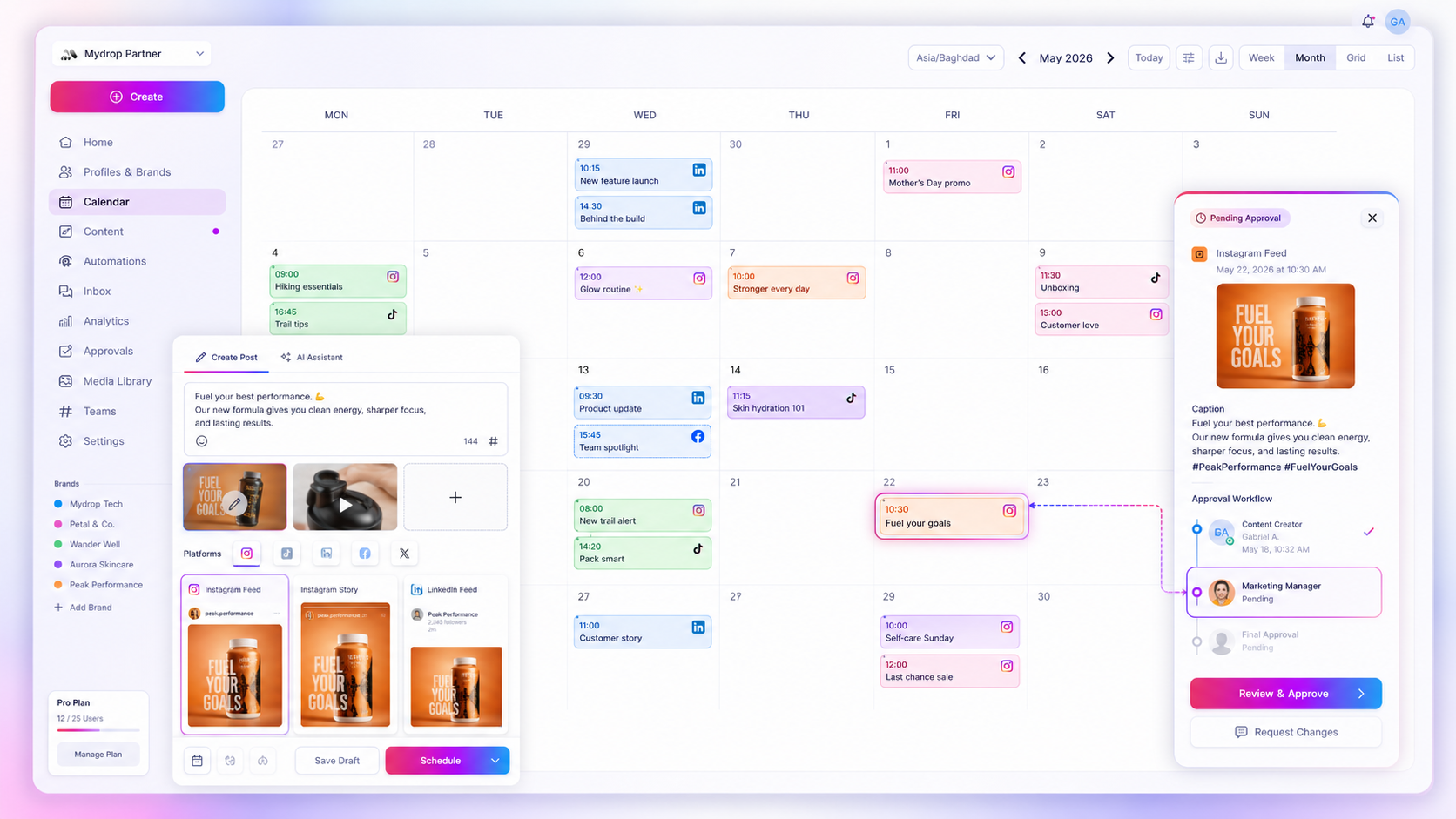
However, move scheduling, status tracking, and final delivery to a centralized calendar immediately. This is the "high-fidelity" layer of your operation. When a post is ready to be committed to a date, it needs to leave the document and live in a view where its status-Draft, Pending Approval, or Scheduled-is visible to everyone without an email chain.
Decision check: If a post is scheduled for a public feed, it exists in the calendar. If it is only a concept, it stays in the working document.
The tradeoff matrix
Most teams stick with spreadsheets because they feel "free." You can add a column for literally anything. But this freedom is exactly what kills your visibility. When you compare a manual sheet to an integrated calendar like Mydrop, you aren't just comparing software; you are choosing between administrative overhead and operational clarity.
| Feature | Manual Spreadsheet | Integrated Calendar |
|---|---|---|
| Visibility | Requires constant manual updates | Real-time aggregate of all activity |
| Workflow | Decoupled; post and status are separate | Linked; change status, trigger actions |
| Filters | Limited to static sorts | Dynamic (by Campaign, Profile, or State) |
| Errors | High; sync lag leads to ghost edits | Low; updates reflect immediate intent |
| Audit | Slow; forensic search through rows | Instant; preview any post in context |
When you look at this matrix, ask where your team spends its time. Are you spending the bulk of your week ensuring that the spreadsheet matches the reality of your publishing accounts? If the answer is yes, you have already hit the ceiling.
At Mydrop, we see teams managing hundreds of profiles effectively not because they have more time, but because they stopped manually synchronizing their "source of truth." They let the calendar act as the engine. By shifting status updates to the same view where the post is previewed, they eliminate the "context gap"-that frustrating period where you have to cross-reference three different tools just to know if a campaign is on track.
The goal isn't just to be faster. It is to be accurate enough that you can stop worrying about the mechanics of the schedule and start focusing on the impact of the content. Most teams do not have a content problem; they have a decision bottleneck. Clearing that hurdle is rarely about better spreadsheets; it is about finally giving your team a single, reliable surface to work from.
How to pilot the workflow safely
Resist the urge to dump everything into a new system on a Monday morning. That is how you lose buy-in before lunch. Instead, use a targeted pilot to prove the value without disrupting your entire output. Pick one low-risk, high-frequency brand or channel where the coordination debt is already causing friction, and move just that subset of work into Mydrop.
The goal here is not total migration; it is workflow validation. Start by pulling in your upcoming calendar for the next two weeks. Set up your profile filters so you are only looking at the slice of the pie that matters for that specific brand. Once the team sees how a filtered, real-time list eliminates the "is this actually the final version?" email thread, they will start pulling the rest of the portfolio in themselves.
Follow this simple checklist to keep the pilot clean:
- Map your stakeholders: Identify the one person who currently acts as the biggest bottleneck in your spreadsheet flow. Give them access to the Mydrop calendar so they can see pending posts directly, rather than waiting for your manual status update.
- Standardize the state: Define what "Final," "Needs Copy," and "Pending Approval" look like in your new surface. Stop using colored cell backgrounds as a substitute for actual status tracking.
- Set a hard deadline: Run the pilot for exactly 14 days. If, after two weeks, the team is still opening the old spreadsheet to "check things," the pilot has failed to become the source of truth. Pivot or double down on training.
The operating rule to keep
There is one hard truth we have seen across thousands of brand profiles: if it isn't in the calendar, it doesn't exist.
When you allow parallel tracks-some planning in a spreadsheet, some in the calendar-you are just creating two places to fail. The spreadsheet becomes the "safe place" for thoughts that aren't ready, while the calendar gets only the finished, polished output. That keeps the calendar as a static display rather than a living, breathing engine for your team's velocity.
Workflow check: Treat the central calendar as the master record. Any post that skips the calendar, even for a "quick win" or "urgent fix," is a post that lacks visibility, approval, and accountability.
Conclusion
The transition from spreadsheet to a central planning surface is less about software features and more about clearing the path. You aren't just buying a calendar; you are buying back the 20% of your week currently spent reconciling versions, chasing status, and manually verifying that what is in the sheet matches what is live on the feed.
When you move your planning to Mydrop, you stop being a manual relay for information and start acting as a curator for content. The friction of the spreadsheet was always a signal that you had outgrown your tools. By centralizing the view, you finally stop the silent erosion of your team's energy and start building a platform that can actually handle the volume you are expected to produce.
Stop managing the ledger. Start running the engine.