Your AI image generation fails your brand style not because the model is broken, but because your briefing process lacks operational constraints. When your colors drift into generic territory or the context feels alien to your brand identity, you are likely treating AI as a creative partner rather than a tool that requires a rigid, audited media plan.
We have all been there. You are racing to meet a social calendar, you feed a prompt into your tool, and the result is... well, it’s fine. But it’s not your brand. Then you spend another twenty minutes fighting the prompt, tweaking keywords, and hoping for a miracle. It is a hidden, soul-crushing tax that adds up when you are managing dozens of campaigns across multiple markets. You don't need a better model; you need a more disciplined way to talk to the one you have.
The decision teams usually frame too broadly

The mistake most teams make is viewing AI media generation as a "creative" choice. They ask the AI to "make something professional" or "design a cool graphic," leaving the heavy lifting of brand alignment to chance. When you outsource your visual guardrails to an algorithm, you should not be surprised when the output loses your signature palette or visual weight.
The reality is that social media scale usually fails from coordination debt, not lack of ideas. When you allow every creator on your team to "wing it" with AI prompts, you end up with a fragmented brand identity that costs more to fix in manual retouching than it would have cost to generate correctly the first time.
To stop the cycle of erratic outputs, you need to shift from an "open canvas" mindset to a bounded media plan. Think of it like this:
| Logic Layer | The "Vibe" Approach (High Failure) | The Audited Approach (High Consistency) |
|---|---|---|
| Color | "Professional blue and orange" | "Hex #005A8D background, #FF8C00 accent" |
| Context | "A business meeting" | "Three diverse team members at a standing desk, mid-sprint, white-board visible" |
| Density | "Minimalist" | "Negative space on left for UI overlay, high contrast, non-cluttered" |
| Validation | "Looks good enough" | "Verified against media plan requirements in agent-flow" |
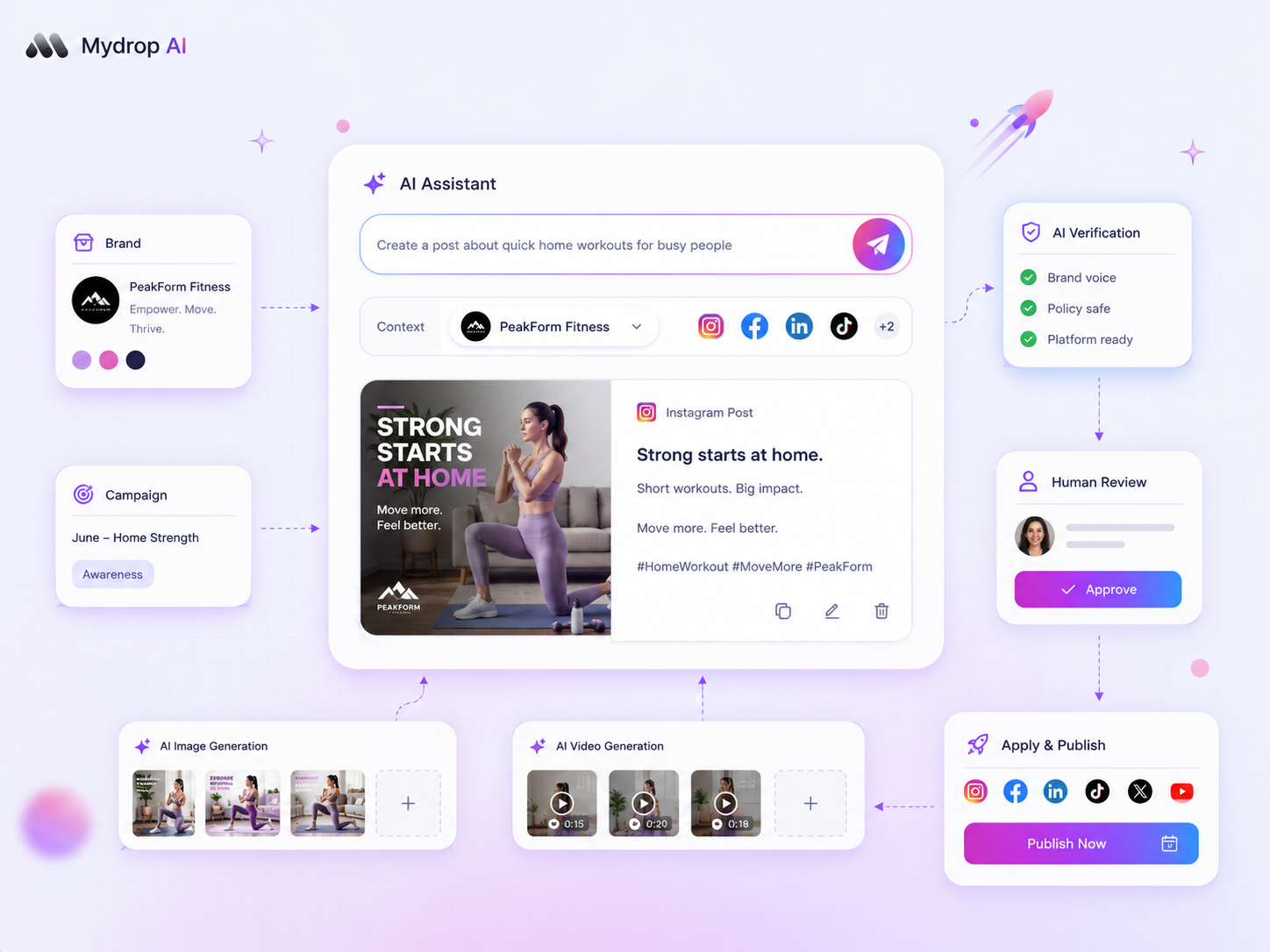
Operator rule: Never treat a generated image as a finished asset until it passes through your defined verification gate. At Mydrop, we see teams that treat AI media generation as a one-step process fail consistently, while teams that build an "intermediate verification" step into their workflow-where an agent or a lead creator checks the media against the specific brand metadata-drastically reduce their rework time.
Stop polling for results and hoping for perfection. Start building a pipeline where the AI generates, and your internal logic verifies. If your current workflow is just a prompt and a prayer, it is time to formalize the constraints.
What should stay manual and what can move faster

Most teams get into trouble by treating every piece of content like a bespoke, hand-crafted artisan piece. The truth is, your high-value hero campaigns and your daily community engagement require fundamentally different workflows. When you force your design team to touch every piece of social filler, you create a bottleneck that slows down your entire publishing calendar.
We generally advise teams to keep high-fidelity assets like primary product launches, campaign hero images, and anything involving sensitive legal or trademarked branding strictly in the hands of your human designers. These assets are your visual reputation; don't outsource the soul of your brand to a model that might hallucinate a competitor's logo or get your color hex codes slightly wrong.
On the other hand, social filler-the day-to-day posts, community polls, and reactive content-is where AI shines. This is where you can trade a bit of "perfect" for a lot of "ready." The goal isn't to replace your designers; it's to stop wasting their time on social media background assets so they can focus on the campaigns that actually drive revenue.
At Mydrop, we see the most successful teams using a simple mental filter: if a creative asset is meant to live for less than 48 hours, it belongs in your automated generation pipeline. If it lives for a month, it stays in the design queue.
The tradeoff matrix
Deciding where to draw the line is harder than it looks because the pressure to "post more" is constant. Use this matrix to categorize your content types and decide which assets should hit your AI media generation tools and which need manual oversight.
| Content Type | Primary Goal | Human Touch | AI Potential | Risk Profile |
|---|---|---|---|---|
| Hero Campaigns | Brand authority | High | Low | High |
| Product Education | Clarity / Accuracy | High | Medium | Medium |
| Community Polls | Engagement | Low | High | Low |
| Trending/Reactive | Speed | Low | High | Low |
| Routine Updates | Consistency | Low | High | Low |
Decision check: If your human team is spending more time on retouching AI output than they would have spent creating the asset from scratch, your prompt or model choice has failed. Stop and reset the constraint.
It is easy to get caught up in the excitement of "generating it all," but the real operational magic happens when you recognize that not every post needs to be a masterpiece. The most dangerous thing you can do is treat your AI generation like a black box that spits out final files.
Instead, shift your workflow to Verify, then Apply. Use your AI tools to generate the raw visual components, but keep your media plan verification process as the final gate. This ensures that even your automated filler passes the "does this look like us?" test before it ever touches a production account. When you treat AI as a rapid-drafting tool rather than a final-mile solution, you move faster, your designers stop burning out on repetitive tasks, and your brand style stays consistent across every single channel.
How to pilot the workflow safely
Moving to an AI-augmented creative process doesn't mean hitting "generate" and praying for the best. It means building guardrails that catch misalignment before it hits your production calendar. Start by separating your public-facing assets from your social filler.
If your team is managing dozens of channels, stop letting the AI wander off-leash. We suggest implementing a Media Plan Verification step. Before any image makes it into your library, have an agent or a senior lead verify it against your brand's core constraints. At Mydrop, we see the most successful teams treat AI media generation as a "request-poll-verify" loop rather than a "create-and-publish" stream. This prevents bad outputs from accumulating as technical debt in your asset folders.
Here is how to audit your incoming media flow:
| Stage | Action | Rule |
|---|---|---|
| Request | Define Brand Context | Use specific brand keywords over subjective "mood" adjectives. |
| Poll | Monitor Status | Never assume a job succeeds until it reaches Completed state. |
| Verify | Compare to Plan | Reject any output that shifts your primary brand color >10% from hex. |
| Store | Archive Metadata | Only save media that passed the verification check. |
If you are using a tool with an AI Media Panel, use it to structure the request itself. When the model returns a result, don't just attach it to a post. Look at the metadata first. Does the aspect ratio fit? Are the brand colors identifiable? If not, discard it immediately. Do not try to "fix" it in post-just re-run the request with a tighter constraint.
Workflow check: If you find yourself retouching more than 20% of your AI-generated images, your prompt is not a creative tool-it is a design liability.
The operating rule to keep
The most common trap we see in enterprise marketing isn't the technology, but the coordination debt created by erratic assets. When every team member has their own "favorite" way to prompt, your brand identity becomes a kaleidoscope of inconsistent colors and disjointed contexts.
Fix this by standardizing your AI Media Plan. Create a shared repository of "verified prompts" that your team must use for standard campaigns. If a campaign requires a specific aesthetic, do not ask the team to "prompt it well." Give them the template. If the output fails the verification check, the template needs an update, not the AI.
By forcing creators to use a validated, structured request flow, you stop chasing approvals at 6 p.m. and start building a reliable, scalable asset pipeline. You aren't just making pictures; you are operating a system. Keep that system predictable.
Conclusion
At the end of the day, AI image generation is just another set of tools in a very busy shop. The goal is to move from reactive "firefighting" of weird AI outputs to proactive content assembly.
When you treat your brand identity as an immutable set of constraints rather than a "vibe" for the AI to interpret, you stop fighting the technology and start directing it. Audit your briefs, lock down your color constraints, and keep your verification loops tight. Your creative team will thank you, your brand consistency will stabilize, and you can finally get back to the parts of your role that actually require a human touch. Stop managing the chaos, and start managing the plan.