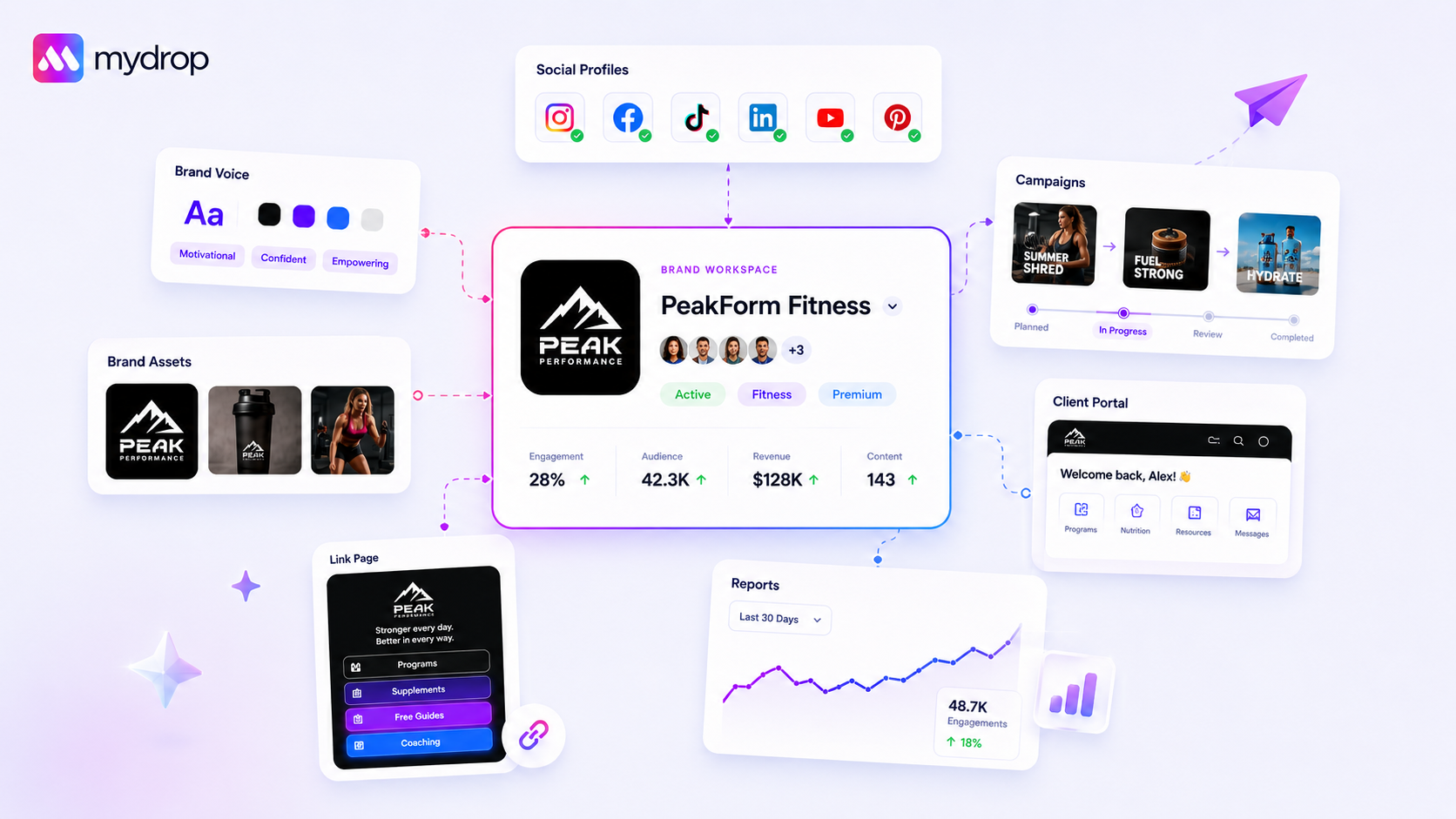
The secret to a seamless social publishing cadence is to stop treating your desktop as a temporary storage locker for every asset you create. If you are manually exporting from Canva, downloading to a local drive, and then re-uploading into a separate publishing tool, you are paying a heavy tax on your team's most valuable asset: focus. The fix is moving to a direct service-import model, which bridges the gap between your design canvas and your social library without ever forcing an asset onto your local disk.
We get it. Your folders are likely a graveyard of final_final_v2.png files, and your team is spending more time managing local file storage than actually thinking about strategy. This manual handoff feels like a necessary chore because, for most, it still is. But when your creative assets don't land in your publishing tool's library automatically, you haven't built a professional workflow. You have built a manual labor trap that slows down even the most talented teams.
The operating problem this solves
The core issue is coordination debt. When creative work is physically detached from the publishing machine, you lose more than just minutes; you lose context, metadata, and version control.
Most enterprise teams rely on a disconnected chain of custody. A designer creates a batch of assets, exports them to a local download folder, and then a social manager picks them up from a cluttered desktop to upload them to a dashboard. This creates a massive, invisible friction point we call the "download tax."
| Action | Manual Method (Legacy) | Direct Sync Method |
|---|---|---|
| Asset Export | Manual export to local storage | Direct push to system gallery |
| Organization | Manual file renaming/sorting | Auto-tagged by folder placement |
| Version Control | Overwriting files locally | Maintained as distinct metadata |
| Average Time | 8-12 minutes per asset | 1-2 minutes per asset |
This isn't just about speed. It is about governance. Every time an asset sits on a local desktop or a personal hard drive, it is essentially invisible to the rest of the organization. It is not part of your searchable library, it has no audit trail, and it is prone to duplication.
Operator rule: If your publishing tool does not provide a direct bridge to your design software via OAuth, you should assume that every single asset transfer is a point of potential failure.
When you collapse this distance, you stop managing files and start managing campaigns. Instead of chasing down files at 6 p.m. because a designer is offline, your team pulls from a centralized library that is already connected to your design tools. It removes the guesswork and the clutter.
Most teams do not have a content production problem. They have a decision and coordination bottleneck. By treating your asset intake as a formal operating habit-rather than a series of one-off tasks-you turn a chaotic handoff into a repeatable, scalable routine.
The minimum system that works

The simplest path to a clean handoff is direct ingestion. You need a system that recognizes finished work and pulls it into your publishing hub without forcing a user to act as the middleman between tools.
To build this, you only need three components: a connected design source, a destination folder structure, and a standard import trigger.
| Step | Action | Benefit |
|---|---|---|
| 1. Connect | Link your Canva service via OAuth | Establishes a secure, permanent bridge. |
| 2. Organize | Create a dedicated destination folder | Keeps raw designs from cluttering active media. |
| 3. Ingest | Trigger the import via your media manager | Moves assets in bulk; retains file quality. |
| 4. Validate | Check quota and status in the dashboard | Ensures compliance before publishing starts. |
When your team treats this connection as the only way assets move from design to distribution, you stop seeing those mysterious copy_of_final.png files floating in your uploads. At Mydrop, we see this as the primary way teams collapse the distance between a finished design and a live social post.
Decision check: If you are still dragging files from your Downloads folder to a web browser, you are carrying unnecessary coordination debt.
Where teams overbuild the process
Here is where teams usually get stuck: they confuse complex integrations with scalable workflows.
Many operations leaders try to solve the friction by building custom middleware, using heavy third-party automation bots, or syncing entire shared drives that nobody has cleaned up in three years. These "solutions" create more fragility. Every extra layer of automation is another point of failure where a token expires or a folder mapping breaks, requiring someone to spend their afternoon debugging the infrastructure instead of moving content.
We have seen agencies try to manage creative assets through complex multi-stage file naming conventions enforced by a script. They spend weeks setting up a rigid, automated filing cabinet that breaks the moment a designer uses a slightly different export format.
The goal is speed, not perfection. A robust system relies on clear, human-readable folder naming conventions-like [Year]-[Quarter]-[Campaign]-rather than automated folders that require constant maintenance.
Common mistake: Relying on a giant, unorganized shared drive as your primary media source. When your publishing team has to search through two thousand files to find the correct version, the time you "saved" in design is instantly lost in the hunt for the right asset.
Choose the simplest possible path: Connect the design source directly to your publishing platform, use a predictable folder naming strategy, and keep the logic inside the tools you already use. If you cannot explain the workflow to a new hire in five minutes, you have overbuilt the system.
How to run the cadence
To make this shift stick, stop treating your creative library as a catch-all bin and start treating it like a high-velocity sorting facility. Your team needs to move away from the "collect-all" mentality and toward a "publish-ready" flow.
Here is how you structure the weekly handoff so it takes minutes, not hours:
- Standardize the folder structure: Create a Mydrop gallery folder for each campaign before the designers start their work. This eliminates the "where does this go" debate entirely.
- Batch your imports: Designers should finalize assets in groups. Instead of exporting one-off files throughout the day, they perform a single bulk import at the end of their design block.
- Use the Service Import tool for validation: When you pull files from your design tools directly into your publishing hub, the system handles the heavy lifting. It verifies file formats-ensuring that your PNGs, MP4s, or GIFs are ready to hit the feed-and checks your storage quota in one go.
- Clean up as you go: Once an import is complete and the assets are tagged for the campaign, delete the original drafts from your design account if they are no longer needed. This keeps your external connections lean and ensures you aren't paying for duplicate storage.
Common mistake: Teams often leave assets sitting in a "Downloads" folder for days, waiting for someone to manually upload them. This creates a massive gap between the creative vision and the live post. If the file is not in your primary library, it does not exist for the publishing team.
The proof that the habit is working
You know your new workflow is successful when the time between a final design sign-off and a scheduled post drops significantly. We see enterprise teams using this approach cut their pre-publishing overhead by roughly 70 percent.
Consider this comparison of a standard campaign week for a team managing 50 assets:
| Metric | Manual Method (Desktop-to-Browser) | Direct Import (Design-to-Hub) |
|---|---|---|
| Asset Export Time | 10 minutes | 2 minutes |
| File Location Friction | High (Searching folders) | Low (Direct to campaign folder) |
| Approval/Metadata Sync | Manual (Risk of version error) | Automated (Linked to metadata) |
| Total Weekly Effort | ~8 hours | ~2 hours |
Example calculation: Saving 6 minutes per asset on 50 assets equals 300 minutes, or 5 hours saved per campaign.
When you see these numbers shift, you aren't just saving time; you are reducing the human error that happens during manual file handling. You stop wondering if you uploaded Campaign_Final_v3 or Campaign_Final_v4. The system knows exactly what was imported and where it belongs.
Conclusion
The friction between your design canvas and your social calendar is a choice, not a technical requirement. Most teams are drowning in coordination debt because they rely on the desktop as a bridge. By connecting your tools directly, you remove the middleman and ensure that every asset has a clear path from creation to live content.
Start by connecting one design service this week. Pick a single upcoming campaign, use the direct import tools to move those assets, and observe how much quieter your Slack channels become when people stop asking for file links. At Mydrop, we find that the best teams aren't the ones working the hardest-they are the ones who refuse to move the same file twice.