
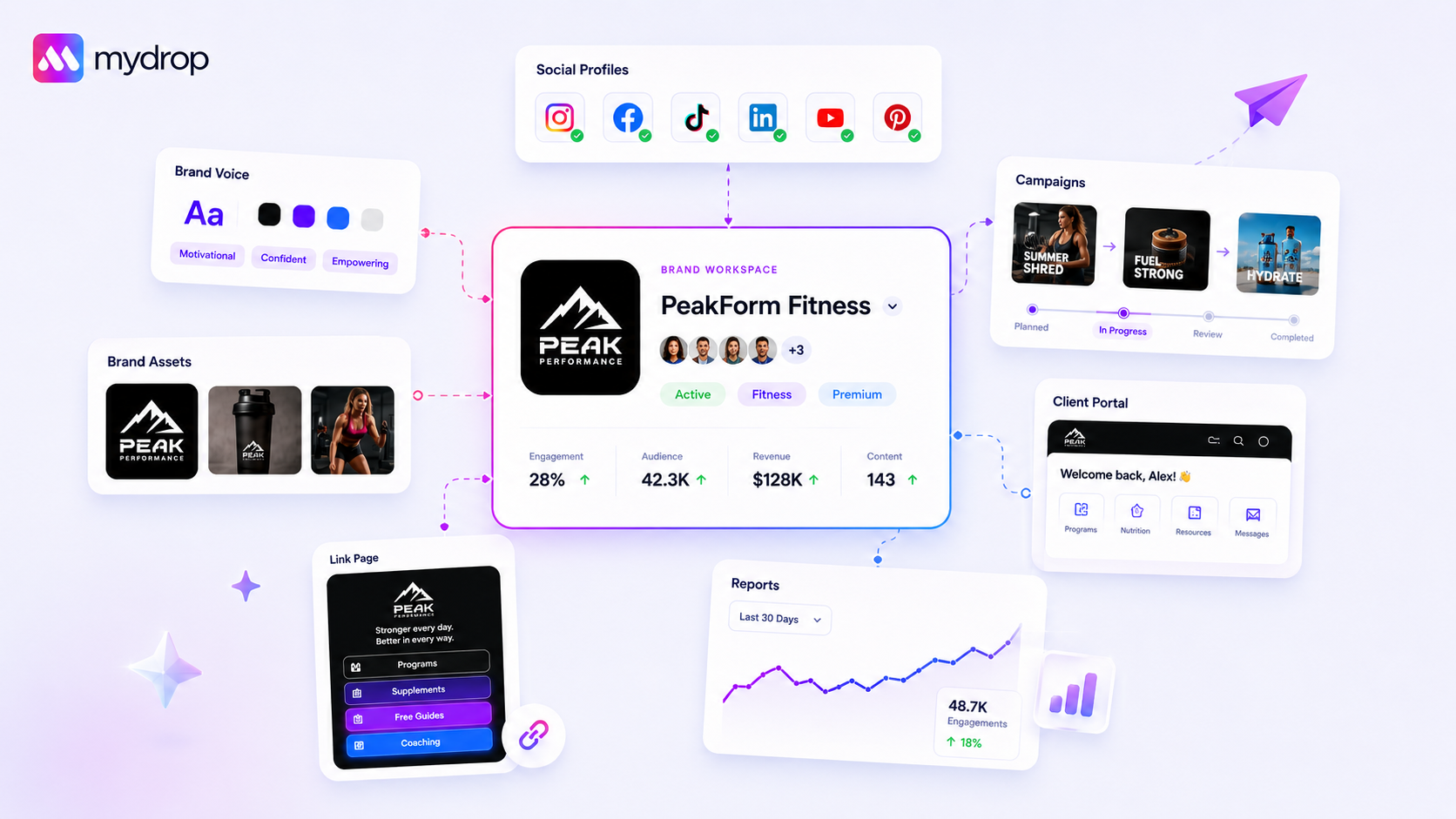
The fastest way to fix your onboarding bottleneck is to stop asking for passwords altogether. By shifting to a portal-based authorization model, you move the technical login process back to the client, where it belongs. This replaces the messy exchange of spreadsheets and 2FA text messages with a secure OAuth connection link that the client handles in their own browser.
We have all been there. It is 4:00 PM on a Friday, the launch is ready, but you are stuck in a 2FA loop because the client's CMO is on a flight and their Instagram is locked. It is frustrating, it looks unprofessional, and it makes you feel like an administrative burden rather than a strategic partner. Onboarding is always a little chaotic, but the "password dance" does not have to be part of it.
Password sharing is not just a security risk. It is a massive coordination debt that creates a friction-filled start to your partnership, delaying contract start dates and eroding trust from day one. In our experience at Mydrop, agencies that eliminate the password exchange cut their onboarding time by days, not hours.
The Zero-Knowledge Handoff: Never touch a client's password. If you do not know it, you cannot lose it, and you cannot be blamed when a platform flags a login attempt from an "unrecognized device."
Where the handoff is actually breaking

The breakdown usually starts with a simple email: "Can you send over the logins for the Facebook Page?" What follows is a week-long game of digital ping-pong. You get the password, but it is outdated. You get the new password, but 2FA is tied to a former employee's phone number. You finally get the code, but the platform blocks the login because your agency is accessing it from a new IP address.
This is the "Security Theater" of encrypted spreadsheets. Agencies often think they are being secure by using password managers, but the act of requesting the credential is the real problem. Every time you ask for a password, you are asking the client to take a risk and do a chore.
To see how much this is actually costing your team, use this quick diagnostic.
The Onboarding Friction Scorecard
| Friction Factor | Score: 1 (Smooth) | Score: 3 (Heavy) | Weighting |
|---|---|---|---|
| 2FA Ownership | Team-wide auth app | Single exec's phone | x2 |
| Access Method | One-click OAuth | Manual login sharing | x3 |
| Wait Time | Under 1 hour | Over 48 hours | x1 |
| Retry Rate | First try works | 3+ failed attempts | x2 |
Decision check: If your total score is above 12, your onboarding process is actively damaging your client relationships before the first post even goes live. (Total = Score x Weighting for each row).
Most teams do not have a technical problem here; they have a workflow problem. They are trying to solve a 2FA issue with better communication, when they should be solving it with better architecture. By the time you receive a "wrong password" email, you have already lost the momentum of a new contract.
The friction audit

Most teams treat password chasing as a one-off chore, something to just "get through" so the real work can start. But if you are managing fifty brands, those chores do not just add up; they compound into a massive operational drag. Every time an account executive has to email a client for a 2FA code while the client is at a kid's soccer game, a little bit of momentum dies.
Let's look at the math. We call this the Friction Score. It measures how much billable time and mental energy you lose before the first post even goes live. If you have ever felt like you are doing "logistical gymnastics" just to get into an Instagram account, this scorecard is for you.
The Onboarding Friction Scorecard
| Category | Metric | Multiplier | Calculation |
|---|---|---|---|
| Access Requests | Profiles to connect | 15 mins | Time spent documenting accounts |
| 2FA Loops | Stakeholders involved | 30 mins | Time lost per "ping-pong" email |
| Login Failures | Incorrect passwords | 45 mins | Troubleshooting and reset time |
| Security Idling | Days waiting for IT | 4 hours | Total "dead time" for the team |
Total Friction Score: (Sum of all categories)
Workflow check: If your total score exceeds 5 hours per brand, your onboarding process is not just slow; it is a "silent killer" for your team's morale and your client's confidence.
We have seen this across agencies and enterprise brands alike: the spreadsheet has become a crime scene. The hours spent asking for "the new password" could have been spent on strategy or creative. By the time you finally get in, the client is already frustrated that the campaign has not started. You're not just fighting 2FA; you are fighting a bad workflow.
How to move decisions closer to the work
The fix is not a better spreadsheet or a more secure password manager. The fix is removing the middleman entirely. The goal is to move the decision point as close to the source as possible.
In a legacy workflow, the agency sits in the center, acting as a translator for login credentials. This is where the wheels fall off. You ask for a password, they send an old one, you try to log in, the platform flags it as "suspicious," and now the client has to reset their entire account. It's awkward, and it makes the agency look like a technical hurdle rather than a partner.
At Mydrop, we believe in the Zero-Knowledge Handoff. You should never touch a client's password. If you do not know it, you can't be blamed for a login alert from an "unrecognized device."
Instead of the password dance, we use a Brand Portal. This moves the technical burden back to the only person who can solve it instantly: the account owner. Here is how that shift looks in practice:
- The Invitation: You send a single, white-labeled link to the client.
- The Authorization: The client clicks "Connect Profile." This triggers a native OAuth flow (Facebook, LinkedIn, TikTok, etc.) directly in their own browser.
- The Confirmation: They see a list of pages they manage, check the right ones, and click "Confirm."
- The Sync: Mydrop securely stores the token, and your team is ready to publish.
The client does not have to explain 2FA to you because they are already logged into their own browser. They just click "Allow," and the connection is made.
| The Spreadsheet Method | The Mydrop Portal Method |
|---|---|
| High risk: Credentials in plain text. | Low risk: Encrypted tokens only. |
| High friction: Constant 2FA pings. | Zero friction: Client authorizes via OAuth. |
| Error prone: Wrong or expired keys. | Reliable: Direct provider verification. |
| Delayed: Starts when IT responds. | Instant: Starts when the client clicks. |
This moves the "technical" part of onboarding into a self-service step for the client. It replaces the "I need your help to log in" conversation with a "Here is the secure link to get started" professional handoff. When you move the authorization closer to the person who actually owns the profile, you don't just save time; you eliminate the most common reason for a delayed contract start.
The roles and rules that reduce rework
The fastest way to break your new, password-free workflow is to let just anyone click the connect button. To keep the lights on without constant troubleshooting, you need to separate the person who authorizes the account from the person who manages the content.
At Mydrop, we call the person who holds the keys the Token Owner. This is usually a client-side director or a senior brand manager who has native admin access to the Facebook Page or LinkedIn Company Page. In a legacy workflow, you would harass this person for their password. In the new model, you simply send them a secure Portal link.
When the client connects via the Portal, they become the Token Owner. They do not need to be a daily user of your social media management tool, and they certainly do not need to see your internal drafts or messy brainstorming boards. They just provide the authorization, and the system handles the rest.
This setup prevents the most common Friday night disaster: the "Expired Token." Most social media tokens expire when a password is changed or for routine security refreshes. If a junior designer connected the account using their personal credentials, and then they leave the agency, your entire publishing pipeline freezes. By making the client the Token Owner through a dedicated portal, the connection remains stable even as your internal team shifts.
Operator rule: Always anchor the profile connection to a permanent brand stakeholder, not a transient team member.
Here is how to decide who should be clicking that "Connect" button during your next onboarding:
The Token Ownership Matrix
| Profile Type | Ideal Token Owner | Why? |
|---|---|---|
| Meta (FB/IG) | Brand Admin | Requires Business Manager "Full Control" to avoid 2FA loops. |
| LinkedIn Pages | Marketing Lead | Personal profiles are tied to page access; seniority ensures longevity. |
| TikTok/X | Brand Manager | These platforms are sensitive to IP changes; client-side auth is safer. |
| Google/YouTube | IT or Ops | High security thresholds; best handled by those with permanent access. |
The weekly habit that keeps the system honest
You can have the most sophisticated OAuth setup in the world, but if you do not check the "pulse" of your connections, you are still gambling with your go-live dates. We have seen teams manage hundreds of profiles across dozens of markets, and the most successful ones all share one habit: The Monday Morning Health Check.
This is not a deep dive. It is a five-minute scan of your profile dashboard to look for the "yellow flags" before they turn into "red alerts." Most platforms give a heads-up when a token is nearing its expiration date. Catching this on a Monday morning means you have five days to send a quick Portal link to the client. Trying to fix it on a Friday afternoon means you are at the mercy of the client's weekend plans.
We recommend a simple three-step ritual for your account leads:
- Scan for Expiry: Check the "Profiles" tab in Mydrop for any connections marked as "Expiring Soon" or "Disconnected."
- Verify Sync: Ensure the latest posts are appearing in your analytics or inbox view. If the data is lagging, the token might be "zombie-fied" (technically active but not passing data).
- The Proactive Reconnect: If a token is within 7 days of expiring, do not wait for it to die. Trigger a fresh Portal link immediately. It takes the client ten seconds, and it saves you two hours of crisis management later.
Conclusion
The "password dance" is a relic of a less professional era of social media management. It creates unnecessary risk, burns billable hours on administrative nonsense, and makes your agency look like a technical burden rather than a strategic partner.
When you stop asking for passwords, you are doing more than just tightening security. You are signaling to your client that you value their time and their data integrity. You are moving from a world of "Let me log in as you" to "Authorize our team to work for you."
It is a subtle shift in language, but a massive shift in professional standing. By using a Portal-first connection model, you eliminate the 2FA ping-pong, bypass the "unrecognized device" flags, and get to the actual work days faster.
The goal was never to have a spreadsheet full of passwords. The goal was to publish great work without the friction. So, archive that "Client_Logins_FINAL.xlsx" file for good. Your team, your clients, and your security officer will all sleep a lot better.