Scalable agency growth isn't about hiring more people; it's about making the client environment so predictable that onboarding becomes a 10-minute clerical task rather than a 3-day security risk. The secret is a Zero-Assumption workspace template: locked naming conventions, validated timezones, and pre-defined permission tiers that protect both the client's data and your agency's reputation. Stop the "Day 1" scramble by enforcing a hard-coded workspace setup before the first post ever hits a draft stage. If your client configuration depends on the memory of a junior account manager, you don't have a process--you have a ticking time bomb of coordination debt.
We get it: client onboarding is usually a messy race to get the first post live. You're chasing passwords, guessing timezones, and hoping the new intern doesn't accidentally have "Owner" access to the billing settings. It's the kind of silent chaos that makes a 40-hour week feel like 80. This is about turning that scramble into a professional, silent "Welcome" experience that actually scales.
The operating problem this solves

The hidden cost of "manual" setup isn't just the hours wasted; it's the mental load of remembering a thousand tiny exceptions. Most agencies treat workspaces as simple digital folders, but the best teams treat them as secure, isolated operating environments. When you treat every new client as a "bespoke" project, you are building coordination debt that eventually eats your margins.
At Mydrop, we've seen this play out across thousands of brand profiles. If your setup depends on an account manager's memory, you are one sick day away from a timezone disaster or a security breach. "Bespoke" is often just a fancy word for "unprotected."
Here is where it gets messy: when setup is manual, your senior talent spends their time auditing settings instead of building strategy. You end up with "Frankenstein" accounts where one client is on UTC, another is on Pacific Time, and nobody is quite sure who has permission to hit "Publish." The result is a team that is constantly playing defense, fixing errors that should have been impossible to make in the first place.
Operator rule: Never assume the default settings are correct. Every workspace must pass a "Configuration Gate" before a single post is scheduled.
To see where your team stands, check your current onboarding against these common failure modes:
| Failure Mode | Root Cause | Impact |
|---|---|---|
| The 3 AM Ghost Post | Defaulting to UTC instead of the client's local market. | Content goes live when the primary audience is asleep. |
| Permission Creep | Granting "Admin" to everyone to "save time" on Day 1. | High risk of accidental billing changes or workspace deletions. |
| The Naming Maze | Using inconsistent labels like "Client_Final" vs "Client_Social." | Cross-account reporting and workspace switching become a nightmare. |
| Approval Bypass | Creating posts before workspace-level permissions are locked. | Compliance risk and unapproved content accidentally going live. |
The minimum system that works

The most effective client setup is not a 50-page manual; it is a tight, 10-minute configuration gate that treats every client environment as a secure, isolated container. We have seen this across hundreds of agencies: the ones that scale effortlessly are the ones that stop "winging it" during the first hour of a contract.
It is tempting to just create a folder, add everyone on the team, and figure out the settings later. But "later" usually means after a post goes live in the wrong timezone or an intern accidentally deletes a client profile. At Mydrop, we suggest a "Zero-Assumption" setup where the workspace settings are validated before a single post is drafted. This isn't about bureaucracy; it is about protecting your team from the kind of 6 p.m. fire drills that ruin weekends.
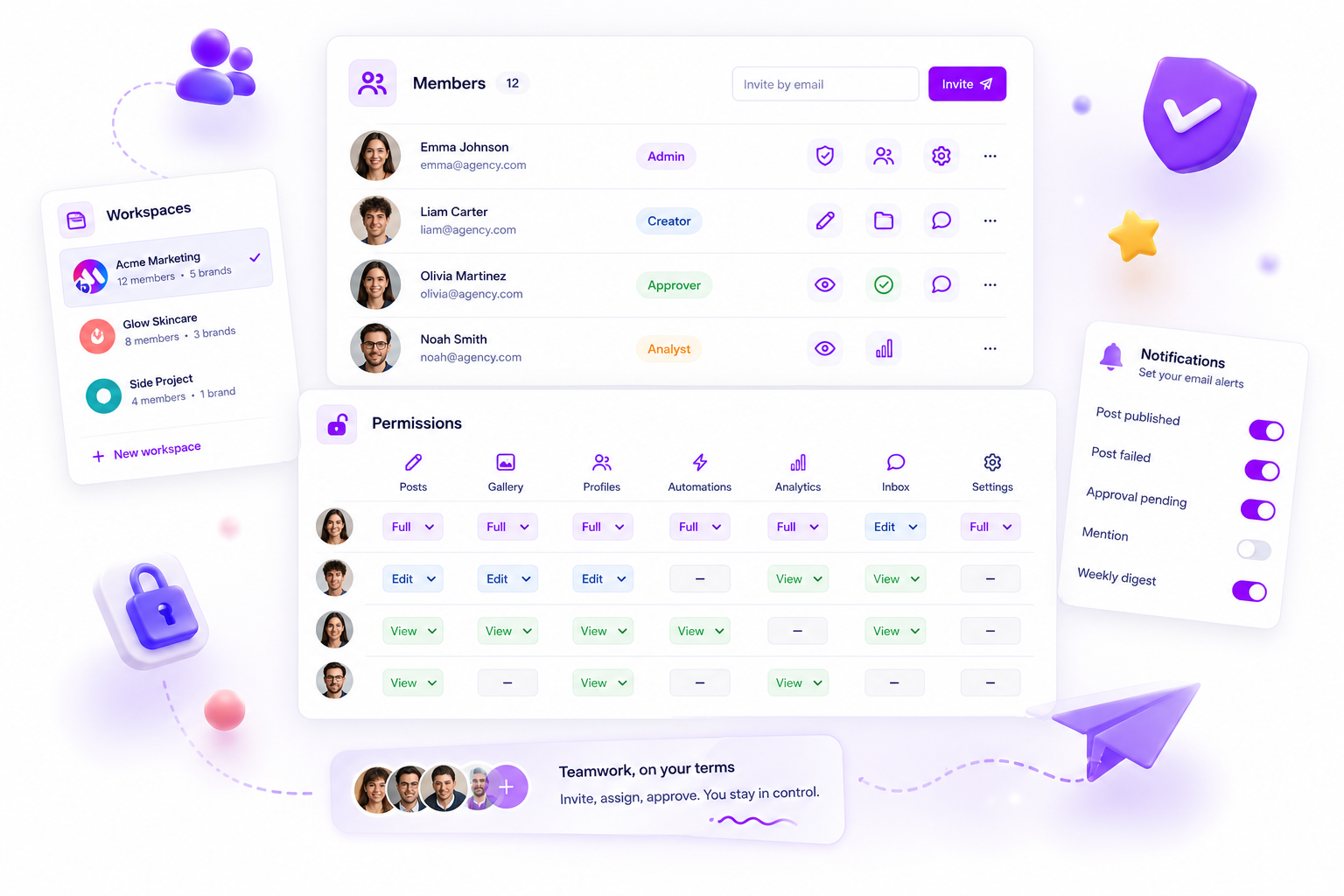
The core of this system lives in the Workspace Settings. You need three "Hard Locks" to ensure the environment is stable from day one: a naming convention that avoids confusion, a validated timezone that matches the client's market, and a restricted member list.
The 10-Point New Workspace Checklist
Use this checklist as your "Configuration Gate." If a workspace fails even one point, it is not ready for production.
| Checkpoint | Requirement | Decision Rule |
|---|---|---|
| 1. Naming | [CLIENT_ID] - [REGION] |
Never use internal nicknames; stick to the billing ID. |
| 2. Timezone | Match Primary Market | Verify if the client's audience is NYC or London. UTC is a trap. |
| 3. Owner | 1 Senior Lead | Only one person should have billing and deletion rights. |
| 4. Editor Tier | Max 3 Members | Limits "too many cooks" in the active calendar. |
| 5. Client Role | "Approver" Only | Clients should never have "Admin" or "Editor" permissions. |
| 6. Quotas | Set Post Limits | Prevents accidental overages on the client's subscription plan. |
| 7. Connectivity | Secure Handshake | Ensure social profiles are linked via the client's own credentials. |
| 8. Assets | Root Folder Sync | Connect the brand's primary asset library to the workspace. |
| 9. Discovery | Switcher Check | Verify the workspace appears correctly in the "Switch Workspace" menu. |
| 10. Audit | Weekly Member Review | Set a calendar reminder to prune access for former contractors. |
Where teams overbuild the process
Here is where it gets messy: we often see teams try to solve "trust issues" with complex technology. You do not need 15 custom roles for a boutique agency. You do not need a different workspace for every single social platform a client owns. Over-engineering your setup creates its own kind of coordination debt.
The most common mistake is creating "Permission Sprawl." If you have a different role for "Junior Designer," "Senior Designer," "Video Editor," and "Copywriter," you are going to spend more time managing permissions than managing content. In our experience, enterprise-grade stability comes from simplicity. Start with two roles: Editor (those who make) and Client Approver (those who sign off).
Another trap is "Workspace Fragmentation." Some teams create separate workspaces for "Client A - Facebook" and "Client A - Instagram." This is a nightmare for reporting and unified scheduling. Keep the client as the container. Use the Mydrop Workspaces environment to keep all profiles for one brand in one place. This keeps the data isolated from other clients but unified for the people actually doing the work.
Decision check: If you cannot explain your workspace permission structure to a new hire in under 60 seconds, it is too complicated.
The goal of standardization is to make the technology invisible. When the workspace is configured correctly from the start, your team stops thinking about "settings" and starts focusing on the strategy. You want your account managers to spend their energy on client growth, not on troubleshooting why a post meant for Tokyo just went live at 3 a.m. in New York. Standardized setup is the silent engine of agency profit.
How to run the cadence
Consistency is the enemy of the "Friday afternoon scramble." We have all been there: a new client is launching on Monday, and suddenly you realize nobody has the login for their LinkedIn page or the billing address is wrong. You can avoid this by turning your workspace setup into a non-negotiable gate in your project management tool.
Whether you use Jira, Asana, or a simple shared spreadsheet, the setup needs to be a hard dependency. Nothing else moves until the workspace is "locked." This means the naming convention is applied, the timezone is validated against the client's primary market, and the permission tiers are set.
At Mydrop, we see the most successful agencies treat this as a 10-minute clerical task that happens immediately after the contract is signed. By moving the technical heavy lifting to the very start of the relationship, you remove the friction that usually kills a campaign's momentum in week two.
- The Intake Trigger: When a "New Client" ticket is created, it automatically generates a sub-task for "Workspace Configuration."
- The Validation Step: A senior lead or operations manager spends 60 seconds reviewing the settings before any content is uploaded.
- The Hand-off: Only once the configuration is verified is the creative team invited to the space.
This isn't about adding red tape. It is about creating a "clean room" where your experts can actually do the work you hired them for, rather than playing tech support for a misconfigured timezone.
The proof that the habit is working
Standardization feels like a chore until you look at the metrics that actually matter to an agency's bottom line: margin and sanity. You know your "Onboarding Maturity" is improving when you stop hearing "Which workspace is this?" or "Why was this post scheduled for 3 AM local time?"
Use the scorecard below to audit your current process. If you find yourself mostly in the Level 1 column, don't panic. Most teams start there. The goal is to move one row at a time toward a predictable, scalable environment.
The Onboarding Maturity Scorecard
| Attribute | Level 1: Chaotic | Level 2: Standardized | Level 3: Scaled |
|---|---|---|---|
| Access Speed | Chasing logins for 5+ days. | Permissions granted within 48 hours via a standard list. | Client is onboarded to a pre-set environment in < 2 hours. |
| Setup Errors | Wrong timezones or naming happens monthly. | Errors are rare and caught during the first week. | Zero configuration errors; settings are part of a locked template. |
| Member Roles | Everyone is an "Owner" to save time. | Roles are assigned based on a 3-tier model (Editor, Approver, Admin). | Permissions are synced with your agency's HR or team structure. |
| Coordination | "Where do I find the assets for Brand X?" | Every client has a dedicated, isolated workspace container. | Workspaces are managed via a central operations dashboard. |
Workflow check: If a setup task takes more than 15 minutes, it is not a process; it is a project. Break it down until it is a routine.
Real maturity is when your team can flip between five different client accounts without having to mentally "re-calibrate" their understanding of the tools. When the workspace structure is identical across every brand you manage, the cognitive load drops significantly. You stop worrying about the plumbing and start focusing on the performance.
Conclusion
The secret to scaling a social media agency isn't a "magical" new content strategy or a viral AI tool. It is the boring stuff. It is the naming conventions, the timezone checks, and the permission tiers that protect your team from making expensive, avoidable mistakes.
By treating your Mydrop Workspace as a secure, isolated operating environment from day one, you are doing more than just "organizing." You are building a professional moat around your client's data and your team's reputation. You are moving from a "bespoke" model that breaks under pressure to a "standardized" model that grows with you.
Stop the Day 1 scramble. Lock your templates, validate your settings, and turn your onboarding into a silent, 10-minute win. Your team, and your clients, will thank you.